BSEM announces HSLC 2026 results with an 88.74% overall pass rate — a dip from recent highs. Chandel tops districts at 97.38% while 327 IDP students pass amid conflict. A new NEP-aligned grading system debuts without raw marks.
|
Overall pass % 88.74% 32,459 of 36,579 |
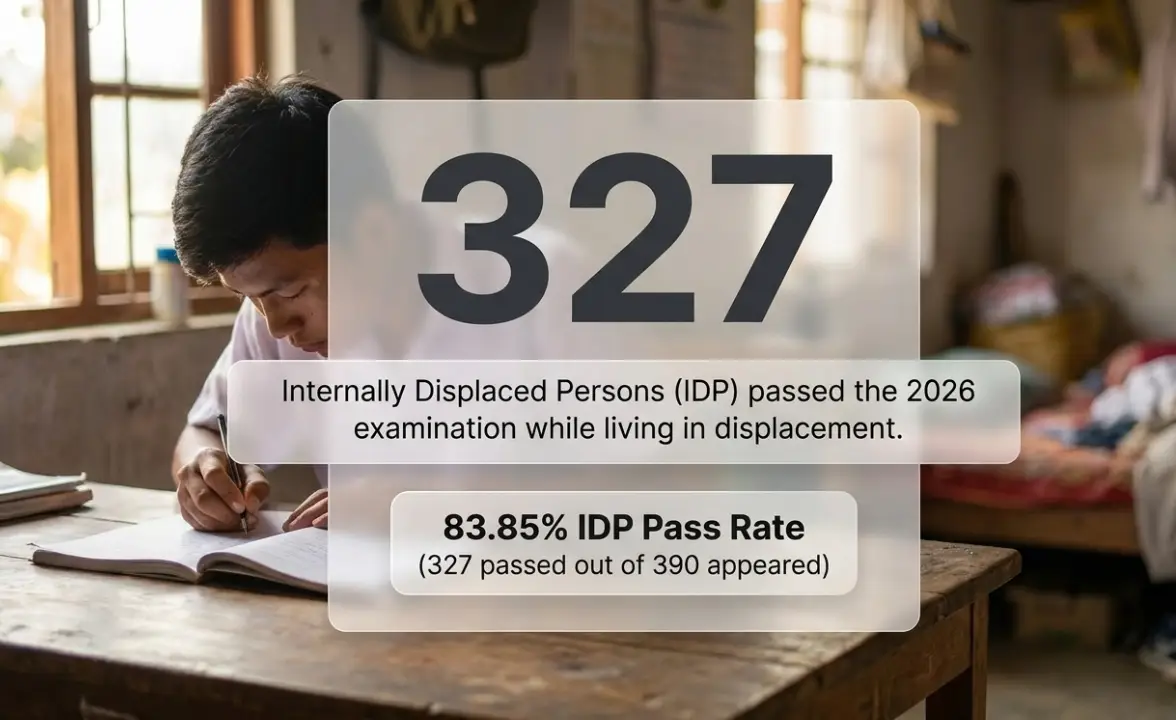
IDP students passed 327 83.85% of 390 appeared |
Top district 97.38% Chandel |
Lowest district 74.59% Jiribam |


The Board of Secondary Education, Manipur (BSEM) officially declared the results of the High School Leaving Certificate (HSLC) Examination 2026 on May 8, in a ceremony held at BSEM's conference hall in Babupara, Imphal. The announcement, presided over by BSEM Chairman and Director of Education (S) Ng. Bhojendra Meitei, came in the presence of Commissioner (Education) Ningthoujam Geoffrey as Chief Guest and Controller of Examinations Ayam Thoibi Singh as Guest of Honour.
The headline figure — an overall pass percentage of 88.74 percent — tells only part of a more layered story. Behind that number lie contrasting narratives of institutional inequality, extraordinary resilience among internally displaced students, the debut of a landmark grading reform, and a decade-long arc of progress that this year's dip does not erase.
A pass rate that recedes, but in context
Of the 36,579 students who appeared for the examination, 32,459 passed, yielding the 88.74 percent result. The figure marks a measurable decline compared to 93.03 percent in 2024 and 91.37 percent in 2025 — the two strongest consecutive years in recent memory. In context, it requires careful reading.
The year 2021 is an acknowledged outlier in Manipur's HSLC data, recording a 100 percent pass rate — a product of pandemic-era assessment policies rather than a genuine pedagogical benchmark. Stripping that anomaly from the decade-long trend, the trajectory from 66.70 percent in 2017 to 88.74 percent in 2026 represents a near-22-percentage-point improvement over nine years. The 2026 figure also coincides with the first year of a substantially reformed examination and grading system — a variable that cannot be discounted when analysing the dip.
This year marks the introduction of the Grades and Grade Points System, aligned with the National Education Policy (NEP) 2020. Raw marks no longer appear on certificates. Performance is recorded on a 10-point scale — from A1 (91–100 marks) at the top to D (33–40 marks) as the minimum passing threshold.
|
Grade |
Marks Range |
Grade Points |
Status |
|
A1 |
91–100 |
10.0 |
Pass |
|
A2 |
81–90 |
9.0 |
Pass |
|
B1 |
71–80 |
8.0 |
Pass |
|
B2 |
61–70 |
7.0 |
Pass |
|
C1 |
51–60 |
6.0 |
Pass |
|
C2 |
41–50 |
5.0 |
Pass |
|
D |
33–40 |
4.0 |
Pass (minimum) |
|
E1 |
21–32 |
— |
Fail |
|
E2 |
0–20 |
— |
Fail |
The private-government divide: a structural fault line
Private schools recorded a pass rate of 92.34 percent, with 24,903 students passing out of 26,970 who appeared. Aided schools achieved 84.15 percent (1,248 of 1,483). Government schools posted just 77.63 percent — meaning more than one in five government school students who sat the examination did not pass.
The institutional variance within the government school category itself is striking. While some schools achieved 100 percent pass rates, others recorded catastrophically low results — Charangpat High School at 0 percent, Thangtong Hr. Sec. School at 3.85 percent, and Bishnupur Higher Secondary School at 5.88 percent. Regular candidates passed at 88.98 percent, while external candidates trailed significantly at 42.56 percent.
District disparities: from Chandel's peak to Jiribam's trough
|
District |
Pass % |
|
Chandel |
97.38% |
|
Thoubal |
96.30% |
|
Noney |
95.42% |
|
Kakching |
91.51% |
|
Imphal West |
88.64% |
|
Kangpokpi |
82.44% |
|
Senapati |
80.18% |
|
Jiribam |
74.59% |
327 IDP students: quiet triumph under crisis conditions
Out of 390 IDP students who appeared for the examination, 327 passed, achieving a pass percentage of 83.85 percent. Three districts — Thoubal, Kangpokpi, and Jiribam — recorded a perfect 100 percent pass rate among their IDP candidates. Bishnupur hosted the largest IDP cohort, with 93 of 105 students passing (88.57 percent).
Demographic breakdown and accountability measures
Gender performance remained virtually identical: male candidates passed at 88.90 percent and female at 88.58 percent. Among social categories, OBC candidates led at 91.38 percent, followed by SC (90.85 percent), General (88.50 percent), and ST (85.58 percent).
Eight candidates caught impersonating others have been fully debarred from the HSLC examination in 2027, 2028, and 2029, with their 2026 results cancelled. Re-scrutiny applications are open from May 11 to May 25, 2026, at Rs. 2,100 per subject. Provisional Grade Statements are available from May 11 (Rs. 1,500), and original certificates will be distributed to school officials from May 26. Students who did not pass have a 45-day window to re-enrol in Class X.
What the numbers mean
The HSLC 2026 results present Manipur's education system in the fullness of its contradictions — a decade of measurable progress alongside entrenched institutional inequality; a reformed assessment framework debuting alongside a declining pass rate; and, most powerfully, hundreds of students who sat a Class 10 board examination while living in displacement, and passed. The overall pass rate may have receded from its recent highs. But the more enduring metric is whether the system reaches those it most risks leaving behind. On that front, the 2026 examination offers at least a partial, and genuinely moving, answer.