The sixth extension of the Manipur violence inquiry commission raises serious questions about delayed accountability, institutional credibility, and whether justice and truth for victims are being indefinitely postponed amid continuing public distrust and deepening social fractures.
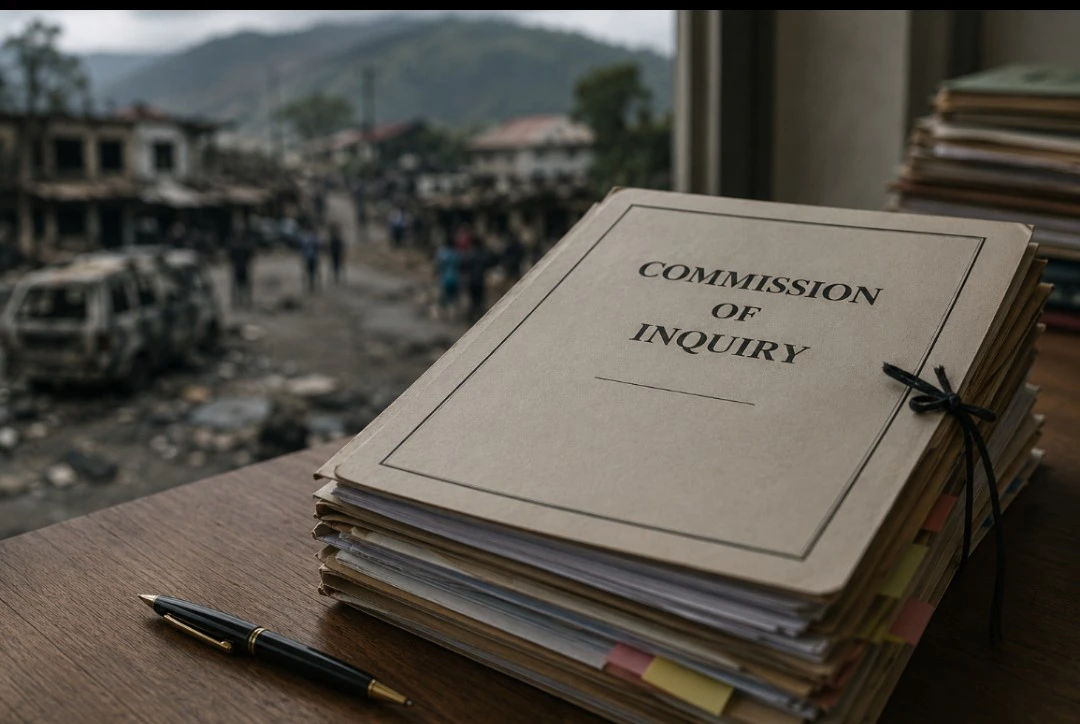
The Government of India has granted yet another extension to the Commission of Inquiry probing the Manipur violence, pushing the deadline to November 20, 2026. It is now the sixth extension since the commission was constituted in June 2023 under former Chief Justice of the Gauhati High Court, Justice Ajai Lamba.
At some point, the question ceases to be procedural and becomes moral. How long can a society remain suspended between tragedy and accountability?
Commissions of inquiry are not created merely to archive pain in official files. They are instituted to establish facts, identify failures, restore public confidence, and offer a path toward institutional correction. But when deadlines continue to stretch endlessly while the wounds on the ground remain raw, the process itself begins to lose credibility.
Manipur has already lived through more than three years of violence, displacement, distrust, and political paralysis. Hundreds have died. Thousands remain displaced. Entire localities have been ethnically fractured. Families still search for answers regarding missing relatives, burned homes, and the chain of administrative failures that allowed the conflict to spiral into one of the darkest periods in the state’s modern history.
Against that backdrop, repeated extensions send a troubling message: that the machinery of accountability moves at a pace entirely disconnected from the suffering of the people it claims to serve.
To be fair, inquiries of this scale are complex. The violence was not a single isolated incident but a prolonged conflict involving multiple actors, districts, institutions, armed groups, administrative decisions, and security responses. Gathering testimonies, verifying evidence, and constructing a legally defensible report takes time. Nobody should demand a rushed report that sacrifices accuracy for speed.
But there is also another truth that cannot be ignored. Justice delayed does not remain politically neutral. Delay itself shapes public perception.
Every extension deepens suspicion among competing communities. One side begins to believe the state is protecting certain actors. Another suspects selective framing. Rumours expand into accepted truths in the absence of official clarity. In conflict societies, informational vacuum is dangerous terrain. It is quickly occupied by propaganda, memory manipulation, and hardened narratives. The commission’s prolonged silence has unintentionally contributed to that vacuum.
There is also the issue of democratic accountability. Governments often use commissions as instruments to signal seriousness during crises. Announce an inquiry, appoint a retired judge, promise a detailed investigation, and public pressure temporarily cools. But if findings never arrive within a meaningful timeframe, commissions risk becoming political waiting rooms rather than mechanisms of truth. That perception is particularly damaging in Manipur because public trust in institutions is already dangerously fragile.
For many citizens, the violence was not merely a law-and-order failure. It represented a collapse of confidence in governance itself. Communities accused the administration, police, intelligence systems, and political leadership of either inaction, bias, or complete inability to control the crisis. In such an environment, the inquiry commission was supposed to function as a stabilising democratic instrument — a formal assurance that facts would eventually prevail over accusation.
Instead, the repeated postponements now risk creating the opposite effect. One cannot ignore the broader emotional exhaustion that exists in the state. Manipur today is not only physically divided; it is psychologically fatigued. Children have spent formative years inside relief camps. Students have seen academic calendars disrupted repeatedly. Businesses collapsed. Neighbourhoods emptied. Public discourse hardened into ethnic binaries where even language, identity, and mourning became contested territory.
In such a climate, accountability delayed becomes reconciliation delayed. The state cannot move toward durable peace if the truth itself remains permanently deferred.
Another uncomfortable question also arises: what exactly has been achieved so far after multiple extensions? Has the commission completed substantial evidence collection? Have key testimonies been recorded? Have interim findings been shared with the public? Has any institutional reform already been recommended? The absence of periodic public communication fuels the impression of opacity.
Transparency does not necessarily mean disclosing sensitive findings prematurely. But democratic institutions must understand that silence over long periods creates distrust, especially in conflict zones.
Even a structured interim briefing could help restore some confidence. The larger danger is historical. If this inquiry drags indefinitely, it risks becoming another forgotten commission buried under bureaucratic dust while society moves on without closure. India has a long history of inquiry reports that arrive years late, are tabled quietly, debated briefly, and implemented selectively — if at all.
Manipur cannot afford that fate. This violence has already reshaped the social and political landscape of the state in profound ways. The findings of the commission, if credible and comprehensive, could become an important historical document for future reconciliation, institutional reform, and conflict prevention. But that relevance depends on timeliness.
Truth has a window. When delayed too long, even factual conclusions struggle to heal because public positions become hardened beyond repair.
The sixth extension may be legally valid. Administratively, it may even be justified. But morally and politically, it reflects a state still unable to provide timely closure to one of the gravest crises in its history.
And with every extension, the same uneasy question grows louder across Manipur:
Is the system still searching for the truth — or merely searching for more time?