IIT Guwahati researchers have developed a new coating technology that improves green hydrogen production efficiency by over 50% in solar-driven water splitting systems.
Guwahati, May 19: Researchers at Indian Institute of Technology Guwahati have developed a new composite coating technology that can significantly improve the efficiency and durability of solar-driven systems used for green hydrogen production.
The research, published in the international journal Small, focuses on improving Photo-Assisted Electrochemical (PAEC) water-splitting systems, which use sunlight to separate water into hydrogen and oxygen. Green hydrogen produced through such methods is considered a cleaner alternative to conventional hydrogen generation processes that rely on fossil fuels and emit greenhouse gases.
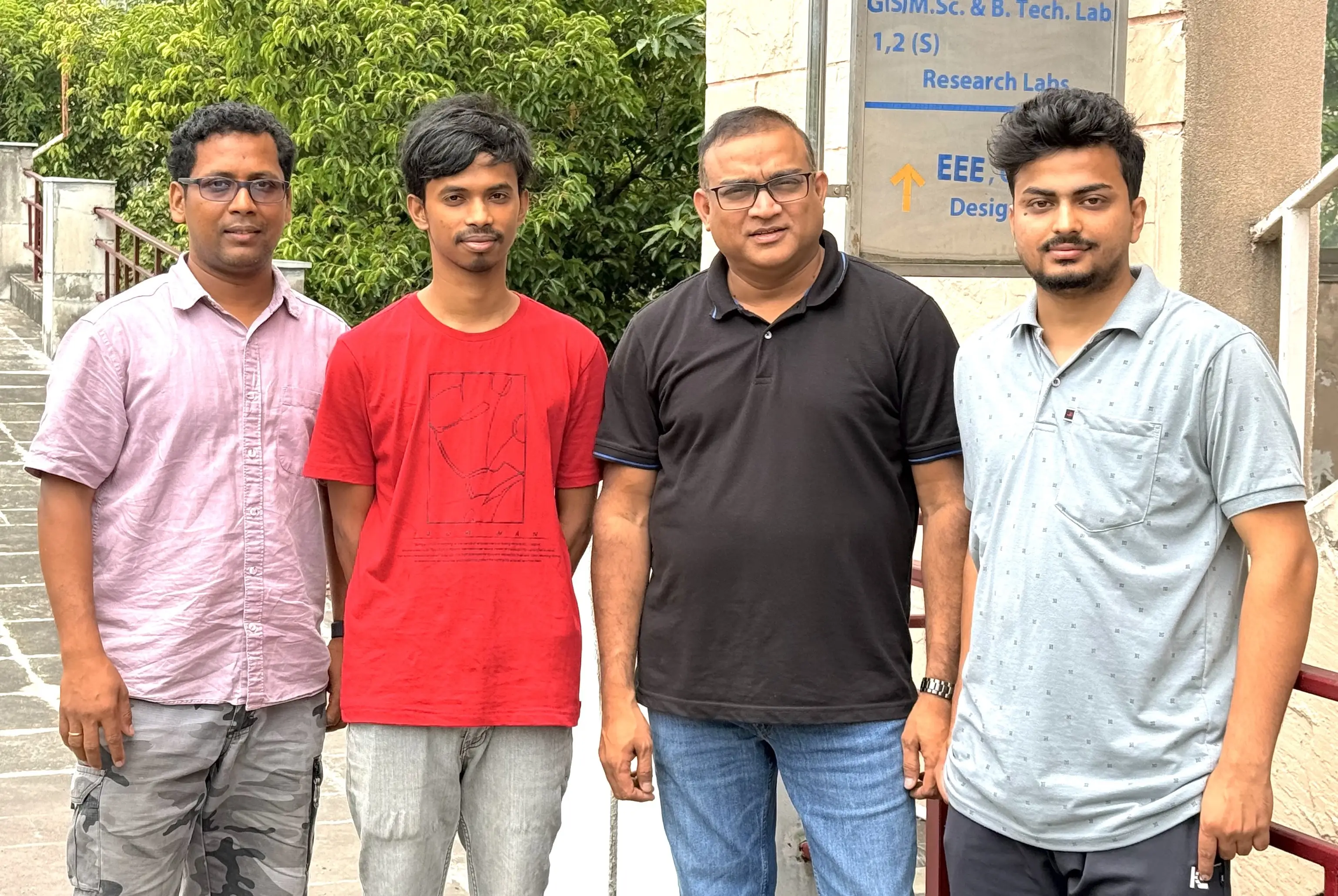
The study was co-authored by Prof. Uttam Manna and Prof. Mohammad Qureshi along with Dr. Hrisikesh Sarma and research scholars Ms. Alpana Sahu, Ms. Anshika Chaudhary, Mr. Sumanta Sarkar, Mr. Sourav Mandal, and Mr. Lingaraj Sahoo from IIT Guwahati.
According to the research team, conventional PAEC systems face two major operational challenges that reduce efficiency over time.
One problem involves catalyst layers gradually peeling away from electrode surfaces. This reduces the durability of the system and weakens long-term hydrogen production performance.
The second challenge is related to gas bubbles formed during the electrochemical reaction. These bubbles often remain attached to the electrode surfaces, blocking active catalytic sites and slowing down hydrogen and oxygen generation.
To address these issues, the IIT Guwahati researchers developed a new coating structure that combines graphitic carbon nitride — a two-dimensional photocatalyst — with a bubble-repellent hydrogel layer on porous nickel foam.
Unlike conventional systems where photocatalysts are simply coated on the surface, the new method embeds the photocatalyst within the coating structure itself. The researchers said this approach helps prevent the catalyst from peeling off while also increasing the electrochemically active surface area required for water-splitting reactions.
The study reported that the new composite coating showed a substantial increase in performance when compared to traditional photocatalyst-coated systems.
According to the findings, the developed coating achieved:
51 per cent higher hydrogen production
44 per cent higher oxygen production
The researchers said the bubble-repellent properties of the coating helped gas bubbles detach more quickly from the electrode surface, thereby improving reaction efficiency.
Speaking about the findings, Uttam Manna from the Department of Chemistry at IIT Guwahati said the study demonstrated the benefits of incorporating graphitic carbon nitride within a highly bubble-repellent matrix.
He said the strategy improved bubble departure frequency and enhanced photo-assisted electrochemical water-splitting performance, resulting in a notable increase in hydrogen production.
Prof. Manna added that the approach could also be adapted for use with other catalysts in future research aimed at advancing green hydrogen technologies.
The research team said the technology could support next-generation clean energy systems, especially in sustainable green hydrogen production through solar-assisted water splitting.
Researchers noted that the coating strategy may also have applications in renewable energy storage technologies and large-scale solar-to-fuel conversion systems.
Speaking on the future direction of the project, Mohammad Qureshi said the team plans to further improve water-splitting efficiency by replacing hydrogels with other advanced photocatalysts.
He added that future studies would focus on scaling up the system for larger electrodes and integrating the technology into practical solar hydrogen production devices.
The study received grant support from the Anusandhan National Research Foundation, the Ministry of Electronics and Information Technology, Indian Institute of Technology Guwahati, and the Ministry of Education.
The authors also acknowledged Prof. P. K. Iyer and Mr. Himangshu Baishya for technical support related to AFM and photoluminescence characterisation studies.
The institute stated that the findings remain at the laboratory stage and will require further validation before any commercial application.
Researchers said the study provides an effective strategy for improving the long-term performance of solar-driven water-splitting systems and may contribute to global efforts aimed at reducing dependence on fossil fuels and achieving carbon neutrality.