The IMF warns developing countries face a growing fiscal squeeze as natural resource revenues and foreign aid grants fall 3.8% of GDP since 2000, outpacing domestic tax gains.
Developing nations are caught in an accelerating fiscal squeeze. According to new report from the International Monetary Fund (IMF), traditional pillars of government finance — income from natural resource extraction and international aid grants — are eroding far faster than domestic tax systems can compensate.
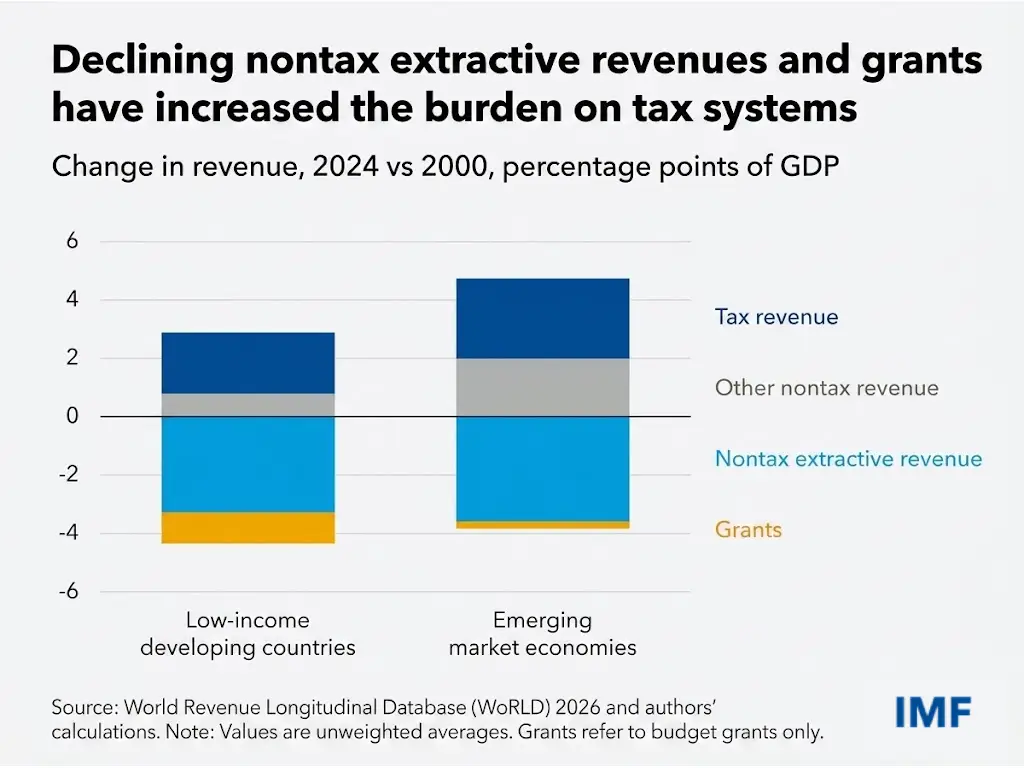
The findings emerge from the 2026 update of the World Revenue Longitudinal Database (WoRLD), the IMF's flagship fiscal dataset. The data reveals that since the year 2000, combined revenue from nontax natural resource extraction and foreign aid grants for general government spending has declined by 3.8 percent of gross domestic product (GDP) across emerging markets and low-income developing countries.
Governments have not stood still in response. Tax collection has increased by 2.6 percent of GDP over the same period — a substantial achievement in many cases. Yet that gain offsets only approximately two-thirds of the revenue that has disappeared. The remaining one-third represents a structural fiscal gap with serious and growing consequences for public services, infrastructure, and long-term development.
"Gains from tax collection since then amounted to just 2.6 percent, offsetting only two-thirds of the decline, our unique tally of detailed public revenue data shows." — IMF Fiscal Affairs Department
The IMF's findings underscore a troubling paradox: countries that have worked hard to build tax systems and mobilise domestic revenue are nonetheless falling behind, squeezed between the slow erosion of the passive income streams they once relied upon and the political and administrative difficulty of expanding tax bases quickly enough to compensate.
The primary driver of the fiscal decline is the steady erosion of nontax extractive revenue — funds derived from royalties, profit-sharing arrangements, and dividends paid by state-owned enterprises (SOEs) in the oil, gas, and mining sectors. According to IMF researchers Mario Mansour and Fayçal Sawadogo, the decline in this specific revenue category is the largest single contributor to the overall revenue drop for both emerging market economies and low-income developing countries.
For decades, resource-rich developing nations benefited from a relatively passive stream of income tied to commodity extraction. These revenues required minimal institutional capacity to collect — they flowed automatically from contractual arrangements with extractive companies or state-owned enterprises — and provided governments with a financial cushion that enabled spending on social programmes, infrastructure, and public administration.
That era is ending. As the global energy transition reshapes demand for fossil fuels and as commodity price cycles grow more volatile, governments that once relied heavily on resource windfalls are finding those flows reduced, unpredictable, or both. For some countries in sub-Saharan Africa, the Middle East, and Latin America — territories that built entire public finance systems around resource revenues — this represents not a temporary fluctuation but a structural transformation of their fiscal landscapes.
The IMF describes this shift as the transformation of what was once a "comparative advantage" into a profound structural vulnerability. Countries that did not use boom years to diversify their revenue bases are now confronting the full fragility of their dependence on extractive industries.
Compounding the loss of resource income is a dramatic reduction in international financial support. The WoRLD database shows that foreign aid grants for general government spending in low-income developing countries have declined by approximately 50 percent since the early 2000s, falling from an average of 6 percent of GDP to just 3 percent of GDP.
Unlike project-specific aid — which is tied to designated investments in infrastructure, health, or education — general-purpose grants were used by governments to cover operational costs, bridge liquidity gaps, and maintain the basic machinery of the state. Their reduction has had a direct and immediate impact on budget planning in some of the world's most fragile economies.
The retreat of international grants reflects broader shifts in the global development finance architecture. Wealthier donor nations have redirected aid toward more targeted programmes, global health emergencies, climate adaptation, and humanitarian responses. For recipient governments that once counted on a stable flow of general budget support, the effect is the loss of a critical financial safety net at precisely the moment when other revenue sources are also declining.
Together, the twin declines in resource revenue and foreign aid have produced what the IMF terms a "fiscal pincer movement" — a narrowing of the fiscal space available to developing nations at a time when demands on public spending, from climate adaptation to demographic pressures, are growing more acute.
The IMF's analysis is unambiguous about the prescription: the only sustainable exit from this fiscal squeeze is domestic revenue mobilisation (DRM) — the systematic strengthening of a country's ability to collect reliable, internally generated revenue.
This means more than simply increasing tax rates. It requires sustained, multi-year investment in tax policy design, tax administration reform, and crucially, the development of effective fiscal institutions. Without the institutional infrastructure to enforce compliance, reduce evasion, and extend the tax net to previously untaxed economic activity, rate increases alone produce diminishing returns and generate political backlash.
The IMF stresses that "sustained investment in domestic tax policy and tax administration" is a prerequisite for countries to meet their economic development goals, including the United Nations Sustainable Development Goals (SDGs). Building effective tax institutions is not a technical nicety; it is a foundational requirement for sovereign fiscal independence.
To support this process, the IMF's Fiscal Affairs Department has been scaling up capacity development programmes tailored to the specific needs of member countries. These include customised technical assistance on policy frameworks — covering areas such as value-added tax design, corporate tax reform, and the taxation of the extractive sector itself — as well as training programmes that build in-country expertise in revenue administration.
The IMF frames this effort as a global public good, not merely a national one: "Helping developing countries with this work... contributes to fiscal resilience, which ultimately benefits global economic growth." In an interconnected world economy, fiscal instability in developing nations — rising debt, reduced public investment, political instability — has ripple effects well beyond their borders.
The intelligence underpinning the IMF's warnings comes from the World Revenue Longitudinal Database (WoRLD), a uniquely comprehensive dataset maintained by the IMF's Fiscal Affairs Department. The 2026 update expanded coverage to 195 economies, stretching back to the early 1980s, with longitudinal data now extended through 2024. Two new territories — Aruba and Liechtenstein — were added in this edition.
What distinguishes WoRLD from other revenue databases is the granularity and rigour of its methodology. The database tracks nine distinct components of government revenue — including total tax revenue, social security contributions, grants, and nontax resource revenue — all computed according to the Government Finance Statistics Manual (GFSM) framework. This ensures comparability across countries using different accounting bases, whether cash, accrual, or modified systems.
Together, these nine components account for more than 80 percent of total global government revenue. For policymakers, this granularity is essential: it enables them to benchmark their country's performance against comparable peers, identify which revenue components are underperforming, and pinpoint the most impactful areas for reform.
At the macro level, the database provides a stable reference point. Global total government revenue has remained broadly stable at approximately 30 percent of GDP since 2000, suggesting that the crisis is not one of aggregate global revenue contraction but of a deepening divergence between advanced economies and the developing world. Global tax revenues stood at 17.5 percent of GDP in 2024, a modest increase of 1.8 percentage points since 2000, with taxes now accounting for between 55 and 60 percent of total government revenues worldwide.
For developing country policymakers and their international partners, however, these global averages obscure a more urgent reality: the composition of revenue is shifting in ways that are placing disproportionate pressure on the nations least equipped to absorb it.
The IMF's 2026 update to the WoRLD database arrives at a critical inflection point. For much of the post-independence era, developing nations could rely — however imperfectly — on a combination of resource royalties and international grants to supplement their still-developing tax systems. That model is now structurally broken.
The challenge is not simply finding new revenue. It is building the institutions, the administrative capacity, the political will, and the public trust needed to sustain a modern tax system — in environments where informality is widespread, enforcement capacity is limited, and populations are weary of austerity. These are not problems that can be solved by a single reform cycle; they require generational commitment.
The IMF's analysis is a call to action for both developing country governments and the international community. For governments, it reinforces the urgency of prioritising tax system modernisation even when political conditions make reform difficult. For international partners — donor governments, multilateral development banks, and technical assistance providers — it highlights the need to sustain support for domestic revenue mobilisation efforts even as the headline figure for foreign aid declines.
As natural resource revenues continue to fade and the era of large-scale general-purpose grants recedes, the ability of developing country governments to build robust, fair, and sustainable domestic tax systems may well be the defining fiscal challenge — and opportunity — of the coming decade. Countries that rise to it will be better positioned to finance their own development. Those that do not face a future of deepening dependence on external borrowing, rising debt burdens, and narrowing fiscal options.