India and the EU have jointly launched a €15.2 million (~?169 crore) call for proposals on EV battery recycling under the TTC framework, targeting critical mineral security, circular economy development, and a shared India-EU pilot manufacturing line.
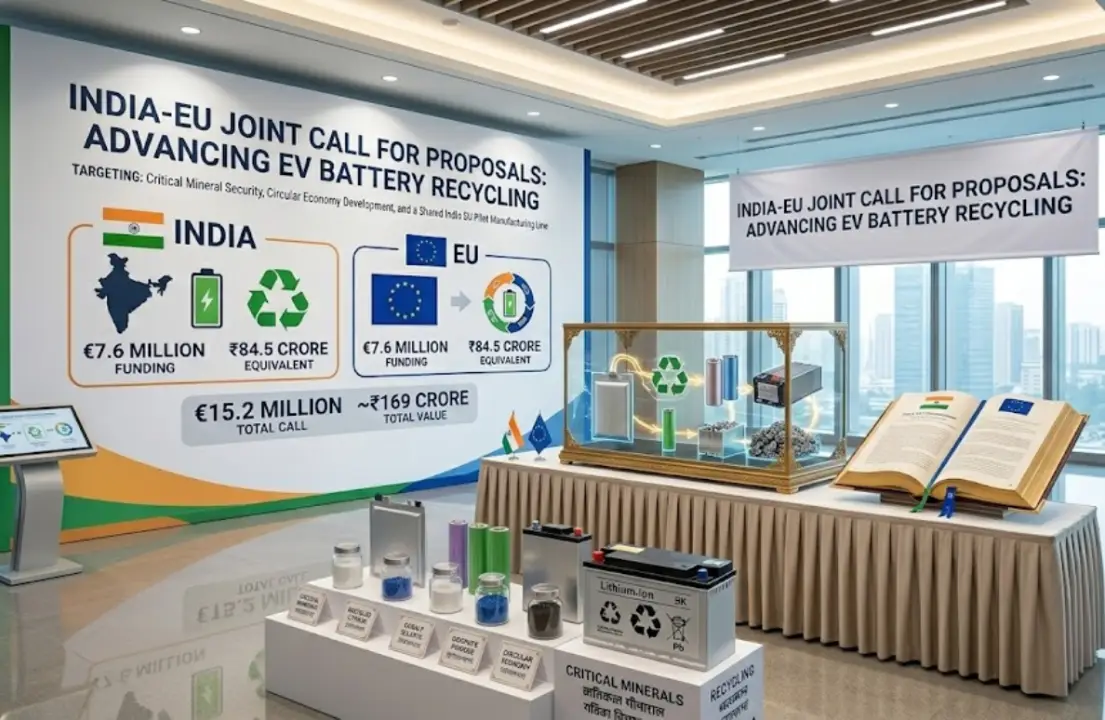
Representative Image
India and the European Union have jointly announced the launch of a coordinated call for proposals focused on the recycling of electric vehicle (EV) batteries — a third such initiative under the framework of the India-EU Trade and Technology Council (TTC) Working Group 2 on Green and Clean Energy Technologies. Announced on May 5, 2026, with a submission deadline of September 15, 2026, the call is backed by a combined funding pool of €15.2 million (approximately ?169 crore). The EU component will be financed through the Horizon Europe programme, while India's Ministry of Heavy Industries (MHI) will support the Indian side.
The initiative brings together leading researchers, industries, and startups from both sides to develop and validate advanced battery recycling technologies at the pilot scale, with the ultimate goal of establishing a joint India-EU pilot line on Indian soil. It represents a significant deepening of the bilateral technology partnership, aligning with shared commitments to critical mineral security, climate action, and the global transition to a circular economy.
ANALYTICAL NOTE → This is the third coordinated call under TTC Working Group 2 — a signal that the India-EU green technology partnership is maturing from dialogue to co-funded execution. Launching a joint pilot line in India is particularly strategic: it positions India not merely as a recipient of technology transfer but as a co-developer, with implications for future IP ownership and industrial scaling.
The call for proposals is centred on four interconnected technology areas that together constitute the full lifecycle of responsible battery recycling. The first is the achievement of high recovery rates for critical minerals — specifically lithium, graphite, and cobalt — which are essential inputs for EV battery manufacturing and are currently subject to significant supply chain concentration risks globally.
The second area covers mixed chemistry handling, acknowledging that real-world EV batteries do not arrive at recycling facilities in uniform condition. Developing processes capable of efficiently handling diverse battery chemistries — including lithium iron phosphate (LFP), nickel manganese cobalt (NMC), and others — is a critical challenge that existing recycling infrastructure has only partially addressed. The third area focuses on logistics and inclusion, with a particular emphasis on developing digitalised, safe collection systems that integrate the informal sector — a distinctive feature of India's waste management ecosystem that the initiative explicitly acknowledges. The fourth area addresses second-life applications and safety standards, exploring how recovered critical minerals and partially degraded battery cells can be repurposed before final recycling, extending material value and reducing waste.
ANALYTICAL NOTE → The inclusion of 'informal sector integration' as an explicit focus area reflects a pragmatic understanding of India's ground-level waste management reality. India's informal recycling sector handles a significant proportion of end-of-life electronics and batteries, often under hazardous conditions. Formalising and digitalising this ecosystem is both a safety imperative and an efficiency opportunity — one that the EU's experience with extended producer responsibility frameworks could meaningfully complement.
The initiative's emphasis on lithium, graphite, and cobalt is not incidental. These minerals are classified as critical raw materials by both the EU and India due to their irreplaceable role in clean energy technologies and the high geographic concentration of their primary production. The Democratic Republic of Congo accounts for over 70% of global cobalt mining; China dominates graphite processing; and lithium production is concentrated in the so-called Lithium Triangle of South America. Both India and the EU face significant import dependency for these materials — a vulnerability that the global acceleration of EV adoption is rapidly intensifying.
Developing high-efficiency domestic recycling capacity is therefore not merely an environmental objective but a resource security strategy. Every tonne of lithium recovered from spent batteries is a tonne that does not need to be imported, reducing both geopolitical exposure and price volatility risk. The joint pilot line proposed under this initiative would create a real-world facility to validate recovery technologies at industrial scale — a step that is typically the most difficult and capital-intensive in the transition from laboratory to commercial deployment.
Initiative Parameters at a Glance
|
Framework |
India-EU Trade and Technology Council (TTC) — Working Group 2 |
|
Call Number |
Third coordinated call under TTC WG2 |
|
Focus Area |
EV Battery Recycling |
|
Combined Funding |
€15.2 million (~?169 crore) |
|
EU Funding Source |
Horizon Europe Programme |
|
India Funding Body |
Ministry of Heavy Industries (MHI) |
|
Submission Deadline |
September 15, 2026 |
|
Critical Minerals Targeted |
Lithium, Graphite, Cobalt |
|
Key Technology Areas |
High recovery rates, mixed chemistry handling, logistics & inclusion, second-life safety |
|
Joint Deliverable |
India-based India-EU pilot line for industrial validation |
The launch drew senior scientific and diplomatic representation from both sides. Prof. Ajay Kumar Sood, Principal Scientific Adviser to the Government of India, described the initiative as a pivotal moment in the India-EU strategic partnership, emphasising the urgency of building a robust domestic recycling ecosystem as India's EV market expands rapidly. H.E. Mr. Hervé Delphin, EU Ambassador to India, underscored the dual objective of translating laboratory innovation into real-world deployment while directly investing in mineral security and shared climate goals.
Dr. Parvinder Maini, Scientific Secretary in the Office of the PSA, highlighted the initiative's potential to catalyse a digitalised, inclusive logistics model that integrates the informal sector while maintaining the highest safety standards for second-life applications. Mr. Marc Lemaître, Director-General for Research and Innovation at the European Commission, pointed to the shared ambition of co-creating a resilient, cross-continental value chain that keeps the strategic materials of tomorrow within the economies of both partners.
ANALYTICAL NOTE → The convergence of language across Indian and EU officials — 'resource security', 'cross-continental value chain', 'second-life applications' — reveals a shared industrial policy logic underlying what is publicly framed as a green technology partnership. Both sides are navigating a world in which clean energy materials are becoming as geopolitically sensitive as fossil fuels once were. This initiative is as much about reducing import dependency as it is about climate action, and the honest framing of that dual objective in official statements is itself noteworthy.
The EV battery recycling call is the latest in a series of deepening technology collaborations under the TTC, which was established in 2022 to serve as the primary structured forum for India-EU cooperation on trade, technology, and security. Working Group 2, focused on green and clean energy technologies, has emerged as one of the most active tracks, reflecting the centrality of the energy transition to both parties' strategic agendas.
For India, the initiative aligns with its Production Linked Incentive (PLI) schemes for Advanced Chemistry Cell (ACC) battery manufacturing and the broader National Electric Mobility Mission, both of which will generate increasing volumes of end-of-life batteries requiring recycling infrastructure over the coming decade. Building that infrastructure now — with EU co-investment, European technology partnerships, and a joint pilot line — positions India to manage its battery waste responsibly while simultaneously developing an exportable recycling technology capability. For the EU, the partnership provides access to India's large and rapidly growing EV market, its established base of chemical process engineering talent, and a partner whose informal recycling sector poses regulatory and environmental challenges that, if solved jointly, could yield globally applicable models.