The State Visit of Vietnam's President to India produced 13 MoUs and 5 key announcements, upgrading bilateral ties to Enhanced Comprehensive Strategic Partnership with a new USD 25 billion trade target and deepened cooperation across digital payments, rare earths, culture, and urban development.
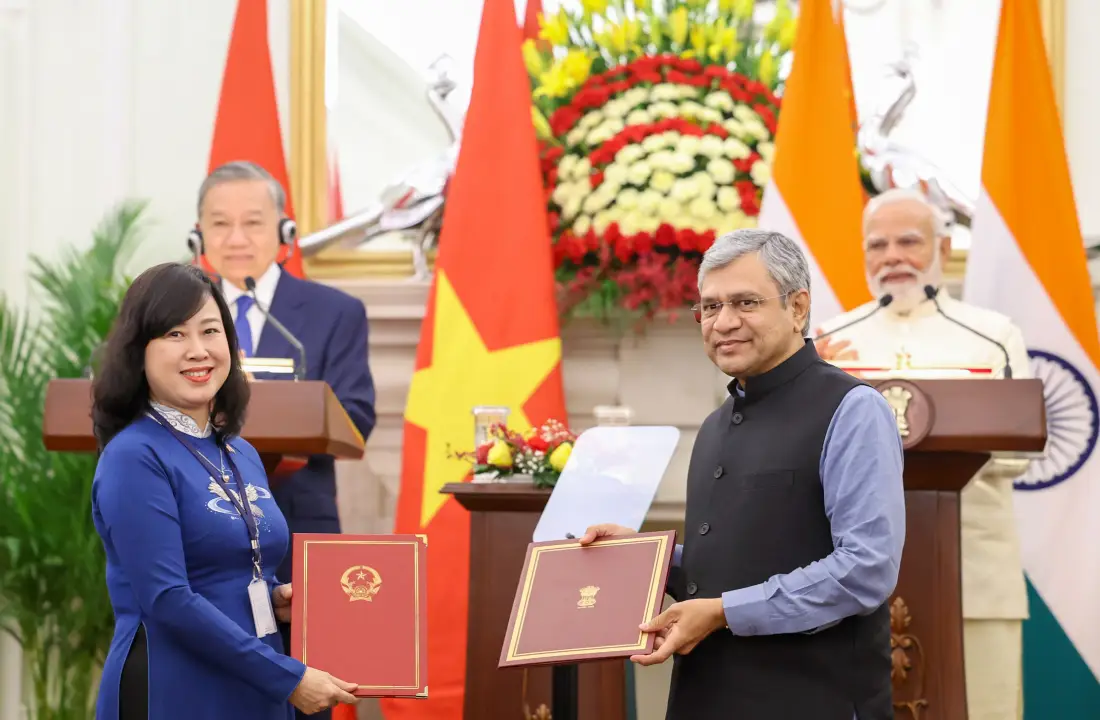
The State Visit of the President of the Socialist Republic of Vietnam to India has concluded with a substantial package of diplomatic deliverables, marking a decisive deepening of one of Asia's most consequential bilateral partnerships. Thirteen Memoranda of Understanding and Agreements were signed across a broad range of sectors — from rare earth cooperation and digital payments to cultural exchange, pharmaceutical regulation, and academic collaboration — alongside five major strategic announcements, the most significant of which is the elevation of bilateral ties to an Enhanced Comprehensive Strategic Partnership.
The breadth of outcomes reflects a relationship that has matured well beyond its historical and civilisational foundations into a modern, multi-dimensional partnership anchored in shared strategic interests across the Indo-Pacific. India and Vietnam are both navigating a complex regional environment shaped by great-power competition, supply chain restructuring, and the accelerating digital and green transitions — and the outcomes of this State Visit suggest a shared intent to manage those challenges in closer coordination.
The elevation of the India-Vietnam relationship to an Enhanced Comprehensive Strategic Partnership is the headline outcome of the visit. The upgrade signals a qualitative shift in bilateral ambition — from a relationship defined largely by historical and cultural affinity to one structured around concrete, measurable cooperation across defence, digital technology, trade, and connectivity.
Accompanying the partnership upgrade is a new bilateral trade goal of USD 25 billion by 2030. Vietnam is already one of India's significant trading partners in Southeast Asia, and the two countries' complementary economic structures — India's strength in pharmaceuticals, IT services, and engineering goods; Vietnam's manufacturing base in electronics and textiles — provide a solid foundation for expanding commerce. The announcement of the export of Indian grapes to Vietnam and Vietnamese Durian to India, while symbolic in scale, signals a practical commitment to expanding agricultural trade and people-to-people economic links.
Vietnam's joining of the Indo-Pacific Oceans Initiative (IPOI), India's framework for maritime cooperation in the Indo-Pacific, is also strategically notable. As a coastal Southeast Asian nation with significant stakes in freedom of navigation and maritime security, Vietnam's participation in IPOI reinforces the initiative's regional credibility and broadens India's coalition of like-minded partners in the maritime domain.
Three of the thirteen MoUs address the rapidly expanding digital and financial domain of the bilateral relationship. The MoU between the Reserve Bank of India and the State Bank of Vietnam on cooperation in payment systems and digital payment innovation establishes an institutional framework for the two central banks to collaborate on financial technology. This is complemented by the MoU between NPCI International Payments Limited and Vietnam's National Payment Corporation (NAPAS) on cross-border QR code interoperability — a concrete step toward enabling seamless real-time payments between Indian and Vietnamese consumers and businesses, potentially extending UPI's international footprint further into Southeast Asia.
The MoU between India's Ministry of Electronics and Information Technology (MeitY) and Vietnam's Ministry of Science and Technology on cooperation in digital technologies broadens the bilateral digital agenda beyond payments to encompass the wider IT and technology domain. Together, these three agreements form a coherent digital integration agenda that could significantly reduce transaction friction for businesses and travellers between the two countries.
Equally significant is the MoU between IREL (India) Limited and Vietnam's Institute for Technology of Radioactive and Rare Elements on rare earth cooperation. As global supply chains for critical minerals come under increasing strategic scrutiny — particularly in the context of clean energy transitions and advanced manufacturing — access to rare earths is becoming a priority for industrial nations. Vietnam holds some of the world's largest rare earth reserves, while India has significant processing and technological capabilities. This MoU formalises a cooperation framework that could reduce both countries' dependence on dominant external suppliers.
MoUs and Agreements Signed During the State Visit
|
No. |
Agreement |
Key Purpose |
|
1 |
IREL (India) Ltd. – ITRRE Vietnam |
Rare earth elements and new-age technology cooperation |
|
2 |
Cultural Exchange Programme 2026–30 |
Bilateral cultural activities under 1976 Cultural Agreement |
|
3 |
RBI – State Bank of Vietnam |
Framework for digital payment innovation |
|
4 |
CDSCO – Drug Administration of Vietnam |
Cooperation in medical products regulation |
|
5 |
Mumbai BMC – Ho Chi Minh City |
Urban management and economic development exchange |
|
6 |
ICCR – University of Da Nang |
ICCR Chair of India Studies at Da Nang University |
|
7 |
Nalanda University – Ho Chi Minh National Academy of Politics |
Capacity building and academic training cooperation |
|
8 |
MeitY – Vietnam Ministry of Science and Technology |
Cooperation in digital technologies and IT |
|
9 |
NPCI International – NAPAS Vietnam |
Cross-border QR code payment interoperability |
|
10 |
CAG India – State Audit Office of Vietnam |
Renewal and modernisation of 2010 audit cooperation MoU |
|
11 |
Ministry of Tourism India – Vietnam Tourism Ministry |
People-to-people tourism linkages |
|
12 |
ICCR – University of Social Sciences and Humanities |
ICCR Chair of Indian Studies |
|
13 |
Gyan Bharatam – USSH, Vietnam National University |
Digitisation of Cham manuscripts of Indian origin in Vietnam |
Several MoUs address the deep cultural and civilisational ties that have historically distinguished the India-Vietnam relationship. The renewal of the Cultural Exchange Programme for 2026–2030, building on the original 1976 Cultural Agreement, provides a structured five-year framework for exchanges in arts, culture, and heritage. Two separate MoUs establishing ICCR Chairs — at the University of Da Nang and the University of Social Sciences and Humanities — will support the academic study of India in Vietnamese institutions, deepening mutual understanding at the intellectual level.
Perhaps the most historically evocative outcome in this domain is the MoU between Gyan Bharatam, India's National Mission on Manuscripts, and Vietnam National University's University of Social Sciences and Humanities for the digitisation of Cham manuscripts of Indian origin preserved in Vietnam. The Cham civilisation of ancient Southeast Asia was profoundly influenced by Indian culture, religion, and language, and significant collections of Cham manuscripts — many written in Sanskrit or in scripts of Indian derivation — survive in Vietnamese archives. The digitisation project will facilitate their documentation, conservation, and global scholarly access, reinforcing the living continuity of India's civilisational influence in Southeast Asia.
The announcement of the establishment of a Site Interpretation Centre at the UNESCO World Heritage Site of My Son in Vietnam — a complex of ancient Cham Hindu temples — further underscores this civilisational dimension of the partnership. The MoU between Mumbai's Brihanmumbai Municipal Corporation and Ho Chi Minh City's People's Committee on urban management cooperation adds a city-to-city dimension to the relationship, linking two of Asia's most dynamic megacities in a formal framework for knowledge exchange.
The cumulative weight of the outcomes from this State Visit — thirteen agreements, five strategic announcements, and a partnership upgrade — reflects a bilateral relationship that has reached a new level of maturity and ambition. The mix of agreements is notably well-balanced across the hard and soft dimensions of diplomacy: digital payments and rare earths sit alongside manuscript digitisation and cultural exchange; urban management cooperation complements maritime strategy. This breadth is a sign of genuine depth, not merely transactional diplomacy.
For India, the Vietnam relationship is a cornerstone of its Act East Policy and its broader Indo-Pacific strategy. For Vietnam, India represents a large and growing market, a source of strategic balancing in a complex regional environment, and a partner whose civilisational heritage overlaps with Vietnam's own historical identity. The Enhanced Comprehensive Strategic Partnership framework announced during this visit provides the institutional scaffolding for that shared agenda to be pursued systematically in the years ahead.