India's 5th IGoM on West Asia, chaired by Defence Minister Rajnath Singh, confirms no shortage of petroleum products amid global conflict. India holds 60 days of crude oil, 60 days of natural gas, and 45 days of LPG rolling stock, with forex reserves at $703 billion.
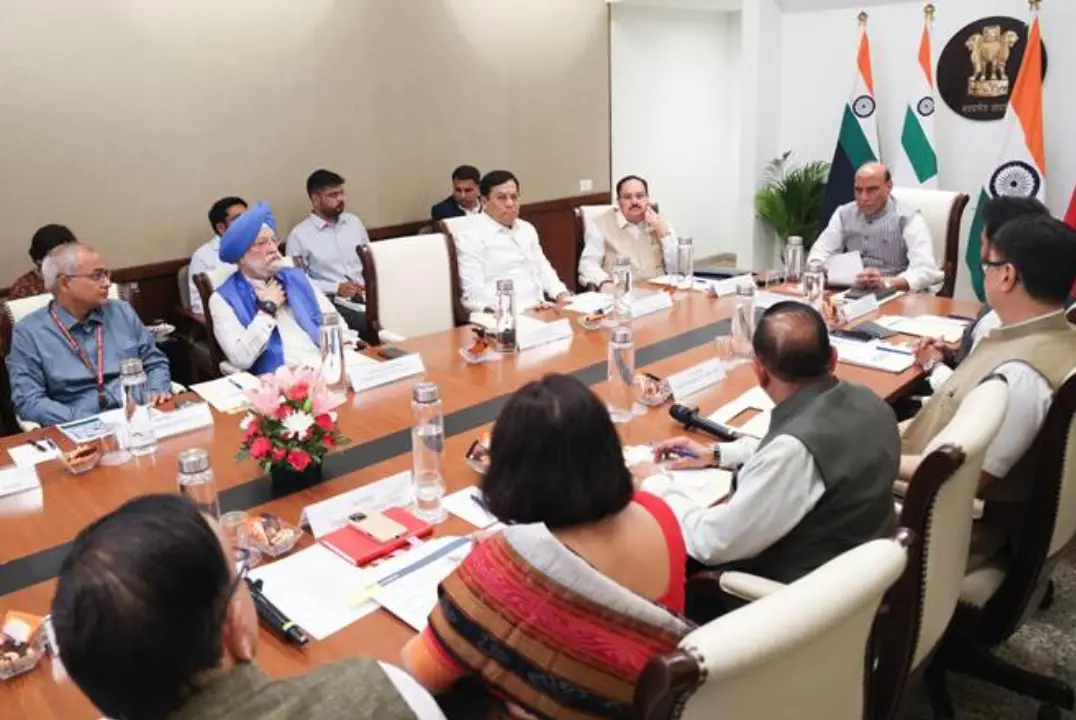
The Indian government's Informal Group of Ministers (IGoM) on West Asia convened its 5th meeting on May 11, 2026, chaired by Defence Minister (Raksha Mantri) Shri Rajnath Singh at Kartavya Bhawan-2, New Delhi. The high-level meeting reviewed the impact of the ongoing West Asia conflict on India's energy supply chains, domestic commodity availability, and broader economic stability — delivering a firm message of reassurance to markets and citizens: there is no shortage of any petroleum product in the country.
For investors tracking oil and gas stocks — including ONGC, Indian Oil Corporation (IOC), Bharat Petroleum (BPCL), Hindustan Petroleum (HPCL), and Petronet LNG — the government's detailed disclosure of strategic reserves, under-recovery burdens, and future energy policy direction provides critical signals.
The IGoM was briefed that India maintains a robust buffer of strategic energy stocks, even as most other nations have enacted emergency measures to drastically cut domestic consumption. The current reserve position stands at:
• 60 days of crude oil rolling stock
• 60 days of natural gas rolling stock
• 45 days of LPG rolling stock
• Foreign exchange reserves at a comfortable $703 billion
India is the world's third largest oil refiner and the fourth largest exporter of petroleum products, supplying to over 150 countries while meeting full domestic demand. Despite this strategic strength, the nation is absorbing significant costs as international crude prices remain at elevated levels due to the conflict.
Critically for equity investors, India's oil marketing companies (OMCs) — Indian Oil, BPCL, and HPCL — have been absorbing losses of approximately Rs 1,000 crore per day, with under-recoveries totalling nearly Rs 2 lakh crore in Q1 FY2026. This has been done deliberately to shield Indian consumers from global price spikes of 30–70% seen in many other nations — a factor investors must price into OMC valuations.
Prime Minister Narendra Modi's appeal on May 11, 2026, and Rajnath Singh's directives to the ministries outlined a clear government strategy with multiple components relevant to market watchers:
• Citizens urged to reduce petrol and diesel consumption by using public transport, metros, and carpooling — a move that could moderate near-term fuel demand.
• Refraining from unnecessary foreign travel and non-essential gold imports for one year to protect forex reserves.
• Farmers urged to cut chemical fertiliser usage by 50%, shift to natural farming, and adopt solar-powered irrigation pumps over diesel pumps — a positive signal for solar and agri-tech sectors.
• Rajnath Singh called for accelerated expansion of renewable energy, diversified energy supplies, greater investment in energy efficiency, and re-evaluation of strategic reserve requirements.
On the industry support front, the Union Cabinet approved the Emergency Credit Line Guarantee Scheme (ECLGS) 5.0 on May 05, 2026, providing a total additional credit flow target of Rs 2,55,000 crore — with 100% credit guarantee coverage for MSMEs and 90% for non-MSMEs and the airline sector. The Ministry of Finance also issued a force majeure relief circular, treating the current crisis as equivalent to war conditions, allowing performance deadline extensions of 2–4 months from February 28, 2026, for public procurement contracts.
The IGoM confirmed that fertiliser availability remains robust, with current stocks significantly exceeding year-ago levels and well above normal seasonal requirements. For Kharif 2026, the DA&FW assessed total fertiliser requirements at 390.54 lakh metric tons (LMT), against which current stock stands at 199.65 LMT — over 51% of the season's requirements already secured, compared to the usual level of about 33%.
|
Product |
Stock 11.05.2026 (LT) |
Stock 11.05.2025 (LT) |
YoY Change |
|
Urea |
76.65 |
75.48 |
+1.6% |
|
DAP |
22.52 |
14.87 |
+51.4% |
|
NPKs |
60.42 |
48.32 |
+25.0% |
|
SSP |
26.99 |
26.92 |
+0.3% |
|
MOP |
13.07 |
12.99 |
+0.6% |
|
Total |
199.65 |
178.58 |
+11.8% |
Source: PIB / Ministry of Chemicals & Fertilizers, May 11, 2026 | LT = Lakh Tons
The IGoM's announcements carry direct implications for several listed companies and sectors on BSE and NSE:
• Oil Marketing Companies (HPCL, BPCL, Indian Oil): Under-recoveries of ~Rs 2 lakh crore in Q1 FY26 remain a key earnings headwind. However, the government's clear signal against passing on prices to consumers indicates continued OMC margin pressure unless crude prices moderate.
• ONGC & Oil India: As upstream producers benefiting from higher realisations, elevated international crude prices are broadly positive, though government-directed subsidised supply arrangements may offset gains.
• Petronet LNG & GAIL: India's 60-day natural gas rolling stock and emphasis on diversified supplies could support long-term LNG import volumes.
• Fertiliser companies (Chambal Fertilizers, Coromandel International, NFL): Robust government stocking — up 11.8% YoY to 199.65 lakh tons — and government focus on natural farming transition will be a dual signal: near-term demand steady, long-term chemical fertiliser volume growth may moderate.
• Renewable Energy (Adani Green, Tata Power, NTPC Green): Rajnath Singh's explicit call to accelerate renewable energy expansion and energy efficiency investment reinforces the long-term growth thesis for India's green energy sector.
• Solar Irrigation / Agritech: PM Modi's appeal for farmers to replace diesel pumps with solar-powered irrigation is a positive demand signal for solar pump manufacturers and agritech platforms.
• MSMEs & Aviation: The ECLGS 5.0 with Rs 2,55,000 crore in additional credit flow is a targeted liquidity lifeline — positive for MSME-focused NBFCs and aviation companies such as IndiGo and Air India (pending listing).
The government's overarching message — that India's petroleum, food, and fertiliser supply chains are secure — is intended to prevent panic buying and market disruption. Rajnath Singh urged all stakeholders, ministries, and state governments to institutionalise fuel efficiency, public awareness, and responsible consumption behaviour. He also underscored that the West Asia crisis must be viewed as part of a broader geopolitical risk framework requiring strategic crisis anticipation, early warning assessment, scenario planning, and whole-of-government preparedness.