India is projected to have 313 billionaires by 2031, reflecting rapid economic growth alongside rising concerns over inequality and wealth concentration.
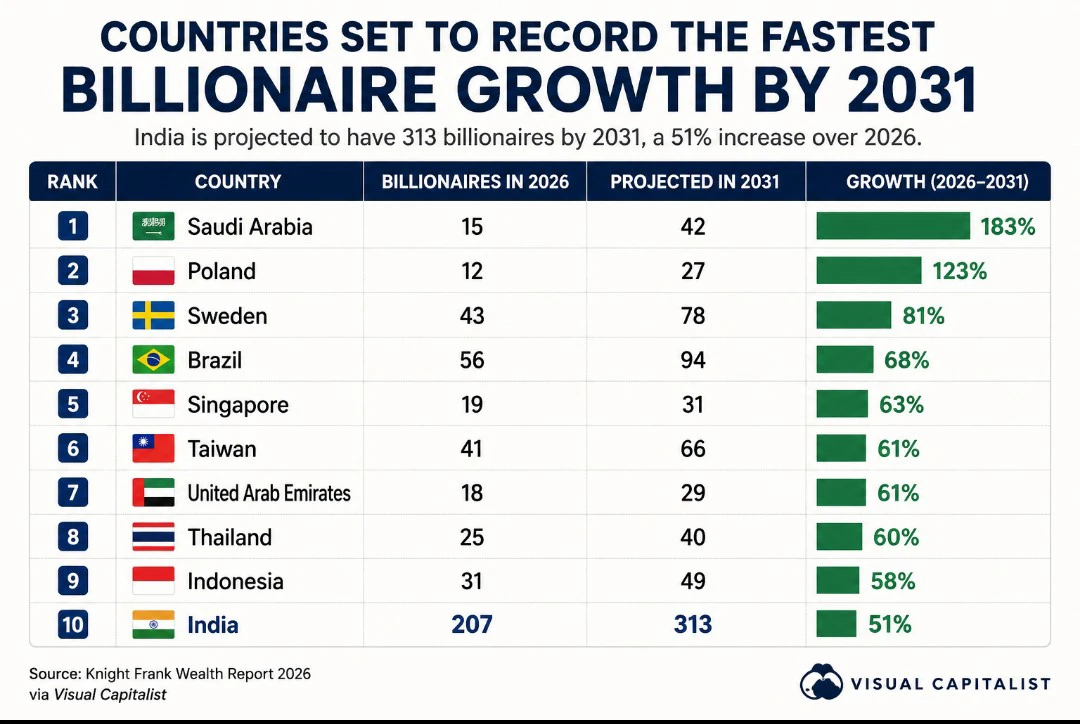
New Delhi, May 28: India is projected to add more than 100 new billionaires by 2031, according to data published by [Visual Capitalist](https://www.visualcapitalist.com?utm_source=chatgpt.com) based on Knight Frank’s Wealth Report 2026, reflecting both the country’s expanding economic influence and the growing concentration of wealth within emerging economies.
The report estimates that India’s billionaire population will rise from 207 in 2026 to 313 by 2031, marking a 51 per cent increase over five years. The projected growth places India among the world’s fastest-growing billionaire hubs, although countries such as Saudi Arabia and Poland are expected to record higher percentage growth.
India’s rise comes amid continued expansion in technology, infrastructure, manufacturing, pharmaceuticals, financial services, renewable energy, and digital commerce. Analysts say the growth reflects a broader structural shift in the Indian economy, where wealth creation is increasingly being driven by innovation-led sectors rather than only traditional industrial businesses.
Countries Expected to Record the Fastest Billionaire Growth by 2031
Although India ranks tenth globally in percentage growth, its numerical increase is among the largest in the world because of its already substantial billionaire base. The report also noted that India currently ranks sixth globally in terms of ultra-high-net-worth individuals with assets exceeding $30 million.
The findings indicate that emerging economies are increasingly becoming major centres of global wealth creation. Unlike earlier decades when billionaire wealth was concentrated heavily in Western economies, the latest projections show faster growth across parts of Asia, the Middle East, and Latin America.
In India’s case, the billionaire surge is closely tied to the rapid rise of digital businesses, startup ecosystems, stock market participation, and large-scale industrial expansion. The country has produced more than 100 unicorn startups in sectors such as fintech, logistics, software services, e-commerce, and artificial intelligence.
Analysts say this marks a significant transition in India’s economic structure. For much of the post-liberalisation period, wealth creation remained dominated by traditional sectors such as real estate, commodities, and family-owned conglomerates. The newer wave of billionaires is increasingly emerging from technology platforms, healthcare services, financial technology, clean energy, and electronics manufacturing.
The shift reflects India’s growing integration into global supply chains and international investment flows. Government-backed manufacturing incentives, infrastructure spending, expanding internet access, and rising domestic consumption have also contributed to rapid capital formation.
However, the projected rise in billionaire wealth has also revived debates around inequality and uneven development.
Economists often point out that billionaire growth alone does not fully reflect improvements in broader living standards. While rapid wealth creation may signal strong investment activity and entrepreneurial growth, it can also coincide with widening income gaps if economic gains remain concentrated among a small section of society.
The contrast is particularly visible between major urban economic centres and large rural or semi-urban regions where employment quality, wages, healthcare access, and educational opportunities continue to lag behind.
Online reactions to the report reflected both admiration and concern. Some viewed the projections as evidence of India’s economic transformation and rising global influence, while others questioned whether increasing concentration of wealth at the top should be celebrated without parallel improvements in public welfare and income distribution.
Analysts believe India’s long-term challenge will be balancing rapid private wealth creation with inclusive economic growth. The country’s ability to generate employment, improve public services, strengthen education systems, and expand social mobility may ultimately determine whether its economic rise benefits a wider population.
The report also noted that mature economies such as the United States are expected to show slower billionaire growth rates because their wealthy populations are already substantially larger. Emerging economies, by contrast, are experiencing faster acceleration from expanding industrial and digital sectors.
India’s projected rise to 313 billionaires by 2031 therefore represents more than a statistical increase in private wealth. It reflects the country’s transformation into a major global economic centre — while simultaneously exposing the difficult questions that accompany rapid wealth concentration in a developing society.