India's agricultural sector is showing early but measurable signs of a structural shift. Fresh data from the Ministry of Agriculture & Farmers Welfare—covering summer crop sowing as of May 1, 2026—reveals a calibrated, policy-driven rebalancing away from rice toward millets, pulses, and oilseeds.
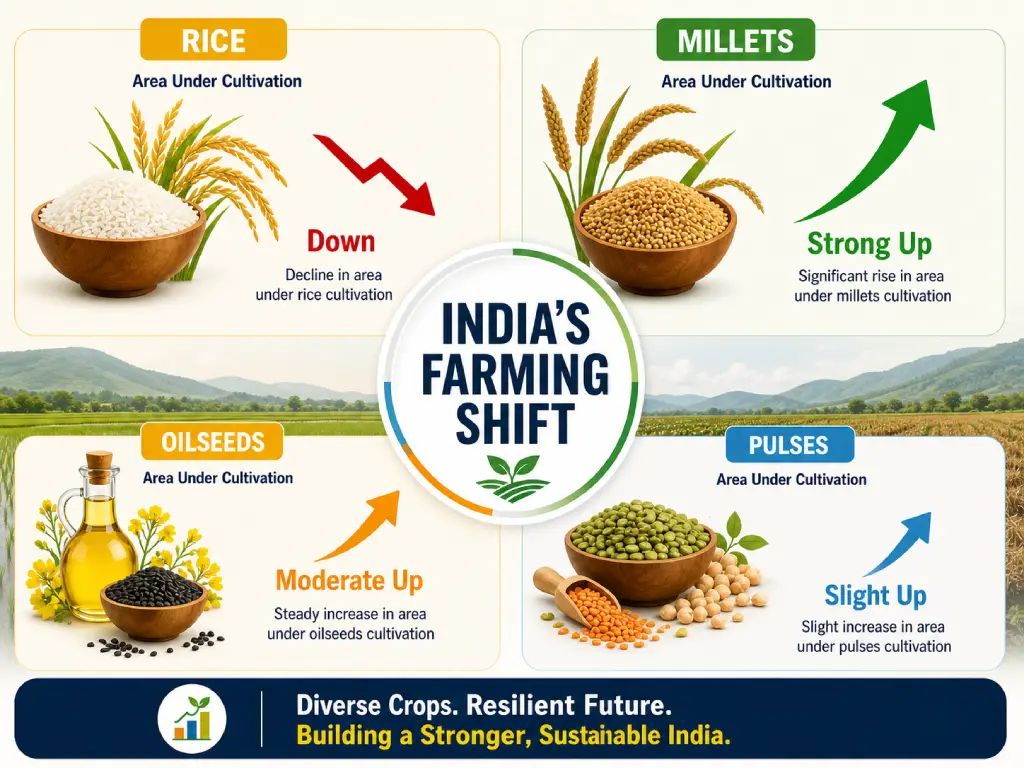
India's agricultural sector is showing early but measurable signs of a structural shift. Fresh data from the Ministry of Agriculture & Farmers Welfare—covering summer crop sowing as of May 1, 2026—reveals a calibrated, policy-driven rebalancing away from rice toward millets, pulses, and oilseeds. The numbers do not point to a dramatic overhaul, but they mark a turning point that analysts say could reshape the country's farm economy over the coming decade.
The headline figures tell a story of deliberate reallocation. India's total summer crop area grew by 3.3% year-on-year—but growth was not uniform. The composition of what is being cultivated is where the real story lies.
|
Crop Category |
2025 Area |
2026 Area |
Change |
% Change |
|
Rice |
33.43 |
32.07 |
–1.36 |
–4.1% |
|
Pulses |
15.83 |
16.56 |
+0.73 |
+4.6% |
|
Coarse Cereals (Millets) |
11.34 |
13.11 |
+1.77 |
+15.6% |
|
Oilseeds |
18.40 |
19.87 |
+1.47 |
+8.0% |
|
Total |
79.00 |
81.60 |
+2.60 |
+3.3% |
Source: Ministry of Agriculture & Farmers Welfare, Government of India (May 4, 2026)
Rice area fell from 33.43 to 32.07 lakh hectares, a decline of just over 4%. For a country where rice is cultural currency as much as crop, this is a number worth pausing on—but not overstating.
Rice continues to anchor India's food system, feeding hundreds of millions and underpinning procurement systems, price support mechanisms, and public distribution networks. The observed decline reflects marginal adjustment, not structural retreat. Farmers are reallocating incremental land—fringe parcels, seasonally variable plots—not abandoning paddy cultivation wholesale.
Agricultural economists caution against reading too much into a single season's data. Weather conditions, delayed monsoon onset, and localized flooding can all produce temporary area shifts. The structural signal, if genuine, will require confirmation over multiple cropping cycles.
|
Key Insight: Rice remains the undisputed anchor of India's food system. Its 4.1% area decline represents incremental reallocation at the margins—not a retreat from paddy farming. |
The most striking change comes from coarse cereals—predominantly millets—which surged by 15.6%, the fastest growth among all crop categories and comfortably above the national average expansion. This is not coincidental.
The momentum traces directly to the International Year of Millets 2023, which placed India at the centre of a global conversation about climate-resilient, nutritionally dense crops. Government promotion through dedicated schemes, minimum support prices for varieties like bajra and jowar, and sustained awareness campaigns among farmer producer organisations are now translating into measurable field-level adoption.
Millets are moving from 'traditional crop'—often associated with subsistence farming in rain-scarce regions—to strategic crop, with export potential and premium market positioning. Domestic demand is also rising, driven by urban health-conscious consumers seeking alternatives to refined grains.
States Driving Millet Growth
|
State |
Growth Driver |
|
Karnataka |
Jowar & Ragi belt; strong FPO network |
|
Maharashtra |
Bajra expansion in Marathwada region |
|
Rajasthan |
Bajra dominates; climate conditions ideal |
|
Policy in Action: The 15.6% millet surge is one of the clearest examples in recent memory of government promotion translating directly into measurable farm-level change within a short policy window. |
Oilseed area rose by 8%, reflecting a clear economic objective that goes well beyond agriculture: reducing India's staggering dependence on imported edible oil. India currently spends tens of billions of dollars annually on palm oil, soybean oil, and sunflower oil imports—a foreign exchange burden that successive governments have pledged to reduce.
This is not just an agricultural shift—it is a trade strategy in action. Expanded domestic cultivation of groundnut, mustard, and soybean could ease pressure on India's import bill and reduce exposure to volatile global commodity markets, particularly in a post-Ukraine-war environment where sunflower oil supply chains remain fragile.
However, the long-standing challenge persists: low productivity may limit gains despite higher acreage. India's oilseed yields remain well below global benchmarks. Without parallel investment in seed technology, irrigation, and post-harvest infrastructure, more hectares under cultivation will not automatically translate into reduced import dependence.
|
Structural Caution: Area expansion alone will not solve India's edible oil import problem. Yield improvement and value-chain investment must accompany acreage growth for the strategy to succeed. |
Pulses saw a moderate 4.6% increase in area, in line with the national crop average and indicative of steady but cautious expansion. The pulse economy is historically characterised by sharp price volatility, making farmers risk-averse about significant acreage commitments.
Government support for pulses—through MSP enhancements and procurement through NAFED—has helped sustain farmer interest, particularly in Madhya Pradesh and Uttar Pradesh where tur (arhar), moong, and urad cultivation has expanded. But pulses remain vulnerable to weather shocks, pest pressure, and sudden import surges that can depress domestic prices.
From a nutritional security perspective, pulse expansion matters enormously. Protein deficiency is a major public health concern in India, and pulses remain the most affordable protein source for hundreds of millions of households. The challenge is building a supply chain that rewards farmers adequately while keeping consumer prices stable—a balance that has historically proven elusive.
Beneath the policy narrative lies a more fundamental driver: climate stress. India's agricultural system is under mounting pressure from erratic monsoons, groundwater depletion, rising temperatures, and intensifying extreme weather events. The cropping shift documented in this data is, at least partly, a rational adaptation response.
|
Crop |
Water Requirement |
Drought Resilience |
Climate Trend |
|
Rice |
High (1,200–2,000mm/season) |
Low |
Increasingly at risk |
|
Millets |
Low (300–600mm/season) |
Very High |
Growing advantage |
|
Pulses |
Low-Medium |
Moderate-High |
Stable to positive |
|
Oilseeds |
Medium |
Moderate |
Context-dependent |
Farmers—particularly in semi-arid regions of Karnataka, Maharashtra, and Rajasthan—may be responding as much to environmental risk as to government price signals. The ability to grow a crop with half the water requirement of rice, in conditions of increasingly unreliable rainfall, is a powerful incentive that no MSP announcement can fully replicate.
This dataset functions simultaneously on two distinct levels, and conflating them risks misreading the evidence.
|
Agricultural Indicator |
Policy Messaging |
|
Signals early-stage diversification of India's cropping base |
Reinforces themes of Atmanirbhar Bharat (self-reliance) in agriculture |
|
Confirms millet adoption is gaining momentum beyond pilot programmes |
Aligns with India's global positioning as 'Millet Nation' post-IYM 2023 |
|
Suggests oilseed strategy is producing measurable area response |
Supports narrative of climate-smart, nutritionally secure agriculture |
|
Indicates farmer risk calculus is shifting in climate-stressed regions |
Provides evidence for ongoing MSP and procurement policy advocacy |
|
Critical Caveat: PIB figures measure area sown—not final production, yield improvements, or farmer income gains. Weather shocks, market price collapses, and implementation gaps could undermine the gains suggested by these area figures. |
India's agricultural transition is real—but it is restrained. The country is not abandoning its traditional staples. It is strategically rebalancing at the margins: nudging land, capital, and farmer attention toward crops that serve multiple national objectives simultaneously—nutrition, trade balance, climate resilience, and rural livelihoods.
The direction of travel is clear. Millets are ascending. Oilseeds are expanding. Pulses are growing cautiously. Rice is easing, but from a position of overwhelming dominance. These are not the numbers of a farm revolution—they are the numbers of a farm evolution, careful and deliberate.
The trajectory is set. The question now is whether India's agricultural policy machine has the capacity—and the political will—to ensure that this transition is inclusive, not merely measurable.
|
KEY TAKEAWAYS • India's summer crop area grew 3.3%, but the composition shift matters more than total growth • Millets posted the strongest growth at 15.6%—a direct result of post-IYM 2023 policy momentum • Oilseeds expanded 8%, reflecting trade strategy as much as agricultural policy • Rice remains the dominant crop despite a 4.1% area decline • Climate pressures—erratic rainfall, water stress—are silently shaping farmer choices alongside policy incentives • Productivity gaps and implementation challenges could limit real-world gains from area expansion |