APEDA facilitates India's first-ever ODOP honey export from Assam's Baksa district to the USA — 20 metric tons shipped, promising beekeepers 43% higher returns and boosting northeast agricultural exports.
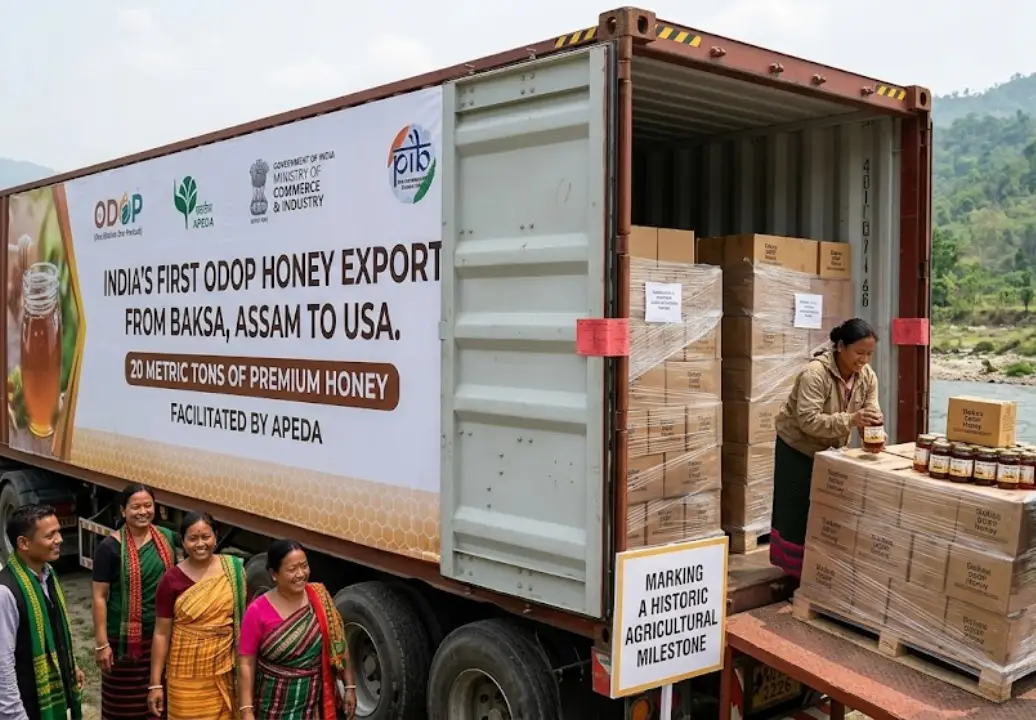
In a landmark development for India's agricultural export sector, the Agricultural and Processed Food Products Export Development Authority (APEDA) facilitated the first-ever export of ODOP honey from Baksa — an Aspirational District in Assam — to the United States of America on May 9, 2026. The historic consignment, comprising 20 metric tons of premium Baksa honey, was shipped by APEDA-registered exporter M/s Salt Range Foods Pvt. Ltd., based in Assam, marking a defining moment for the One District One Product (ODOP) initiative and India's northeast agricultural exports.
This milestone underscores the Government of India's sustained commitment to diversifying its agricultural export basket, integrating farmers from Aspirational Districts into global value chains, and empowering local communities through market-linked income opportunities. The Baksa honey export is being widely viewed as a model initiative that demonstrates how niche, high-quality agricultural products from India's northeastern region can find competitive footing in global markets, including one as demanding as the United States.
Assam is home to one of India's most vibrant beekeeping traditions, deeply embedded in the cultural and livelihood practices of its indigenous communities. Honey collection has been practised for centuries by tribes such as the Karbi, Mishing and Bodo, who have long used honey as food, traditional medicine, and a component of cultural and religious ceremonies. This centuries-old tradition has laid a strong foundation for modern honey production in the state.
According to the latest data from the National Horticulture Board, Assam produced approximately 1,650 metric tons of honey during the financial year 2023–24. The state's rich biodiversity, dense forest cover and pesticide-free agricultural environments contribute to the exceptionally high quality of Assam honey. Key honey-producing districts in the state include Baksa, Kokrajhar, Chirang, Udalguri and Tamulpur — all located within the Bodoland Territorial Region (BTR).
Baksa district, in particular, has emerged as a significant centre for honey production. Honey sourced from Baksa is recognised for its near-organic characteristics, natural purity and rich floral diversity. The region's pristine ecological conditions — free from industrial pollution and chemical pesticide use — make its honey prized for high nutritional and medicinal value. These intrinsic quality attributes positioned Baksa honey as a strong candidate under the ODOP initiative, with considerable potential for value addition, livelihood generation and export growth.
The One District One Product (ODOP) initiative is a flagship programme of the Government of India designed to identify, develop and promote one distinctive product from each district, with the dual aim of strengthening local economies and enhancing India's presence in global export markets. By branding and creating market linkages for unique district-level products, ODOP plays a pivotal role in generating employment opportunities, boosting value addition and reducing regional economic disparities.
Baksa honey's inclusion under the ODOP initiative reflects recognition of its strong export potential and the significance of beekeeping as a source of rural livelihood in Assam's BTR region. The initiative aligns with the broader vision of transforming India into a globally recognised supplier of diverse, high-quality agricultural products — moving beyond traditional commodities to value-added and niche offerings. APEDA honey export initiatives such as this one directly support this vision by opening premium international markets for produce that might otherwise remain restricted to local farm gate transactions.
By facilitating the Baksa honey export to the USA, APEDA has demonstrated that district-level agricultural products, when supported by the right infrastructure, quality standards and market access mechanisms, can successfully compete in some of the world's most stringent consumer markets.
The Agricultural and Processed Food Products Export Development Authority (APEDA), functioning under the Ministry of Commerce and Industry, played a central facilitative role in enabling this historic export. APEDA's support extended to infrastructure development at the processing facility operated by M/s Salt Range Foods Pvt. Ltd., including the provision of specialised testing and laboratory equipment. These measures were critical in ensuring that the exported honey met rigorous international quality standards and food safety requirements, particularly those mandated for entry into the US market.
Quality compliance is a decisive factor in accessing high-value international markets for Indian agricultural exports. APEDA's intervention in building testing infrastructure at the source level — rather than relying solely on external laboratories — represents a strategic investment in supply chain integrity. This approach ensures that the honey exported from Baksa consistently meets the expectations of international buyers and regulatory authorities, reinforcing India's credibility as a reliable agricultural exporter.
APEDA reiterated its unwavering commitment to promoting farmer-led exports, strengthening quality infrastructure across the country, and supporting flagship government programmes such as ODOP to elevate India's standing as a trusted supplier of premium agricultural products in global markets. The authority's role in this export showcases how institutional support can transform raw agricultural potential into tangible export success.
One of the most significant outcomes of the Baksa honey export initiative is the direct economic benefit it delivers to local beekeepers and farmers. Producers supplying honey for the export consignment are expected to receive nearly 43 per cent higher price realisation compared to prevailing local farm gate prices. This substantial improvement in income is a game-changer for beekeeping communities in Baksa and the surrounding BTR region, where farming households often have limited access to premium markets and are forced to sell produce at suppressed local prices.
The higher returns made possible through ODOP honey exports translate directly into improved livelihoods, greater investment capacity for beekeepers and stronger rural economies in Assam's aspirational districts. By linking grassroots producers to premium international buyers in the USA, the initiative creates a sustainable income model that can be replicated across other honey-producing districts in Assam and the wider northeast region.
Beyond immediate financial gains, the export initiative marks a pivotal step in integrating farmers from India's Aspirational Districts into global agricultural value chains — ensuring consistent market access, better price discovery and long-term export growth. The success of this consignment is expected to catalyse further exports of northeast India honey to the USA and other international destinations, amplifying the region's footprint in the global honey trade.
India's northeast has long been recognised for its extraordinary biodiversity and the premium quality of its agricultural produce. The Baksa honey export to the USA validates this potential on the international stage and signals a new chapter for northeast agricultural exports — one defined by quality, sustainability and farmer empowerment. APEDA's facilitation of this landmark shipment reflects its broader mission of channelling India's agricultural diversity into global market opportunities, with lasting benefits for farming communities across the country.