India’s total telecom subscriber base rose to 1.337 billion in April 2026, with broadband users crossing 1.07 billion, according to TRAI data.
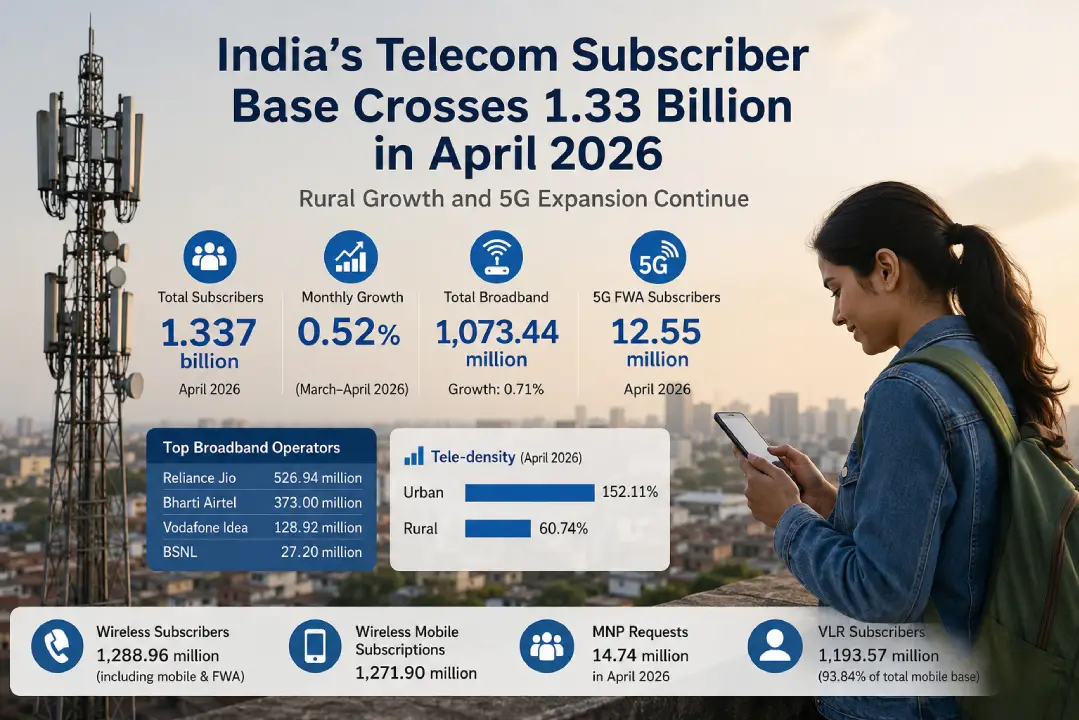
New Delhi, May 26: India’s telecom sector continued to expand in April 2026, with the country’s total telephone subscriber base rising to 1.337 billion, according to the latest telecom subscription data released by the Telecom Regulatory Authority of India (TRAI).
The total subscriber base increased from 1,330.58 million in March to 1,337.54 million in April, registering a monthly growth rate of 0.52 per cent. Wireless subscribers, including mobile and Fixed Wireless Access (FWA) users, stood at 1,288.96 million, while wireline subscribers increased to 48.58 million.
Broadband adoption also maintained steady momentum. Total broadband subscribers increased from 1,065.88 million to 1,073.44 million during the month, reflecting a growth rate of 0.71 per cent.
The data showed that Reliance Jio continued to dominate India’s broadband market with 526.94 million subscribers, followed by Bharti Airtel at 373 million and Vodafone Idea at 128.92 million. BSNL remained the leading public sector operator with 27.20 million broadband subscribers.
Industry analysts say the continued rise in broadband subscriptions reflects growing dependence on digital services, online education, OTT platforms, remote work and AI-driven applications that require stable high-speed internet access. The expansion of affordable 5G-enabled smartphones and data-centric plans has also accelerated internet consumption in semi-urban and rural areas.
One of the notable trends in the April data was the continued rise of 5G-based Fixed Wireless Access services. TRAI reported that 5G FWA subscribers increased from 12.32 million in March to 12.55 million in April 2026.
The rapid growth of FWA services indicates that telecom operators are increasingly using 5G infrastructure as an alternative to conventional fibre broadband, especially in regions where laying physical fibre networks remains difficult or expensive. This trend is particularly relevant for remote and geographically challenging regions in the Northeast.
In the Northeast telecom service area, which includes Arunachal Pradesh, Manipur, Meghalaya, Mizoram, Nagaland and Tripura, 5G FWA subscriptions increased from 134,454 to 137,218 during April. UBR-based wireless broadband subscriptions in the region also rose from 15,222 to 16,503.
The growth, though modest compared to larger telecom circles, suggests gradual digital expansion in the region where connectivity gaps, terrain challenges and infrastructure limitations have historically affected telecom penetration.
TRAI data also highlighted the continuing rural-urban divide in telecom access. While urban tele-density rose to 152.11 per cent, rural tele-density stood at 60.74 per cent, less than half the urban level.
The disparity points to the uneven distribution of telecom infrastructure despite rising smartphone adoption across rural India. Experts note that improving rural connectivity remains crucial for digital governance, telemedicine, online education and rural economic integration.
Wireless mobile subscriptions alone rose to 1,271.90 million in April 2026. Private telecom companies continued to dominate the sector with a combined market share of 92.67 per cent, while BSNL and MTNL together accounted for 7.33 per cent.
Another indicator of competition within the telecom sector was the high level of Mobile Number Portability (MNP) requests. Around 14.74 million subscribers applied to port their mobile numbers during April 2026, reflecting continued consumer movement between operators based on pricing, network quality and service experience.
The report also showed that 1,193.57 million wireless subscribers were active on the date of peak Visitor Location Register (VLR), accounting for nearly 93.84 per cent of the total wireless mobile subscriber base.
TRAI stated that the figures were based on subscriber data submitted by telecom service providers across India.