A large-scale water hyacinth bloom is threatening Lamphelpat wetland's Rs 650-crore restoration in Imphal — choking fish, accelerating silt and raising flood risk ahead of the monsoon season.
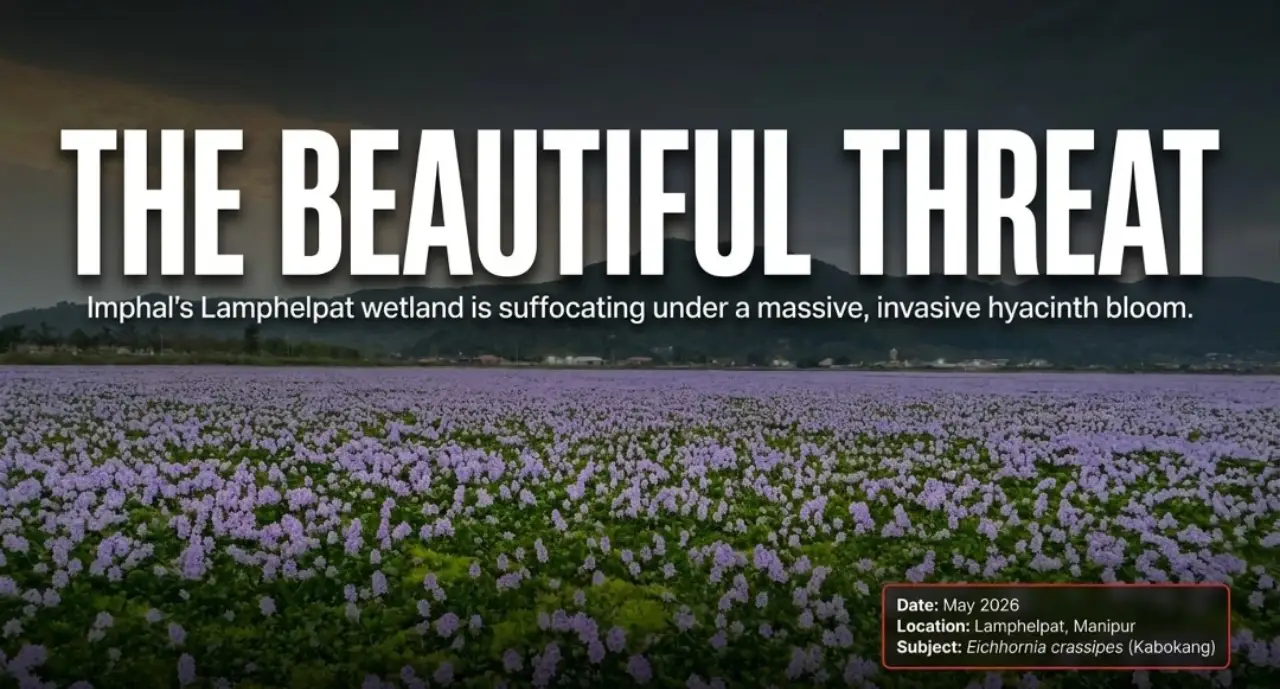
IMPHAL, May 22: In early May 2026, the surface of the Lamphelpat water body in Imphal began disappearing beneath a continuous carpet of purple-flowered water hyacinth. Within weeks, dense mats of Eichhornia crassipes, which is classified among the world's most invasive aquatic plants, had spread across large portions of the 300-acre wetland, prompting growing alarm from environmental scientists, local observers and wetland management experts.
The timing could scarcely be worse. Lamphelpat sits at the centre of an ambitious Rs 650-crore government restoration programme — one of the most significant urban wetland interventions in North-East India's recent history. Roughly 60 percent of dredging work had been completed by late 2025, and wildlife indicators had started moving in the right direction. An invasive weed now threatens to reverse that trajectory faster than engineers can sustain it.
This report draws on available project data, published ecological research and field observations to assess the scale of the threat, trace its origins and outline what an effective response must include.

The Project and What Is at Stake
Lamphelpat's rehabilitation is not a beautification exercise. The Rs 650-crore integrated scheme carries three distinct mandates that together make it one of the most consequential infrastructure investments in the Imphal Valley.
First, it is a flood-control project. Lamphelpat's dredged basin is designed to absorb monsoon peak flows and release them gradually, reducing inundation risk for downstream Imphal — a city that has historically suffered severe urban flooding. Second, it is a water-security project: the plan targets a storage capacity of 124 million cubic metres, sufficient to supply potable water to approximately four lakh people. Third, it is an ecological and economic project, converting around 140 acres into a recreation and ecotourism zone, with a proposed cable car as one of its marquee features.
By late 2025, dredging of approximately 245 acres of lake bed was around 60 percent complete, with project completion targeted for November 2026. Bird surveys conducted at the site showed the wetland's recovery was already visible: the winter bird count rose from 1,194 in 2021 to 2,460 in 2023, a 106 percent increase. The hyacinth bloom now places each of these gains under direct threat.
"This bloom could undo years of work restoring Lamphelpat if the nutrient sources and plants are not tackled together." — Wetland ecologist, declining to be named pending official consultations.

Anatomy of an Invasion: How Water Hyacinth Works
Water hyacinth is exceptional among invasive plants in both the speed and completeness of the damage it causes. Under warm, nutrient-rich conditions — exactly those now present at Lamphelpat — it can double its biomass every one to two weeks. A lake surface that appears manageable one month can be comprehensively covered the next.
The ecological mechanisms are well-documented. Once mats form, they intercept sunlight before it reaches underwater vegetation and disrupt gas exchange between the water surface and the atmosphere. Dissolved oxygen levels drop sharply, particularly at night, stressing fish and other aquatic organisms. Extended low-oxygen events cause fish kills. Submerged native plants die off as light becomes insufficient for photosynthesis. The mat itself then begins decomposing, releasing nutrients back into the water and accelerating the cycle.
Siltation is a parallel problem. Hyacinth mats slow water flow, causing suspended particles to settle out rather than pass through. In a wetland where engineers have spent years and hundreds of crores of rupees removing accumulated silt, invasive vegetation can rebuild that sediment burden in a single growing season. An official familiar with the Lamphelpat project, speaking on background, described this dynamic as the weed potentially reversing the project's desilting progress, the core of the restoration's engineering rationale.
For flood management specifically, the threat is counterintuitive but real: dense mats slow drainage through inlet and outlet channels, meaning Lamphelpat could fill and overflow during heavy rains rather than absorb and buffer them. A wetland built to reduce flood risk could, under severe hyacinth infestation, briefly worsen it.
Public health risks compound the ecological damage. Stagnant water sheltered beneath hyacinth mats provides optimal breeding habitat for mosquitoes and freshwater snails, vectors for malaria, dengue and other diseases. Earlier water-quality assessments of Lamphelpat documented E. coli contamination in lake water, a baseline that hyacinth-driven deoxygenation can only intensify.

Reading the Data: Why the Bloom Appeared
Water hyacinth does not bloom at random. Its explosive growth is a biological indicator — a response to eutrophication, the process by which excess nutrients, primarily nitrogen and phosphorus, accumulate in a water body and tip its ecology out of balance. The question of why Lamphelpat is experiencing this bloom in 2026 is answered, at least in part, by data collected years earlier.
A 2013 water-quality assessment documented that large volumes of sewage were being dumped directly at or near the Lamphelpat site. Monitoring data from drainage points in the wetland's catchment recorded electrical conductivity of approximately 605 microsiemens per centimetre and total dissolved solids exceeding 1,000 milligrams per litre — values far above those expected in clean freshwater. E. coli was detected in lake-water samples. These findings pointed to chronic, high-volume organic waste input that had been building nutrient levels in the sediment and water column for decades.
Urban growth has not improved matters. Imphal's first sewage treatment plant, a 27-million-litre-per-day facility, came online only in 2021. As of that year, fewer than seven percent of target households had active sewer connections. The city's Phase II sewerage project — designed to handle 49 million litres per day — remains incomplete. State water authorities have indicated that treated wastewater is planned for eventual reuse at Lamphelpat, which implies that for now, the untreated majority of Imphal's sewage continues to find its way into drainage networks that feed the wetland.
Municipal solid waste compounds the problem. Field documentation shows waste from households, markets and small commercial operations reaches nearby drains and ultimately the lake. Construction activity associated with the restoration project itself may contribute some nutrient and sediment loading. The cumulative result is a water body primed, at the biochemical level, to sustain exactly the kind of bloom now observed.
No official water-quality assessment of the current bloom has been publicly released, and no government agency had issued a formal response as of the time of publication — a data gap that significantly constrains the precision of any response.

The Ecological Ledger: What Is Being Lost
Beyond the engineering calculus, the hyacinth bloom represents a loss that is harder to quantify but no less significant. Lamphelpat was once one of the few wetlands in Manipur where Kombirei — a native flowering aquatic plant embedded in Meetei cultural memory — bloomed naturally each season. The flower appears in folk poetry, songs and oral tradition as an emblem of the valley's wetland identity. Older residents of Imphal describe a seasonal landscape that no longer exists.
"Earlier generations associated Lamphelpat with Kombirei. Today, the conversation is about invasive weeds. That itself tells the story of how much our wetlands have changed." — Longtime Imphal resident
Environmental volunteers note that the loss of Kombirei and the arrival of water hyacinth are not separate events. They reflect the same underlying trajectory. Native aquatic flora requires stable water chemistry, adequate dissolved oxygen and light penetration. Decades of nutrient loading and reduced water quality progressively eliminated the conditions Kombirei needed. The hyacinth thrives in exactly the degraded environment that displaced it.
The same dynamic threatens the bird populations whose recovery has been one of the restoration project's most cited successes. Migratory and resident waterfowl depend on open water, aquatic insects and submerged vegetation for feeding. As hyacinth mats expand, those resources contract. If the bloom is not controlled before the next migratory season, the species diversity gains documented between 2021 and 2023 could erode.
Response Options: A Tiered Assessment
Environmental scientists and wetland managers outline a layered intervention strategy, with measures calibrated by urgency, cost and ecological risk.
Immediate priorities centre on physical removal and containment. Mechanical harvesting using weed-cutting boats or modified dredgers represents the most scalable option for clearing large mat areas quickly. Manual removal with nets and rakes can address margins and narrow channels where machinery cannot operate. Floating booms at inlet points can slow further spread. All removed biomass requires proper disposal, composting or biofuel processing rather than dumping, which risks returning nutrients to the water.
Chemical options are available but carry significant constraints. Herbicides such as 2,4-D or glyphosate deliver rapid plant kill but are toxic to fish, non-target aquatic vegetation and can degrade water quality during the breakdown period. Regulatory requirements for water withdrawal periods before treated water can be used for irrigation or drinking supply make chemical intervention particularly complicated at a site that has water-supply ambitions. Most experts recommend chemical control only as a targeted last resort under strict environmental supervision.
Biological control by introducing hyacinth-eating weevils (Neochetina species) or grass carp offers a low-chemical alternative but operates on a timeline of months to years, making it unsuitable as a primary immediate response. It may play a long-term maintenance role once physical removal has reduced the bloom to manageable levels.
Removal Method Comparison

Medium-term interventions must address the nutrient source problem, otherwise any clearing effort will produce regrowth within weeks. This requires accelerating completion of the Phase II sewerage project, extending sewer connections to a far higher proportion of Imphal households, and enforcing existing environmental regulations against illegal dumping in the wetland catchment. Markets and commercial establishments near the lake should be required to install effluent pre-treatment systems before discharging to drains.
Several environmental organisations have called for the restoration project's governance structure to be broadened by incorporating ecologists, water-quality scientists and local community representatives alongside engineers and tourism planners. They argue that a project conceived primarily around infrastructure targets will remain structurally vulnerable to biological threats unless scientific monitoring and adaptive management are built into its institutional framework from the outset.

The Narrowing Window
The monsoon season in Manipur typically begins in late May and runs through September. Warm temperatures, high rainfall and the nutrient-rich conditions already present at Lamphelpat create near-optimal conditions for hyacinth proliferation over the coming months. If large-scale removal does not begin immediately, the bloom could reach a scale that overwhelms mechanical harvesting capacity and meaningfully interferes with ongoing dredging operations.
The restoration project itself faces a compounding problem. Hyacinth mats trap silt and organic debris, rebuilding the sediment load that engineers have spent years removing. Every week of unchecked growth narrows the gap between the project's engineering targets and ecological reality.
The data picture is clear even where the gaps are significant. Lamphelpat's nutrient burden has been accumulating for decades. The sewerage infrastructure needed to reduce it remains largely unbuilt. The restoration project has achieved real gains in water capacity, in birdlife, in flood management potential, but it has not yet addressed the biochemical conditions that make the wetland vulnerable to exactly this kind of invasion.
The purple bloom spreading across Lamphelpat in May 2026 is not an anomaly. It is a signal — one that the restoration project's architects, funders and managers must now decide whether to read.
Data Notes
Project investment (Rs 650 crore) and dredging targets sourced from state water resources directorate documentation. Bird count data from Lamphelpat surveys 2021 and 2023. Water-quality figures (conductivity, TDS, E. coli) from 2013 assessment reports. Sewerage connection data from 2021 state records. Hyacinth growth rate and ecological impact parameters drawn from peer-reviewed aquatic ecology literature. No official water-quality measurements for the May 2026 bloom had been publicly released at time of publication.