Manipur cabinet approves grading system for Higher Secondary exams replacing position rankings, government jobs for 83 National and Asian Games medalists, new industrial policy, and Indo-Myanmar border land acquisition.
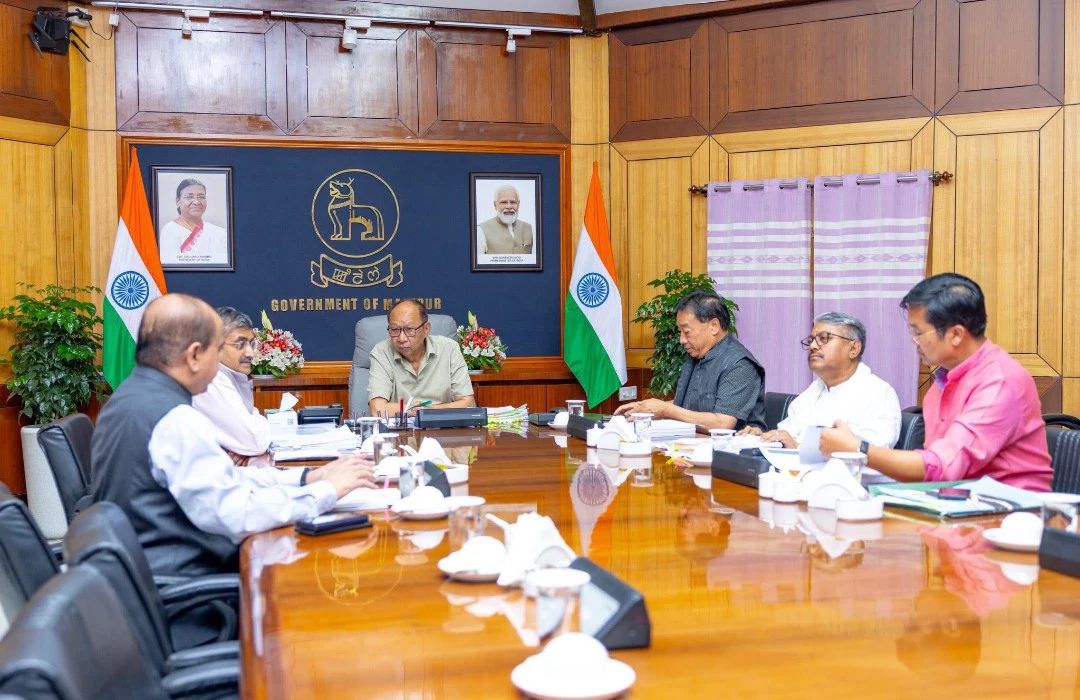
In a cabinet meeting chaired by Chief Minister Yumnam Khemchand at the Cabinet Hall of the Chief Minister's Secretariat on May 7, the Manipur State Cabinet approved 25 out of 27 submitted agendas, a high approval rate that signals both administrative decisiveness and a clear developmental intent. The session produced decisions spanning three distinct policy domains: a generational reform of the higher secondary education assessment system, a structured employment pipeline for elite athletes, and critical updates to industrial regulation and border infrastructure. Taken together, the resolutions chart a course that trades high-stakes academic competition for institutional well-being, and converts sporting excellence into career security.
Chaired the 7th Cabinet Meeting today at the Secretariat, deliberating key issues on governance and administration.
— Khemchand Yumnam (@YKhemchandSingh) May 7, 2026
Decisions taken with due diligence will strengthen governance and guide Manipur’s development.
Committed to effective governance, public welfare & inclusive… pic.twitter.com/6mUR7xSNys
The most culturally consequential decision of the session is the cabinet's approval to discontinue the position-based marking system for Higher Secondary examinations conducted by the Council of Higher Secondary Education Manipur (COHSEM). For decades, the announcement of Higher Secondary results meant a public ranking of students, the declaration of a narrow tier of 'toppers' whose marks separated them from the thousands who followed. For students outside that tier, even those with strong performances, the system often translated high effort into a public measure of inadequacy.
The cabinet's move to replace this with a standardised grading system is an explicit alignment with the National Education Policy (NEP) 2020 and follows a precedent already set by the Board of Secondary Education Manipur (BSEM), which transitioned Class 10 examinations to a grading model. The stated rationale from the cabinet is direct: to reduce the excessive anxiety and pressure faced by students during examinations. The reform recognises that a student's academic worth cannot be collapsed into a single-digit competitive rank, and that the relentless drive for 'position' has long produced an examination culture centred on rote memorisation over genuine comprehension.
The transition will be phased across two academic years. The grading system will be introduced for Class 11 examinations starting next year, and will extend to Class 12 examinations by 2027, a deliberate sequencing designed to ensure that students who enter the new framework in Class 11 complete their entire Higher Secondary cycle under a single, unified standard. Under the new assessment architecture, student performance will be categorised into eight passing grades and one failing grade:
|
Grade |
Performance Category |
Status |
|
A1, A2 |
High Achievement |
Pass |
|
B1, B2 |
Above Average Achievement |
Pass |
|
C1, C2 |
Average Achievement |
Pass |
|
D1, D2 |
Minimum Passing Achievement |
Pass |
|
E |
Below Passing Threshold |
Fail |
The reform carries significant analytical weight. By decoupling student identity from competitive rank, it redirects academic energy toward competency and skill acquisition — outcomes that are more aligned with the demands of a modern, diversified economy. It also creates parity between the Class 10 and Class 12 assessment frameworks, establishing a coherent, less adversarial academic environment across the full span of secondary education in Manipur.
The second major policy decision of the session directly addresses a long-standing tension at the heart of Manipur's sporting culture. The state has produced some of India's most celebrated athletes, and yet, for many of them, the journey from the medal podium back to everyday life has been financially precarious. A gold medal earns prestige; it does not guarantee economic security. The cabinet's decision to appoint 83 medalists to government positions is a structural intervention designed to close that gap permanently.
The approved appointments cover gold medalists from the 36th and 37th National Games and a bronze medalist from the 18th Asian Games, distributed across three state departments in functional, substantive roles:
|
Department |
Role / Designation |
Appointments |
Basis |
|
Youth Affairs and Sports |
Under Graduate Physical Education Teacher (PET) |
73 |
Sports Quota |
|
Forest and Environment |
Forester |
1 |
Sports Quota |
|
Home Department |
Assistant Sub-Inspector (ASI) |
4 (Male) |
Sports Quota |
|
Home Department |
Riflemen |
2 |
Sports Quota |
|
Home Department |
Followers |
3 |
Sports Quota |
|
TOTAL |
|
83 |
|
The appointments are analytically significant beyond their symbolic value. The deployment of 73 medalists as Physical Education Teachers within the Youth Affairs and Sports department creates what analysts describe as a virtuous cycle of talent reinvestment: high-achieving athletes are placed back into the educational ecosystem, where they become mentors and trainers for the next generation of students. This institutionalises sporting excellence rather than allowing it to dissipate after competition ends. The integration of nine athletes into the Home Department, as ASIs, Riflemen, and Followers, further signals the state's intent to harness the discipline and high-performance attributes of competitive athletes within its security and administrative structures.
Beyond education and sports, the cabinet session addressed the regulatory frameworks governing industrial and private school operations. The Manipur Industrial Estates Policy, 2026, was approved, replacing the existing Manipur Industrial Estate Rules, 2019, in alignment with proposals from the Government of India. The update signals a forward-looking regulatory recalibration to bring the state's industrial estate governance in line with current national industrial frameworks.
The Manipur Private Schools (Registration and Regulation) (First Amendment) Rules, 2026, were also approved, indicating a tightening of the oversight framework for private educational institutions in the state, a move that acquires additional relevance in the context of the broader education reforms approved in the same session. On personnel decisions, the cabinet approved a one-year service extension for Khuraijam Temba, former Chief Engineer of the Rural Engineering Department, ensuring continuity of technical leadership over ongoing rural infrastructure projects.
The final significant resolution of the session addressed infrastructure along one of India's most strategically sensitive international boundaries. The cabinet approved the acquisition of 80.592 hectares of land in Churachandpur district for the purpose of fencing and road construction along the Indo-Myanmar border, spanning from Border Pillar number 43 to the vicinity of Border Pillar 47 on the southern side of the Manipur River.
Critically, the cabinet also approved an increase in land compensation rates for landowners affected by the acquisition. This decision carries both security and social dimensions. Churachandpur is a district with significant ethnic complexity and a history of community sensitivities around land. By ensuring upward revision of compensation, the state government is managing a dual imperative: accelerating a national security infrastructure project while maintaining community stakeholder alignment and minimising local resistance in a region where such tensions have historically complicated infrastructure delivery.
ANALYSIS
The May 7 cabinet session is best read as a coherent, integrated policy statement rather than a collection of discrete administrative decisions. The education reform, sports employment policy, industrial modernisation, and border infrastructure decisions all converge on a single underlying logic: the state is attempting a simultaneous recalibration of how it measures human achievement, how it rewards it, and how it protects the conditions under which it can flourish. Whether these reforms translate into measurable improvements in student mental health outcomes, sporting participation rates, industrial investment, or border security will depend on implementation fidelity, but the directional intent, at least, is unambiguous.