Manipur-born astrophysicist Dr. Ronaldo Laishram has identified a massive ancient galaxy cluster 12.6 billion light-years away, naming it the Loktak Protocluster after his home state’s iconic lake.
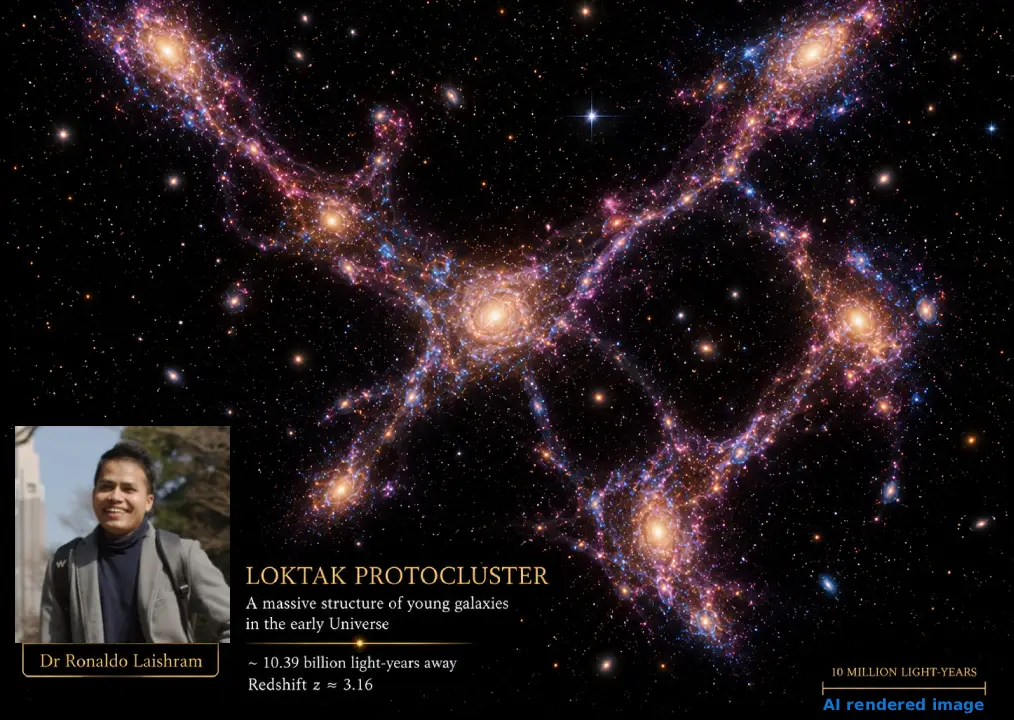
Imphal, May 26: A Manipur-born astrophysicist at Japan’s National Astronomical Observatory (NAOJ) has discovered a colossal assembly of young galaxies from the infant Universe and named it after one of Northeast India’s most iconic natural landmarks — Loktak Lake.
Dr. Ronaldo Laishram, originally from Khangabok in Thoubal District, Manipur, led an international research team that identified the structure — now officially designated the Loktak Protocluster — at a distance of approximately 12.6 billion light-years from Earth. The discovery was published April 27, 2026, in The Astrophysical Journal Letters, one of the world’s foremost peer-reviewed astronomy journals.
The Loktak Protocluster is the progenitor of what scientists predict will become one of the most massive galaxy clusters in the present-day Universe. At the time its light departed on the journey to Earth, the Universe was just 1.2 billion years old — less than 9 percent of its current estimated age of 13.8 billion years.
“This is not just a scientific discovery. It is a personal and cultural bridge between my homeland and the cosmos,” Dr. Ronaldo Laishram said. “Loktak is deeply connected to Manipur’s identity. Naming this protocluster after Loktak Lake is my way of telling the world that this land, its lakes, and its people also have a place in the story of the Universe.”
The research team combined data from Japan’s Subaru Telescope and NASA’s James Webb Space Telescope (JWST) to identify and characterize the structure, and performed one of the first systematic comparisons of galaxy shapes and sizes between dense protocluster environments and quieter field regions at this extreme cosmic distance. Co-authors on the study include Yusei Koyama of NAOJ and The Graduate University for Advanced Studies, Haruka Kusakabe of the University of Tokyo, Satoshi Kikuta of the University of Tokyo, Shunta Shimizu of the University of Tokyo, and Tadayuki Kodama of Tohoku University.

What Is the Loktak Protocluster?
Astronomers define a protocluster as the earliest observable stage of a galaxy cluster — a region of the early Universe where gravity is slowly drawing together the raw material for what will eventually become a vast, gravitationally bound city of galaxies. In the present-day Universe, fully formed galaxy clusters can contain thousands of individual galaxies and rank among the most massive structures held together by gravity. Protoclusters are their ancestors, caught in the act of assembly.
The Loktak Protocluster, observed as it existed 12.6 billion years ago, consists of four distinct concentrations of galaxies spanning roughly 65 by 36 comoving megaparsecs on the sky — a scale that, when expressed in today’s expanded Universe, stretches across hundreds of millions of light-years. The primary concentration shows a galaxy surface density approximately four times higher than the average surrounding field within a radius of 1.5 proper megaparsecs, rising to 5.5 times denser within 1.0 proper megaparsec of the peak — a steeply rising density profile that marks the core of an actively assembling system.
The naming of the structure carries deliberate poetic and cultural weight. Loktak Lake, located in the Bishnupur and Churachandpur districts of Manipur, is the largest freshwater lake in Northeast India and is celebrated for its distinctive phumdis — floating islands of soil, matted vegetation, and organic debris that cluster together within a single interconnected body of water. The world’s only floating national park, the Keibul Lamjao National Park, rests on one of these islands.
“This is not just a scientific discovery. It is a personal and cultural bridge between my homeland and the cosmos.” — Dr. Ronaldo Laishram, National Astronomical Observatory of Japan
Dr. Ronaldo Laishram and his colleagues drew a direct structural parallel between the lake and their cosmic discovery. Just as Loktak’s phumdis form multiple linked islands within one shared body of water, the Loktak Protocluster’s four overdensity peaks form multiple interconnected galaxy concentrations within a single vast evolving system. The journal paper formally records this inspiration in a footnote, describing how “the floating islands within an interconnected body of water evoke the multicomponent nature of this large-scale structure.”
The Role of JWST and the Subaru Telescope
The discovery required two of the most powerful astronomical instruments currently in operation. The research team first identified the cluster’s galaxy members using data from the SILVERRUSH narrowband survey program, which uses the Subaru Telescope’s Hyper Suprime-Cam on Mauna Kea, Hawaii, to image large areas of sky through custom narrowband filters. SILVERRUSH targets a class of objects known as Lyman-alpha emitters (LAEs) — young, actively star-forming galaxies that emit a distinctive ultraviolet spectral signature called the Lyman-alpha line, produced when hydrogen gas in and around a galaxy fluoresces under intense radiation from newborn stars.
The combined SILVERRUSH catalog used in the study contains 726 photometrically selected LAEs detected through the NB718 narrowband filter — a filter designed to isolate Lyman-alpha emission from galaxies at redshift z = 4.90, corresponding to a cosmic epoch 12.6 billion years ago. The catalog covers 1.76 square degrees of sky in the COSMOS field, one of the most extensively studied patches of sky in observational cosmology. Thirteen of those 726 LAEs in the COSMOS region have confirmed distances from spectroscopic follow-up, validating the photometric selection method.
To examine the structural properties of these galaxies in detail, the team turned to NASA’s James Webb Space Telescope and its COSMOS-Web treasury imaging program, a Cycle 1 JWST survey that mapped 0.54 square degrees of the COSMOS field using the Near Infrared Camera (NIRCam). JWST’s extraordinary sensitivity and resolution at near-infrared wavelengths allows it to capture light that, after 12.6 billion years of cosmic expansion, has been stretched from its original ultraviolet and optical wavelengths into the infrared. This capability lets astronomers observe the actual rest-frame optical and ultraviolet structure of these ancient galaxies — something the Hubble Space Telescope, limited to shorter-wavelength observations, could not provide at these extreme distances.
The team identified 177 LAEs within the COSMOS-Web footprint with robust redshift confirmation, and used these galaxies to construct detailed maps of the local galaxy surface density, revealing the protocluster’s four-peaked structure. For morphological analysis, 16 protocluster member galaxies and 23 field galaxies passed the resolution cuts required for reliable size measurements in rest-frame optical light.
A Wavelength-Dependent Environmental Signal
The most scientifically significant finding reported by Dr. Ronaldo Laishram, Yusei Koyama, Haruka Kusakabe, Satoshi Kikuta, Shunta Shimizu, Tadayuki Kodama and their collaborators concerns not simply the existence of the protocluster, but what the dense environment does to the galaxies within it — and how that effect depends on the wavelength of light used to observe them.
Using a mathematical technique called Sérsic profile fitting, Dr. Ronaldo Laishram and co-investigators measured the effective radii — the physical distances from the center of each galaxy that enclose half of its total light — for galaxies in both the protocluster and the surrounding field. They performed these measurements independently in two JWST filters: the F150W filter, which at redshift z = 4.90 samples rest-frame ultraviolet light at roughly 2,540 angstroms and traces the output of the youngest, hottest stars formed within the past 100 million years; and the F277W filter, which at the same redshift samples rest-frame optical light at roughly 4,700 angstroms and is more sensitive to the contribution of older stellar populations that have been accumulating over longer timescales.
In rest-frame optical light, protocluster member galaxies showed median effective radii of 0.81 kiloparsecs, compared to 0.58 kiloparsecs for galaxies in field environments — a difference of roughly 40 percent. A Mann-Whitney U statistical test returned a p-value of 0.041, indicating the difference is statistically meaningful at marginal significance. When the researchers controlled for the well-established tendency of more massive galaxies to be physically larger — examining size residuals at fixed stellar mass — protocluster galaxies still lay systematically above the expected field size-mass relation by a median of 0.12 dex, corresponding to approximately 31 percent, with a 68 percent confidence interval ranging from 0.08 to 0.21 dex. Three-quarters of protocluster galaxies showed sizes above the field expectation for their mass, compared to 44 percent of field galaxies.
In rest-frame ultraviolet light, however, no significant difference appeared. Protocluster and field galaxies looked statistically identical when observed at those shorter wavelengths, with a Mann-Whitney p-value of 0.51 — fully consistent with no environmental signal. The environmental effect is present in one wavelength band and absent in the other.
Ronaldo Laishram, Yusei Koyama and their team interpret this wavelength-dependent pattern as evidence that the dense protocluster environment preferentially affects the extended, older stellar populations of galaxies — the populations traced by rest-frame optical light — while leaving the compact, actively star-forming cores, traced by rest-frame ultraviolet light, largely unchanged. Tidal interactions between neighboring galaxies, which can stretch and redistribute existing stellar material outward to larger radii, and the gradual accretion of smaller companion galaxies, which deposits stars preferentially in the outer regions of a larger host, are both proposed as physical mechanisms capable of producing this signature. An earlier onset of star formation in the denser environment, which would allow more time to build up extended older stellar populations, is also considered, though the current data are insufficient to test that scenario conclusively.
Crucially, the Sérsic index — a parameter describing how centrally concentrated a galaxy’s light profile is — showed no environmental dependence in either wavelength band. This indicates that protocluster galaxies possess more extended outer stellar distributions without any corresponding change in the shape or structure of their inner light profiles, consistent with material being added at large radii rather than the core being disturbed.
Why This Discovery Matters
The morphology-density relation — the observation that galaxies in denser environments tend to be rounder, redder, and less actively star-forming than those in sparser regions — has been established in the present-day Universe for more than four decades, since astronomer A. Dressler’s foundational 1980 study. Subsequent work has progressively pushed observations of environmental effects on galaxy structure to higher and higher redshifts. But reaching back to z ~ 5, where the Universe was less than 1.2 billion years old, has remained out of reach until the arrival of JWST.
Previous studies of LAE morphology in protocluster environments, including a study by R.A. Overzier and colleagues of LAEs in the TN J1338-1942 protocluster at z = 4.1 using Hubble rest-UV imaging, found no evidence of environmental differences in galaxy sizes. The present study, authored by Dr. Ronaldo Laishram, Yusei Koyama, Haruka Kusakabe, Satoshi Kikuta, Shunta Shimizu and Tadayuki Kodama, suggests the reason: the environmental signal resides specifically in the rest-frame optical, a wavelength range inaccessible to Hubble at these distances but now within reach of JWST.
This finding has implications for models of galaxy formation and evolution. Theoretical predictions had suggested that processes such as enhanced merger rates, tidal interactions, and accelerated gas accretion would leave observable signatures on galaxies in overdense environments even at early cosmic times. The Loktak Protocluster study provides one of the first direct observational confirmations of such signatures at z ~ 5, during what astronomers describe as the early buildup phase of cosmic star formation.
Each of the four overdensity peaks in the Loktak system carries an estimated present-day descendant mass in the range of 6.65 to 7.85 times 10 to the power of 14 solar masses, with a plausible range spanning 0.6 to 1.1 times 10 to the power of 15 solar masses per peak depending on assumptions about the galaxy bias parameter. These estimates place each peak firmly in the progenitor mass range of present-day massive galaxy clusters, confirming that the system will grow into one of the most gravitationally dominant structures in the future Universe.
The Scientist Behind the Discovery
Dr. Ronaldo Laishram is the son of the late Laishram Mahajon Singh and Laishram Sanahanbi Devi of Khangabok, Thoubal District, Manipur. He completed his undergraduate studies before pursuing his Master’s degree and doctorate at Tohoku University in Sendai, Japan — the same institution where co-author Tadayuki Kodama is a senior faculty member. Dr. Ronaldo Laishram subsequently joined NAOJ in Tokyo as a postdoctoral researcher, where he has continued research into the morphological and environmental properties of high-redshift galaxies.
His engagement with astronomy began before he left Manipur. At age 18, while still a student in his home state, he discovered a preliminary asteroid and received a formal felicitation from former President Dr. A.P.J. Abdul Kalam — an encounter that he has credited with reinforcing his determination to pursue astrophysics professionally.
Beyond his research, Dr. Ronaldo Laishram serves as the Founding Coordinator of the Manipur Astronomical Society (MAS), through which he designs and delivers science outreach programs and astronomy education initiatives across Northeast India. He has described MAS as part of a deliberate effort to build scientific awareness and aspiration among young people in a region that has historically had limited access to premier science institutions.
“I want young people from Manipur and Northeast India to know that curiosity and hard work can carry them anywhere — even to the edges of the observable Universe,” Dr. Ronaldo Laishram said.
The discovery’s personal dimension was not incidental to the science. Dr. Ronaldo Laishram deliberately invoked the name of Loktak Lake, which holds deep ecological, cultural, and spiritual significance across Manipur. Beyond its ecological fame as the largest freshwater lake in Northeast India and home to the world’s only floating national park, Loktak occupies a central place in Meitei cultural identity. By naming the protocluster after it, Dr. Ronaldo Laishram ensures that Manipur’s cultural heritage now carries a permanent record in the peer-reviewed scientific literature of observational cosmology — a record that will endure as long as the field of astronomy itself.
What Comes Next
The research team acknowledges in the paper that the current study carries statistical limitations arising from the relatively small number of galaxies with reliable resolved size measurements — 16 protocluster members and 23 field galaxies in rest-frame optical. The reported size difference holds at marginal significance, and the authors are explicit that larger samples spread across multiple protoclusters at similar redshifts will be required to determine whether the wavelength-dependent environmental signal identified in the Loktak system represents a general feature of galaxy evolution in overdense early-Universe environments or is specific to this structure.
The team also notes that galaxies too compact to be resolved by current JWST imaging — which tend to be lower-mass systems — were excluded from the morphological comparison. This selection effect, driven by instrumental resolution limits rather than any intrinsic property of protocluster membership, means the current results apply specifically to the resolved, higher-mass population and may not capture the full picture.
Future observations proposed by Dr. Ronaldo Laishram, Yusei Koyama, Haruka Kusakabe, Satoshi Kikuta, Shunta Shimizu, Tadayuki Kodama and colleagues include wide-field spectroscopic follow-up using instruments such as the Subaru Prime Focus Spectrograph (PFS), which can confirm galaxy distances across large sky areas simultaneously, and spatially resolved spectroscopy using JWST’s NIRSpec Integral Field Unit (IFU). The latter would allow direct measurement of stellar population gradients — mapping how the age and composition of stars varies from the center to the outskirts of individual galaxies — and gas kinematics that could distinguish between different proposed physical mechanisms for the observed size enhancement.
A companion paper presenting a more detailed morphological analysis of the same galaxy sample, listed in the published paper as Ronaldo Laishram et al. 2026 in preparation, is expected to follow.
Publication Details
The paper, titled “Discovery of a z ? 4.9 Lyα Emitter Protocluster: Wavelength-dependent Environmental Effects on Galaxy Structure,” was received by the journal on March 3, 2026, revised on March 23, accepted on March 27, and published on April 27, 2026. It appears in The Astrophysical Journal Letters, volume 1002, as paper L25, published by the American Astronomical Society under a Creative Commons Attribution 4.0 license.
The full author list is: Ronaldo Laishram (NAOJ and The Graduate University for Advanced Studies), Yusei Koyama (NAOJ and The Graduate University for Advanced Studies), Haruka Kusakabe (University of Tokyo, Graduate School of Arts and Sciences), Satoshi Kikuta (University of Tokyo, Department of Astronomy), Shunta Shimizu (University of Tokyo, Department of Astronomy), and Tadayuki Kodama (Tohoku University, Astronomical Institute). The research was supported by the Japan Society for the Promotion of Science (JSPS) KAKENHI grant No. J23H01219 and the JSPS Core-to-Core Program grant No. JPJSCCA20210003.
The JWST COSMOS-Web imaging and photometric catalog data used in the study are publicly available through the COSMOS2025 data release at cosmos2025.iap.fr. The NB718 LAE catalog from the SILVERRUSH survey will be made public following the HSC-SSP Public Data Release 4.