An analysis of the 2026 Manipur education crisis examining CBSE Class 9 textbook shortages, NCF-SE 2023 reforms, ethnic conflict, academic disruptions, digital divide, school closures, and socio-economic pressures impacting students, parents, and educational institutions across the state.
The academic year 2026–2027 marks a period of profound transition and simultaneous crisis within the Indian educational landscape, particularly for students transitioning into Grade IX under the Central Board of Secondary Education (CBSE). This transition is defined by the nationwide implementation of the National Curriculum Framework for School Education (NCF-SE) 2023, an ambitious project aimed at aligning secondary education with the goals of the National Education Policy (NEP) 2020. However, the rollout of this new curriculum has been severely compromised by systemic logistical delays, a national shortage of printed textbooks, and—most critically—the protracted civil unrest in the state of Manipur. In Manipur, the convergence of curriculum reform and ethnic violence has created a unique educational emergency, where the unavailability of textbooks is compounded by the physical destruction of schools, the displacement of over 58,800 individuals, and a breakdown of the essential supply chains required for academic continuity.
The move toward the NCF-SE 2023 represents the most significant overhaul of the Indian school curriculum in decades. For Grade IX students, this change is not merely a change of textbooks but a fundamental shift in pedagogical philosophy. The framework introduces a 5+3+3+4 design, where Grades IX and X constitute the first phase of the four-year secondary stage. This stage aims to move away from rote memorization toward a "competency-based" model that emphasizes critical thinking, interdisciplinary linkages, and an appreciation for the Indian Knowledge System (IKS).
The NCF-SE 2023 organizes learning into ten distinct curricular areas for Grades IX and X, requiring students to engage with a broader spectrum of subjects than in previous years. This includes the mandatory introduction of Vocational Education and Arts Education, alongside traditional core subjects, which are now being completely reimagined.
|
Curricular Area |
Implementation Status (2026-27) |
Pedagogical Focus and Key Titles |
Subject Code |
|
Language 1 (R1) |
New Rollout |
Focused on Kaveri (English); emphasizes linguistic diversity. |
0903 |
|
Language 2 (R2) |
New Rollout |
Focused on Ganga (Hindi); national language proficiency. |
0901 |
|
Language 3 (R3) |
New Rollout |
Focused on Sharada (Sanskrit) or regional options. |
0902 |
|
Mathematics |
New Rollout |
Ganita Manjari; integrates Indian Knowledge Systems (IKS). |
0904 |
|
Science |
New Rollout |
Exploration; inquiry-based methodologies. |
0906 |
|
Social Science |
New Rollout |
Multi-disciplinary approach to history and civics. |
N/A |
|
Vocational Education |
New Rollout |
Pre-vocational competency and work-readiness. |
N/A |
|
Arts Education |
New Rollout |
Regional artistic traditions and contemporary forms. |
N/A |
|
Physical Education |
New Rollout |
Khel Praveen; health and well-being focus. |
0918 |
|
Individuals in Society |
New Rollout |
Interpersonal empathy and social harmony. |
N/A |
The implementation of this framework for Grade IX was scheduled for the 2026–27 session, while Grades X and XI were directed to continue with existing textbooks until the 2027–28 session. This staggered approach was intended to prevent an abrupt academic shift for students in board examination years. However, the complexity of developing these new materials has led to significant bottlenecks.
The delays in the release of Grade IX textbooks are partially attributed to the scale of the consultation process undertaken by the National Council of Educational Research and Training (NCERT). According to Director Dinesh Prasad Saklani, approximately 4,000 experts were involved in authoring the new materials. This represents a significant increase from previous cycles, where only a few authors typically drafted textbooks. The collaborative process, aimed at ensuring a diversity of perspectives and minimizing future controversies, significantly extended the time needed for consensus and finalization.
As the 2026–27 academic session commenced, a nationwide crisis emerged: physical copies of the new Grade IX textbooks were unavailable in the open market. This shortage was not confined to remote areas but was reported in major urban centers like Delhi, Mumbai, and Navi Mumbai, leaving schools and parents in a state of "paralysis".
The NCERT faced severe challenges in meeting the April 15, 2026, deadline for textbook rollout. Many titles were still in the printing stage at this time, with some delayed due to the need for meticulous review to avoid public and legal controversy. This caution was driven by a high-profile incident in February 2026, where the Supreme Court criticized a section on judicial corruption in a Class VIII book, forcing the NCERT to recall over 80,000 copies and issue an apology. Consequently, the review process for Grade IX materials, particularly those dealing with social and political themes, was intensified, further slowing the production line.
The council has emphasized that it is printing materials on a "war-footing," but the results on the ground remain inconsistent. In regions like Maharashtra and Uttar Pradesh, teachers have reported that they cannot conduct structured lessons or complete the syllabus without physical books in the hands of students. While the board issued "rough draft syllabus books" to some schools covering basic topics, these were viewed as insufficient for a full-term curriculum.
A critical failure in the transition process has been the disconnect between official policy announcements and local school operations. On March 17, 2026, the NCERT issued a specific advisory confirming that new textbooks aligned with NCF-SE 2023 were under development and would be introduced starting from the 2026–27 academic session. This advisory explicitly informed stakeholders that while Classes 10 and 11 would continue with existing books, Class 9 was undergoing a complete overhaul. While textbooks for class 1 to 8 are already available, textbooks for Class 9 are not available in the market, except for one or two textbooks, that too in select stores. While new books for other Grade 9 subjects have been released, the Social Science integrated textbook—which replaces the four previous separate books—is in the final stages of development. The official Class 9 Social Science new textbook PDF is not yet available for download on the NCERT website till the time of writing this report.
Despite this clear directive, reports from Manipur indicate that many CBSE-affiliated private schools continued to sell "old" or "outdated" versions of Class IX textbooks to students as late as March 23 and into early April. This practice occurred while the new textbooks were still in the printing stage and unavailable in the open market.
The academic and financial implications of these post-advisory sales are severe:
? Academic Misalignment: Students who purchased these outdated materials are studying from a curriculum that no longer aligns with the competency-based learning objectives of the NCF-SE 2023.
? Wasted Expenditure: Parents in Manipur have reported spending approximately Rs 3,000 on these obsolete book sets, often mandated by schools through specific authorized or school-linked vendors.
? Regulatory Grey Area: The sale of old stock after a formal change advisory has highlighted a "regulatory grey area" where private institutions prioritize the liquidation of existing inventory over the academic requirements of the new session.
The national textbook shortage is particularly devastating in Manipur, where the academic environment has been paralyzed by ethnic violence since May 2023. The situation worsened in early April 2026 following a bomb attack in Tronglaobi, Bishnupur district, which killed two children and sparked a new wave of protests and shutdowns.
Ongoing unrest has severely disrupted the schooling of thousands of children in Manipur. Frequent bandhs, blockades, and incidents of violence have restricted movement, making it difficult for students and teachers to reach educational institutions, particularly in valley districts such as Imphal, Jiribam, and Bishnupur.4 The United Naga Council (UNC) and other organizations have frequently declared multi-day shutdowns, effectively closing all schools and colleges for weeks at a time.
Manipur Chief Minister Yumnam Khemchand Singh has expressed grave concern over the "long-term human capital loss" that this instability represents. He noted that the government alone cannot restore normalcy without the cooperation of public and civil society organizations, emphasizing that the disruption to education is one of the most severe consequences of the conflict.
The 2026–27 session for Grade IX presents a unique problem: the curriculum has officially changed, but the new books are not ready. Consequently, some schools and vendors are still selling "outdated" versions of the previous curriculum.3 Parents find themselves in "double trouble"—they are enrolling their children in coaching classes to bridge the gap, but even these centers are providing "speculative" instruction because the official NCERT materials are unavailable online or in print.3 The materials currently hosted on many websites are the obsolete editions, leading to a situation where families pay high prices for books that will not align with the eventual board exams based on the NCF-SE 2023.
To mitigate the loss of instructional time, both the central and state governments have proposed interim measures. These strategies, however, have been met with skepticism from educators and parents alike.
In the absence of physical textbooks, the CBSE and NCERT have advised school principals to use the draft syllabi available on their websites to begin "classroom transactions".5 Teachers are encouraged to focus on foundational topics such as language grammar, introductory mathematical concepts, and basic scientific principles that do not strictly require a specific textbook chapter.
However, educators like Rashmi Panagria, principal of Skyline School, have argued that "you can't teach in isolation". The new Grade IX curriculum is designed so that chapters are interlinked, and teaching without a physical guide disrupts the logical flow and the "experiential" nature of the subjects. This pedagogical fragmentation is a major concern for Grade IX, which is a foundational year for the secondary stage.
The Ministry of Education has heavily promoted digital platforms like DIKSHA (Digital Infrastructure for Knowledge Sharing) and ePathshala as the primary solution to the textbook shortage. These platforms offer a range of advanced features designed to make learning more accessible.
DIKSHA has been adopted by 36 States and Union Territories and serves as a repository for curriculum-aligned content.
? Ask DIKSHA: An AI learning assistant that provides instant answers and guided concept support.
? Text-to-Speech (TTS): A Read Aloud feature that helps students with diverse learning styles and supports early learners.
? Energized Textbooks: QR codes on existing physical books that link directly to digital interactive modules and videos.
? Offline Access: The ability to download lessons and study materials to be used without active internet connectivity.
While these digital tools are theoretically robust, they face severe operational challenges in Manipur. The state’s internet connectivity is frequently suspended for security reasons during periods of unrest. Furthermore, students in rural areas and relief camps often lack access to individual devices, relying instead on shared mobile phones within large families.
A Grade IX student from a rural background reported that "downloading full books is not easy" even when the internet is functioning, due to the large file sizes and limited data. In relief camps, the lack of private space and consistent electricity further hampers the efficacy of e-learning. Education experts believe that while digital availability prevents a "complete halt" in learning, it cannot fully replace printed textbooks, especially for students who depend on traditional study methods to cope with the stress of displacement.
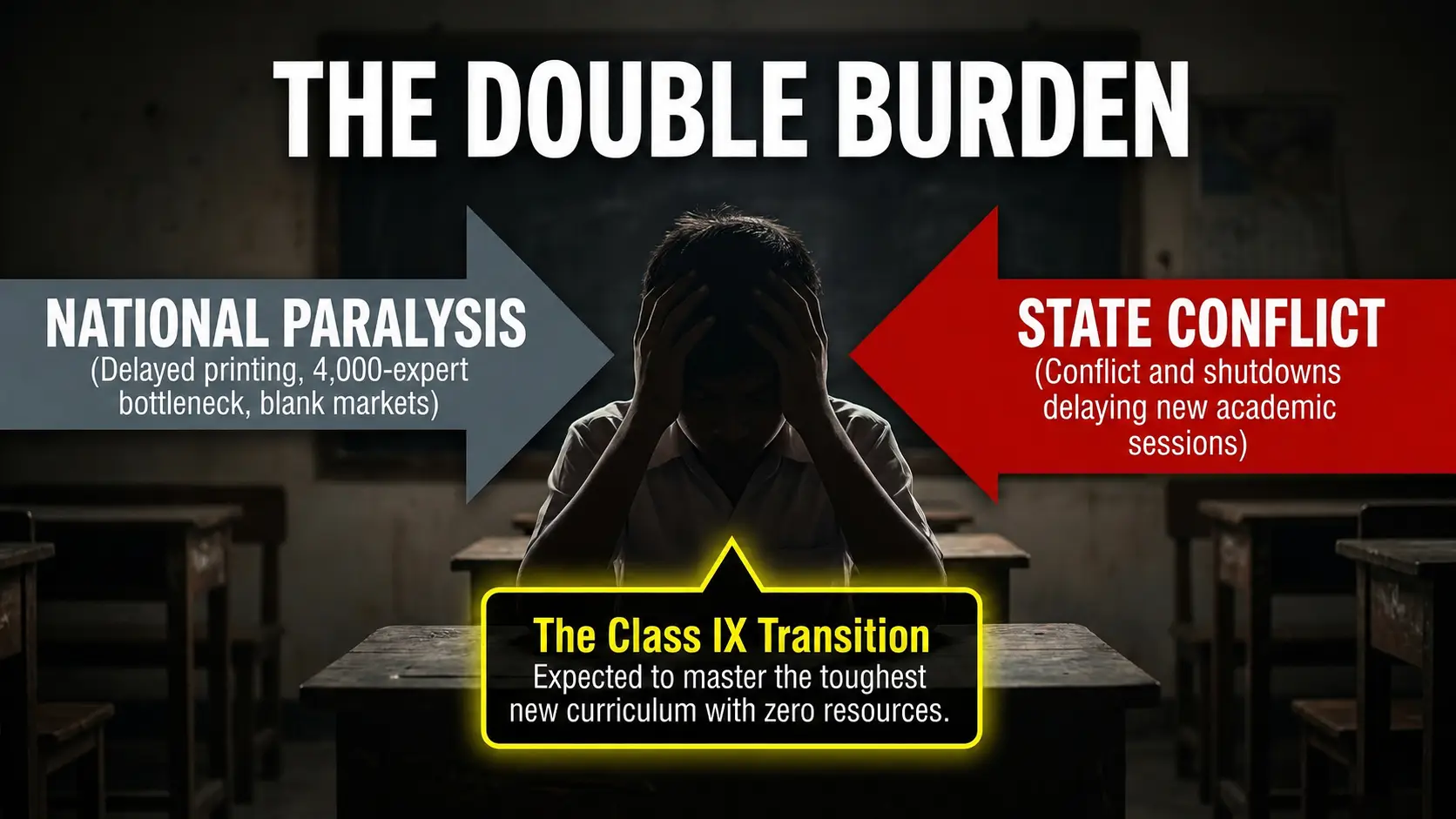
The educational crisis in Manipur for the 2026–27 academic session is a symptom of a larger national failure in textbook procurement, exacerbated by an acute regional tragedy. The rollout of the NCF-SE 2023 for Grade IX, while pedagogically sound, was undermined by a lack of logistical preparedness and a "pervasive paralysis" caused by 4,000-expert-long review cycles and legal fears. For the students of Manipur, this has meant a "double burden": they are the first to face a rigorous new curriculum without the necessary books, and they are doing so while navigating a landscape of ethnic violence and displacement.
The transition to digital learning, while helpful for some, remains a partial solution that risks leaving behind those in the digital desert of rural Manipur and its relief camps. The financial exploitation of parents by private publishers further deepens the inequality in the system, forcing families to choose between financial stability and their children's education.
Addressing this crisis requires more than just the delivery of books; it requires a coordinated effort to restore the "human dignity and security" of students. This includes stabilizing the physical environment of schools, regulating the textbook market to prevent profiteering, and providing targeted financial and psychosocial support to displaced students. Only through such a holistic intervention can the promise of the NEP 2020—an equitable and high-quality education for all—be realized for the youth of Manipur.
---
1. national council of educational research and training sri ... - NCERT, https://ncert.nic.in/pdf/announcement/notices/Advisory_ncertbooks.pdf
2. New NCERT textbooks to roll out in phases, schools prepare for shift under NEP, https://timesofindia.indiatimes.com/education/news/ncert-fixes-rollout-timeline-for-new-textbooks-schools-face-pressure-to-deliver-nep-shift-in-classrooms/articleshow/129714581.cms
3. No books for Class IX students as new CBSE academic session ..., https://education.economictimes.indiatimes.com/news/school-education/no-books-for-class-ix-students-as-new-cbse-academic-session-kicks-off-nationwide/129981792
4. Manipur CM flags education crisis amid ongoing unrest - Education News, https://educationpost.in/news/education/manipur-cm-flags-education-crisis-amid-ongoing-unrest
5. New Class 9 textbooks aligned with NEP to roll out by April 15 ..., https://www.hindustantimes.com/india-news/new-class-9-textbooks-aligned-with-nep-to-roll-out-by-april-15-ncert-director-101775139666051.html
6. Manipur Lockdown Continues: Markets Shut, Commercial Vehicles Defunct, Schools And Colleges Closed - YouTube, https://www.youtube.com/watch?v=RaYkIafaOg4
7. Syllabus - NCERT, https://ncert.nic.in/pdf/announcement/Syllabus_Secondary_Stage_Phase_I_Grade_9_Part_2.pdf
8. Syllabus - NCERT, https://ncert.nic.in/pdf/announcement/Syllabus_Secondary_Stage_Phase_I_Part%203_Grade_9-DRAFT.pdf
9. Syllabus - NCERT, https://ncert.nic.in/pdf/announcement/Syllabus_Secondary_Stage_Phase_I_Grade_9_Part_1_Languages.pdf
10. NCERT makes Class 9 textbooks available online amid shortage in markets, https://timesofindia.indiatimes.com/education/news/ncert-makes-class-9-textbooks-available-online-amid-shortage-in-markets/articleshow/130527026.cms
11. NCERT Class 9 Books 2026 Available Online Amid Shortage of Printed Textbooks - Edinbox, https://edinbox.com/index.php/news/top-news/8373-ncert-class-9-books-2026-available-online-amid-shortage-of-printed-textbooks
12. Manipur unrest paralyses education; schools shut, exams missed; CM appeals for peace, https://nenow.in/north-east-news/manipur/manipur-unrest-paralyses-education-schools-shut-exams-missed-cm-appeals-for-peace.html
13. Early education goes out of budget - The New Indian Express, https://www.newindianexpress.com/states/delhi/2026/Mar/31/early-education-goes-out-of-budget
14. DIKSHA - for School Education - Apps on Google Play, https://play.google.com/store/apps/details?id=in.gov.diksha.app
15. ePathshala - Apps on Google Play, https://play.google.com/store/apps/details?id=in.gov.epathshala
16. DIKSHA - PM e-Vidya, https://pmevidya.education.gov.in/diksha.html
17. DIKSHA AND ENERGIZED TEXTBOOKS FOR ELEMENTARY AND SECONDARY LEVEL, https://scert.assam.gov.in/latest/diksha-and-energized-textbooks-for-elementary-and-secondary-level