Researchers have introduced MemForest, a new AI memory system designed to improve long-term memory, temporal reasoning, and update efficiency in large language model agents.
Imphal, May 27: As artificial intelligence systems move beyond single prompts and short conversations into long-term autonomous interactions, one of the biggest technical challenges facing researchers is memory itself — not storage capacity alone, but how AI systems remember, update, organize, and retrieve information over time.
A newly released research project called MemForest proposes a different answer to that challenge. Developed by researchers from the National University of Singapore and Zero Gravity Labs, the system introduces a hierarchical temporal memory architecture aimed at making AI agents faster, more scalable, and more reliable in long-term interactions.
The research paper, titled “MemForest: An Efficient Agent Memory System with Hierarchical Temporal Indexing,” argues that current AI memory systems suffer from a structural bottleneck: as conversations and experiences accumulate, maintaining memory becomes increasingly slow and computationally expensive.
Most present-day AI assistants operate using variations of retrieval-augmented generation systems, vector databases, summaries, or compressed memory profiles. While these approaches help language models retain some context, the paper says many systems still depend heavily on repeated large-language-model processing whenever new information is added. This creates what the researchers describe as “write-heavy” latency problems, where updating memory becomes slower as memory grows.
The MemForest project attempts to solve this by rethinking memory management as a temporal data management problem rather than simply a retrieval problem.
At the core of the system is a structure called “MemTree,” a hierarchical temporal index that organizes memories as time-ordered trees instead of flat lists or continuously rewritten summaries.
The architecture divides memory into localized scopes such as sessions, entities, or scenes. Instead of rewriting an entire user profile or conversation summary whenever new information arrives, MemForest updates only the affected branches of the memory tree. According to the researchers, this sharply reduces maintenance overhead while preserving historical states and transitions.
The paper uses a simple example to explain the problem. If an AI assistant learns that a user first lived in Boston, later moved to Davis, and then relocated to Miami, conventional systems may struggle to correctly answer a query such as “Where did the user live before moving to Miami?” because semantic similarity retrieval may incorrectly prioritize either the oldest or newest location. MemForest instead preserves explicit temporal relationships between states.
Another major feature of the architecture is parallel chunk extraction. Traditional memory systems often process conversations sequentially, forcing the language model to repeatedly reread and reconcile existing memory. MemForest breaks this into smaller independently processed chunks that can run concurrently before being consolidated into “canonical facts.”
The researchers say this approach significantly improves memory construction speed.
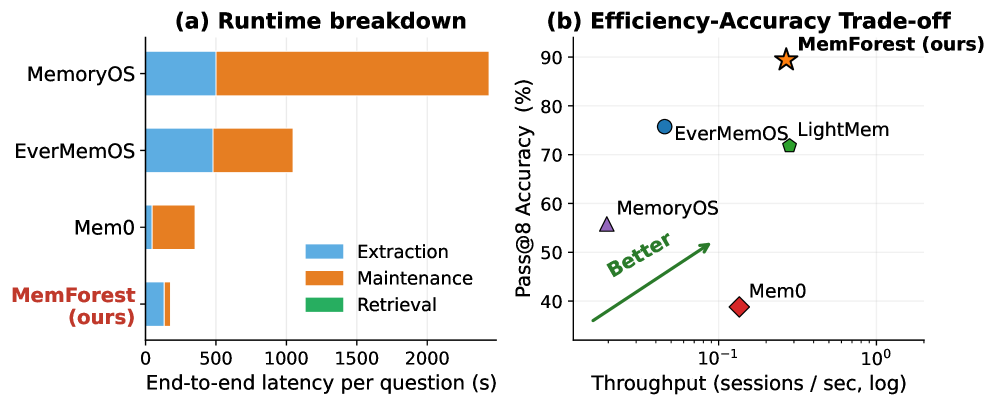
In benchmark testing on LongMemEval-S, a benchmark designed to evaluate long-term conversational memory, MemForest achieved a pass@1 accuracy score of 79.8% while maintaining memory construction throughput approximately six times higher than EverMemOS, one of the strongest competing systems evaluated in the study.
The paper reports that the system reduced write-path latency dramatically compared to several existing memory frameworks. In one comparison, MemForest completed memory construction tasks in 178 seconds versus more than 2,400 seconds for MemoryOS under similar evaluation conditions.
The architecture also showed strong performance in temporal reasoning and multi-session memory tasks. Researchers noted that while some competing systems performed better in certain adversarial or multi-hop reasoning categories, MemForest remained consistently balanced across most benchmarks.
The broader significance of projects like MemForest extends beyond benchmark scores.
AI companies are increasingly building systems expected to function as persistent assistants capable of maintaining relationships, preferences, projects, and long-running workflows over months or years. That creates pressure for AI memory systems that can scale without continuously increasing inference costs.
The MemForest paper positions memory as an infrastructure problem similar to database indexing or operating system design rather than merely an extension of prompting techniques. The researchers explicitly compare parts of their architecture to write-optimized database structures such as Log-Structured Merge Trees (LSM-trees), widely used in modern distributed databases.
The work also reflects a broader shift occurring in AI research during 2025 and 2026. Recent systems such as Mem0, EverMemOS, LightMem, HiMem, MemoryOS, and MemGPT have all explored different approaches to persistent AI memory, hierarchical reasoning, and temporal retrieval. MemForest enters that growing field with a strong focus on write efficiency and localized updates.
The researchers conclude that future long-context AI systems may depend less on ever-expanding context windows and more on intelligently structured memory architectures capable of preserving historical continuity while remaining computationally efficient.
The project’s research paper has been published on Hugging Face, while the implementation code has been released through the official GitHub repository.