MoPR holds regional workshop in Guwahati on Panchayat-led digital governance and rural service delivery with participation from seven states.
Guwahati, May 29: The Ministry of Panchayati Raj (MoPR) on Friday organised a regional workshop titled “Seva Se Samriddhi: Panchayat-led Service Delivery” in Guwahati, bringing together Panchayat representatives, Village Level Entrepreneurs (VLEs), policymakers and officials from seven states to discuss strengthening grassroots governance and improving rural public service delivery.
The workshop was organised by the Ministry of Panchayati Raj in collaboration with the Common Services Centre Special Purpose Vehicle (CSC-SPV) and the Department of Panchayat and Rural Development, Government of Assam.
The programme forms part of a broader initiative of the Ministry aimed at improving service delivery systems and enhancing ease of living in rural India through empowered and accountable Panchayati Raj Institutions (PRIs) and rural local bodies. Participants included elected Panchayat representatives, government officials and Village Level Entrepreneurs from Assam, Andhra Pradesh, Madhya Pradesh, Odisha, Punjab, Rajasthan and Telangana. The workshop was chaired by Prof. S. P. Singh Baghel, Union Minister of State for Panchayati Raj.
Addressing the gathering, Prof. Baghel said India’s path towards prosperity and self-reliance depends significantly on the development of villages, farmers and rural livelihoods. He emphasised that empowering individuals at the grassroots level forms the foundation for stronger villages, states and ultimately a developed nation.
The Minister highlighted the role played by Common Services Centres (CSCs) in generating employment opportunities in rural areas while ensuring easier access to public services for citizens. He said CSCs have enabled crores of people to avail essential services such as pensions, certificates, insurance schemes and welfare benefits without travelling long distances.
Prof. Baghel also stressed the importance of maintaining accurate Aadhaar, bank and land records, noting that discrepancies in documentation often prevent eligible beneficiaries from accessing schemes such as PM-Kisan. He called for enhanced training and capacity building of CSC operators and stated that integration between CSCs and Gram Panchayats can transform rural governance and improve last-mile service delivery.
According to him, stronger convergence between digital platforms and local governance institutions would help ensure that welfare benefits reach eligible citizens efficiently and transparently.
On the occasion, Assam Minister for Transformation and Development, Labour Welfare, and Tea Tribes and Adivasi Welfare Rameswar Teli highlighted the collaborative efforts between the Centre and the Assam government in strengthening Panchayati Raj institutions and public service delivery mechanisms. He said the welfare of Tea Tribe and Adivasi communities remains a major priority of the Assam government and pointed to initiatives related to livelihoods, education, healthcare and social security.
Rameswar Teli stressed the importance of empowered local governance in implementing welfare schemes effectively and expressed confidence that stronger coordination among departments would accelerate development in the state.
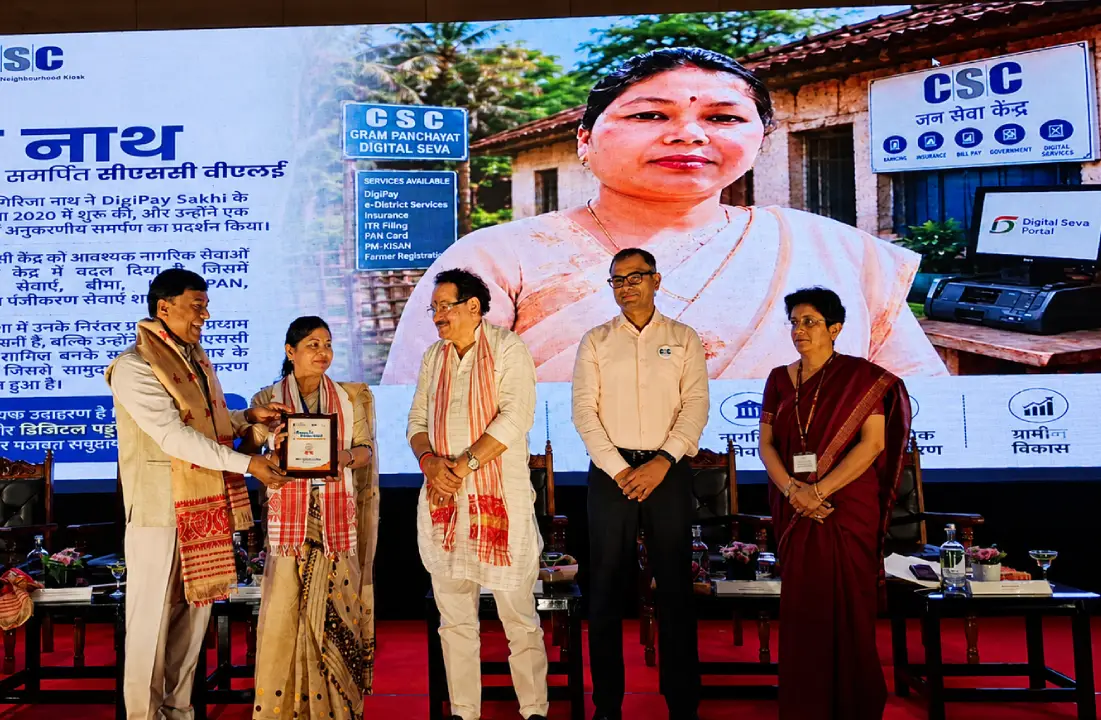
The workshop also felicitated outstanding Gram Panchayats and Village Level Entrepreneurs from participating states for innovation and contribution to digital service delivery.
Suakati Gram Panchayat of Kendujhar district in Odisha, which won the Jury Award at the National e-Governance Awards 2025 for pioneering digital service delivery, was recognised during the event. The Panchayat was commended for digitising essential citizen services through OdishaOne and Seva Odisha platforms and ensuring round-the-clock access to services with real-time tracking systems.
Shivareddygudem Gram Panchayat from Telangana’s Yadadri Bhuvanagiri district was also felicitated as one of the top-performing Gram Panchayats recognised at the National e-Governance Awards 2025. The Panchayat was acknowledged as a model for transparent and technology-driven grassroots governance.
Village Level Entrepreneurs honoured during the workshop included Girija Nath from Assam, Sumitra Das from Odisha, Amandeep Singh from Punjab and Surta Devi Saini from Rajasthan for their contribution to digital service delivery in rural areas.
Mukta Shekhar, Joint Secretary, Ministry of Panchayati Raj, said the convergence of Gram Panchayats and CSCs has emerged as a significant driver of rural transformation by combining digital access with local governance structures. She stated that digital governance is not only about technology but also about ensuring dignity, inclusion and accessibility for rural citizens. She also informed participants that a dedicated category for Gram Panchayat Service Delivery Innovations has now been introduced under the National e-Governance Awards.
Dr. Ballepu Kalyan Chakravarthy, Additional Chief Secretary of Panchayat and Rural Development, Government of Assam, reiterated the state’s commitment towards inclusive and digital governance. He emphasised the importance of capacity building, devolution of powers and effective use of digital platforms in strengthening Panchayati Raj systems.
Akhil Kumar, Managing Director and CEO of CSC-SPV, said CSC has evolved into one of the world’s largest last-mile service delivery networks. He noted that the initiative has empowered lakhs of Village Level Entrepreneurs, including a significant number of women entrepreneurs, while expanding digital access in rural areas.
The workshop also featured technical sessions and panel discussions on Panchayat-led governance and digital service delivery models across states.
Representatives from service delivery platforms including Rajasthan’s e-Mitra, Punjab’s e-Sewa, Madhya Pradesh’s Lok Seva Guarantee Portal, Andhra Pradesh’s Panchayat Secretariat, Telangana’s Mee Seva and OdishaOne participated in discussions on governance innovation and public service accessibility.
Technical sessions were delivered by experts from IIT Guwahati and BHASHINI, focusing on technology-enabled governance and multilingual digital infrastructure for inclusive service delivery.