NHAI has identified 17 highway stretches across nine states for monetization in FY 2026–27 under TOT and InvIT models to raise infrastructure funding.
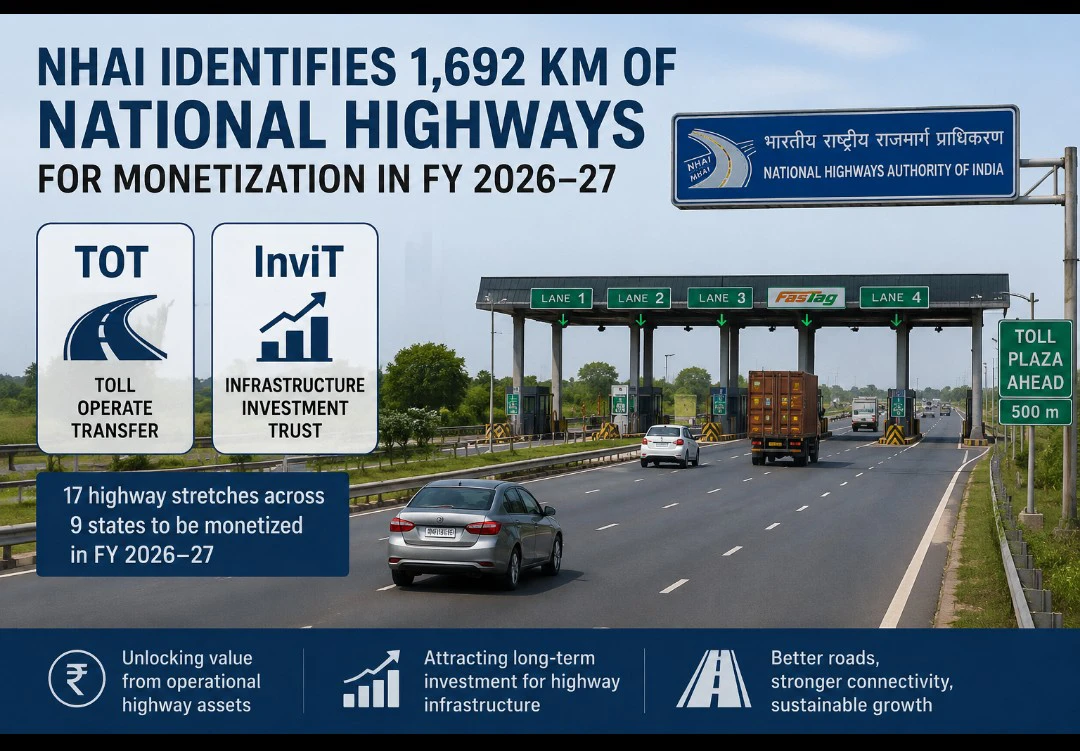
New Delhi, May 28: The National Highways Authority of India (NHAI) has finalized a tentative list of 17 National Highway stretches covering a combined length of 1,692.5 km for monetization during the financial year 2026–27 under the Toll-Operate-Transfer (TOT) and Infrastructure Investment Trust (InvIT) models.
The move is part of the Centre’s broader asset monetization strategy aimed at generating capital from operational highway assets to finance new infrastructure projects and expand the national highway network.
According to the Ministry of Road Transport and Highways, the identified stretches are spread across Haryana, Jharkhand, Karnataka, Rajasthan, Tamil Nadu, Telangana, Uttar Pradesh, Bihar, and Maharashtra. The selected corridors are considered economically important due to their traffic volume, logistics significance, and regional connectivity.
The tentative list has been published on the NHAI website and includes major highway sections such as the Delhi-Haryana border to Rohtak stretch on NH-9, parts of NH-34 in Uttar Pradesh, NH-38 in Tamil Nadu, NH-163 in Telangana, and several strategic routes in Jharkhand and Karnataka.
Under the TOT model, private entities pay an upfront concession fee to operate and maintain highway stretches for a fixed concession period while collecting toll revenue. In the InvIT model, revenue-generating road assets are pooled into a trust structure to attract institutional investors.
NHAI said the monetization exercise would be conducted through “transparent and structured mechanisms” and is intended to attract long-term institutional investment into the highway sector. The authority also stated that the exercise would support “efficient asset management and operational excellence.”
The official document noted that the current list only includes assets earmarked for monetization through TOT and InvIT frameworks and does not include projects proposed under the Raajmarg Infra Investment Trust (RIIT) for FY 2026–27.
Among the larger stretches identified is the Aligarh-Kanpur section of NH-34 in Uttar Pradesh spanning about 283.8 km. Other significant corridors include the Bellary-Byrapura-Hiriyur section in Karnataka covering 147.4 km and the Hubli-Hospet section of NH-63 extending 143.2 km.
Officials said the monetization strategy is intended to recycle public capital. Instead of waiting for fresh budget allocations, revenue generated from operational highways can be redirected into the construction of new roads, expressways, and logistics corridors.
The Centre has increasingly relied on asset monetization in recent years to sustain large-scale infrastructure expansion without sharply increasing fiscal pressure. Highway monetization has emerged as one of the government’s major non-tax resource mobilization mechanisms.
Potential Impact on Common People
For ordinary road users, the impact of highway monetization is likely to be mixed.
On one hand, commuters and transport operators may benefit from improved highway maintenance, faster emergency response systems, cleaner toll infrastructure, and better operational efficiency if private operators invest consistently in upkeep. Freight movement could also become smoother on key logistics corridors, potentially reducing transport delays and fuel wastage.
However, concerns over rising toll costs are likely to remain significant for daily commuters, small transport operators, and local businesses dependent on road connectivity. Since private concessionaires recover investments primarily through toll collection, users may experience periodic toll revisions over the concession period.
In several states, local residents living near toll plazas have previously raised concerns about repeated toll payments even for short-distance travel. Small traders, farmers transporting produce, and passenger vehicle operators could face additional financial pressure if toll charges increase over time.
There are also broader questions about the balance between public infrastructure ownership and long-term private operational control. Critics of monetization argue that highways developed using taxpayer money should remain fully under public administration, while supporters contend that private participation allows the government to rapidly expand infrastructure without slowing investment.
For the logistics sector, however, improved road quality and reduced travel time may help lower operational inefficiencies. This could indirectly benefit consumers if transportation costs stabilize for essential goods and commercial supply chains.
The success of the monetization programme will likely depend on whether service quality improves proportionately for highway users while keeping toll-related burdens manageable for the public.
Selected Highway Projects in the Monetization List
Delhi/Haryana Border to Rohtak section of NH-9 — Haryana
Hissar to Dabwali section of NH-9 — Haryana
Ranchi to Mahulia corridor — Jharkhand
Bellary-Byrapura-Hiriyur section — Karnataka
Hubli-Hospet section of NH-63 — Karnataka
Deoli to Kota stretch of NH-52 — Rajasthan
Trichy to Thuvarankurichi-Madurai section of NH-38 — Tamil Nadu
Yadgiri-Warangal section of NH-163 — Telangana
Aligarh to Kanpur section of NH-34 — Uttar Pradesh
Aunta-Simaria-Khagaria section of NH-31 — Bihar
Aurangabad to Karodi section of NH-52 — Maharashtra