Women scientists at NIT Rourkela have developed a patented low-cost dairy wastewater treatment system using natural filtration and hydroponic technology.
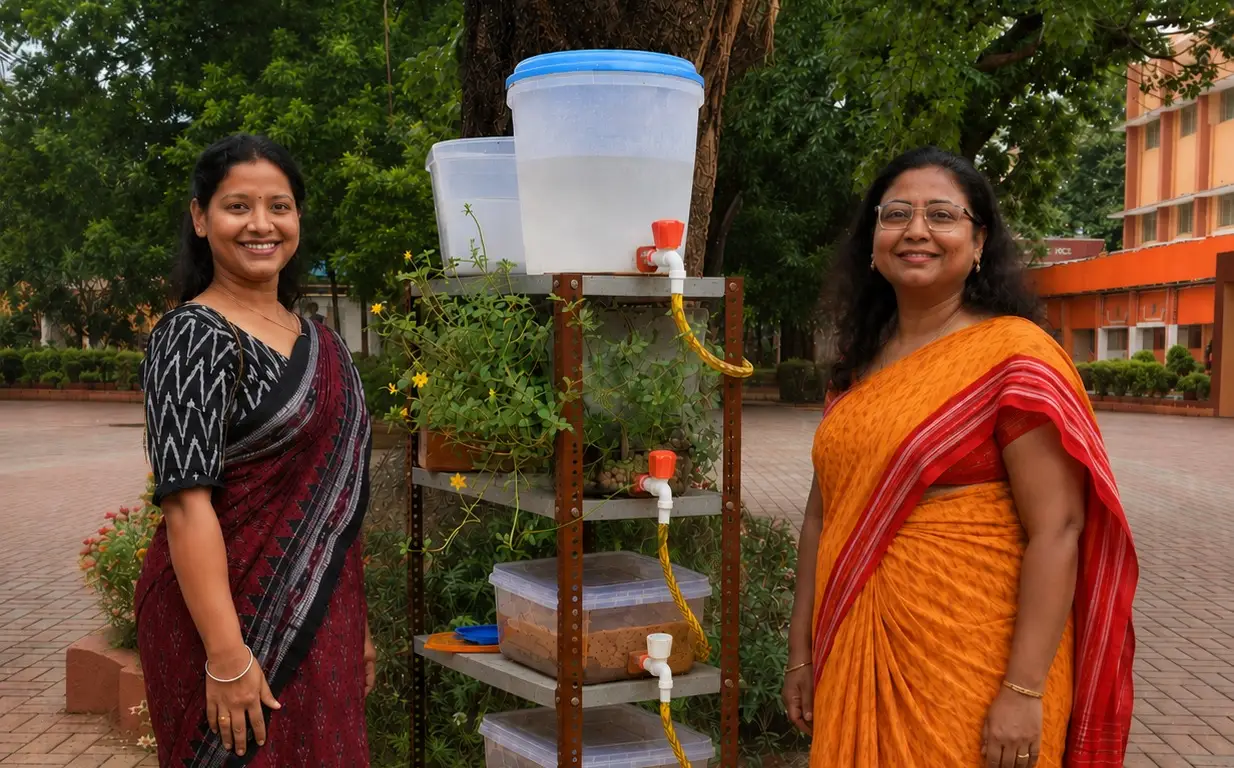
Rourkela, May 22: Researchers from National Institute of Technology Rourkela have developed a low-cost biological wastewater treatment system aimed at addressing pollution caused by dairy industry effluents. The system, developed by women scientists from the institute’s Civil Engineering department, combines natural treatment processes with hydroponic filtration to make dairy wastewater suitable for agricultural reuse.
The research team, led by Kakoli Karar Paul and research graduate Pragyan Das, has secured a patent for the innovation titled Method and System for Treating Dairy Wastewater (Patent number: 583949; Application number: 202431032506).
According to the institute, the Indian dairy sector generates billions of litres of wastewater daily during the production of products such as cheese, paneer, and yogurt. This wastewater contains high levels of fats, proteins, carbohydrates, and Chemical Oxygen Demand (COD), which can severely reduce dissolved oxygen levels in water bodies and harm aquatic ecosystems if discharged untreated.
The researchers said conventional wastewater treatment systems, including membrane filtration methods, often face clogging issues and are expensive to maintain. The newly developed system aims to offer a more sustainable and affordable alternative.
Speaking about the project, Prof. Kakoli Karar Paul said the laboratory-scale setup costs around Rs. 10,000 and can treat nearly 30 litres of dairy wastewater per day. She added that the capacity can be scaled up depending on requirements.
The treatment system uses a five-layer integrated process, where each stage performs a specific purification function.
In the first layer, wastewater enters a worm-active reactor containing earthworms and aquatic plants. The earthworms help break down organic waste into smaller particles and improve oxygen circulation in the water. This supports microbial growth, which further decomposes pollutants. The aquatic plants also provide root surfaces for beneficial microbes while helping prevent blockages.
The second layer consists of sand filtration, which removes suspended solids physically from the wastewater. In the third stage, fly ash pellets are used to adsorb pollutants and reduce phosphorus compounds present in the water. The fourth layer contains gravel beds where aerobic microbes remove remaining organic contaminants.
In the final stage, the partially treated water enters a hydroponic chamber where plant roots remain submerged in water. The roots release oxygen into the surrounding environment, creating conditions that support microbial biofilms capable of further breaking down pollutants and improving water quality.
Dr. Pragyan Das said the system was designed to provide an affordable wastewater treatment solution, especially for regions lacking access to large-scale treatment infrastructure. He stated that the treated water can be reused directly for agricultural purposes, helping reduce environmental pollution while promoting resource-efficient waste management practices.
Laboratory tests conducted using actual dairy wastewater showed that the treated water retained useful phosphate nutrients and was suitable for irrigation purposes, according to the research team. The researchers also noted that the aquatic plants used in the treatment process can later be repurposed as cattle feed or processed for biogas and biodiesel production, creating additional resource recovery opportunities.
The team now plans to improve treatment speed and optimise reactor design for larger-scale deployment. Researchers are also seeking industry collaboration to help move the technology from laboratory testing to practical implementation.
According to the institute, while existing wastewater treatment approaches have separately used vermi-filtration, macrophyte-assisted treatment, and hydroponic purification, the integrated use of these methods in a single sustainable system has helped improve pollutant removal efficiency while addressing clogging issues commonly seen in dairy wastewater treatment systems.