An in-depth look at how rote learning limits critical thinking, creativity, and long-term understanding, and why modern education must move beyond memorization-based learning.
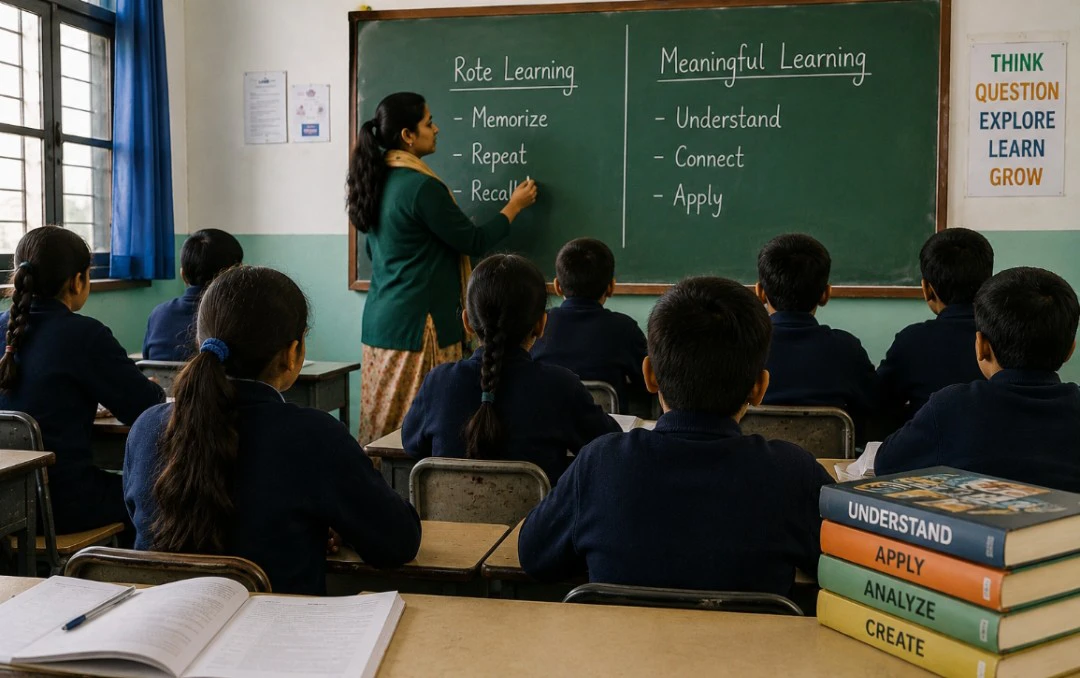
For generations, academic success was measured largely through one visible ability — memorization. A “good student” was often someone capable of reproducing textbook answers with precision during examinations. In many classrooms, repetition became synonymous with learning, while silence and obedience were interpreted as discipline and intelligence.
That culture still survives in many educational systems today.
Across examination-driven environments, including states like Manipur, rote learning continues because it appears effective on the surface. Students score marks, schools showcase results, and tuition centres market ranks and percentages. Yet beneath those visible achievements, a quieter problem often develops: many students struggle to think independently once memorized patterns disappear.
The issue is not that memorization itself is harmful. Human learning depends on memory. Foundational knowledge — multiplication tables, vocabulary, formulas, historical facts — must often be repeated until they become familiar. The real problem begins when memorization replaces understanding instead of supporting it.
A student may remember an answer perfectly and still fail to explain the underlying idea in simple language. Another may solve familiar mathematical problems quickly yet become confused when the structure of a question changes slightly. Such situations are increasingly common because many learners are trained to recognize patterns rather than reason through concepts.
Educational psychologist Daniel Willingham has repeatedly argued that knowledge and thinking are deeply connected. Facts matter, but meaningful learning happens when students can connect ideas, interpret them, and apply them in unfamiliar situations. This distinction has become far more important in the modern world, where information is available instantly through digital devices.
Today, society rewards adaptability more than repetition.
In earlier decades, access to information itself carried value. Now, almost any factual detail can be retrieved within seconds through a smartphone. What increasingly matters is the ability to analyze information, distinguish reliable sources from misleading ones, solve problems creatively, and continue learning throughout life.
Education systems built heavily around memorization often struggle to prepare students for such realities.
The effects become visible across subjects. In language learning, students may memorize grammar rules word-for-word but fail to apply them naturally in unfamiliar sentences. In science, students may remember definitions while lacking practical understanding of why phenomena occur. In mathematics, formulas may be memorized without clarity about when or why they should be used.
Ironically, excessive rote learning can weaken long-term retention itself.
Cognitive science research suggests that the brain remembers information more effectively when learners engage actively with meaning. Passive repetition creates familiarity, but familiarity is not always understanding. Many students mistakenly believe they have mastered a topic simply because it feels recognizable after repeated reading.
This illusion often collapses during higher education or competitive examinations where analytical thinking becomes necessary. Students who relied primarily on memorization frequently struggle when asked to interpret unfamiliar questions, conduct independent research, or solve practical problems without rehearsed patterns.
The emotional consequences are equally significant.
Rote-heavy learning environments often produce fear-based educational cultures. Mistakes become sources of embarrassment instead of opportunities for improvement. Curiosity gradually declines because questioning can slow classroom pace or move beyond examination expectations. Learning turns transactional: study for marks, reproduce answers, forget after examinations, and repeat the cycle again.
Psychologist Carol Dweck, known for her research on growth mindset, has emphasized that students develop resilience when effort, experimentation, and gradual improvement are valued more than merely appearing intelligent. Learners who see education as a process rather than a performance often become more adaptable in the long run.
Yet many classrooms unintentionally reward the opposite behavior.
Students quickly understand that asking questions may appear risky, while memorizing expected answers brings immediate rewards. Over time, intellectual risk-taking decreases. Learners begin avoiding uncertainty rather than exploring it.
One practical way to challenge this pattern is surprisingly simple: encouraging students to generate their own questions.
When learners are asked to frame questions independently instead of merely answering textbook exercises, their relationship with learning changes. They begin paying closer attention to concepts, connections, and gaps in understanding. Question formation itself becomes a cognitive exercise. Students stop searching only for “correct answers” and start exploring why ideas work the way they do.
This shift from passive reception to active engagement may become one of the most important educational transitions of the coming decades.
At the same time, rejecting memorization entirely would be unrealistic and even counterproductive. Foundational knowledge still matters deeply. Cognitive researchers acknowledge that higher-level thinking depends upon a certain degree of automatic recall because human working memory has limits. A student cannot analyze advanced problems effectively if basic concepts remain completely unfamiliar.
The goal, therefore, is balance rather than elimination.
Students need opportunities to move beyond memorization into interpretation, experimentation, discussion, and application. A science lesson should not end with recalling definitions alone. Learners should predict outcomes, compare situations, and explain observations. Language education should include expression, debate, interpretation, and creative communication rather than only reproducing prepared paragraphs.
Teachers, however, often work within difficult structural realities. Large classrooms, examination pressure, administrative responsibilities, and syllabus deadlines frequently make rote-oriented teaching appear practical. Many educators themselves were products of memorization-heavy systems. Transforming educational culture requires institutional support, patience, and training rather than simplistic blame directed at teachers.
In households where educational success feels closely tied to economic security, marks naturally carry emotional weight. Comparisons between children become common, and tuition culture often reinforces the belief that more repetition automatically produces better learning. But an uncomfortable question remains necessary: Is the child genuinely understanding concepts, or merely performing academically for short-term results?
Sometimes the signs are subtle. A student unable to explain lessons in simple language may not fully understand them. A learner who becomes helpless when questions change format may depend too heavily on memorization patterns.
Fortunately, meaningful improvements do not always require expensive reforms or advanced infrastructure.
Students can adopt more active learning habits by explaining concepts aloud in their own words, teaching peers, solving unfamiliar problems, creating mind maps, and repeatedly asking “why” and “how” questions instead of only rereading notes.
Teachers can introduce discussion-based learning, reflective writing, peer evaluation, and small project-based assignments even within traditional examination systems. Incremental changes often create long-term impact.
Technology may also support this transition if used thoughtfully. Interactive simulations, educational videos, coding platforms, and AI-assisted learning tools can encourage exploration beyond passive repetition. But technology alone cannot solve weak learning cultures. A student can memorize digital content just as mechanically as printed notes. At its core, the debate surrounding rote learning is philosophical.
If the objective is merely temporary information storage for examinations, memorization alone may appear sufficient. But if education aims to prepare individuals for uncertain futures, changing careers, complex social realities, and lifelong learning, then understanding becomes indispensable.
The future is unlikely to reward those who can only reproduce familiar answers. It will increasingly favor people capable of connecting ideas, adapting to unfamiliar situations, asking intelligent questions, and learning continuously. Memorization may help students pass examinations. Understanding helps them navigate life. And education, if it truly deserves that name, must prepare learners for far more than the next test.
(Keithellakpam Manikanta Meetei is a seasoned journalist and a former educator. He also writes under his pen name Keicha Chingthou Mangang instead of his actual name. You can contact him at chingthouheiya@gmail.com)