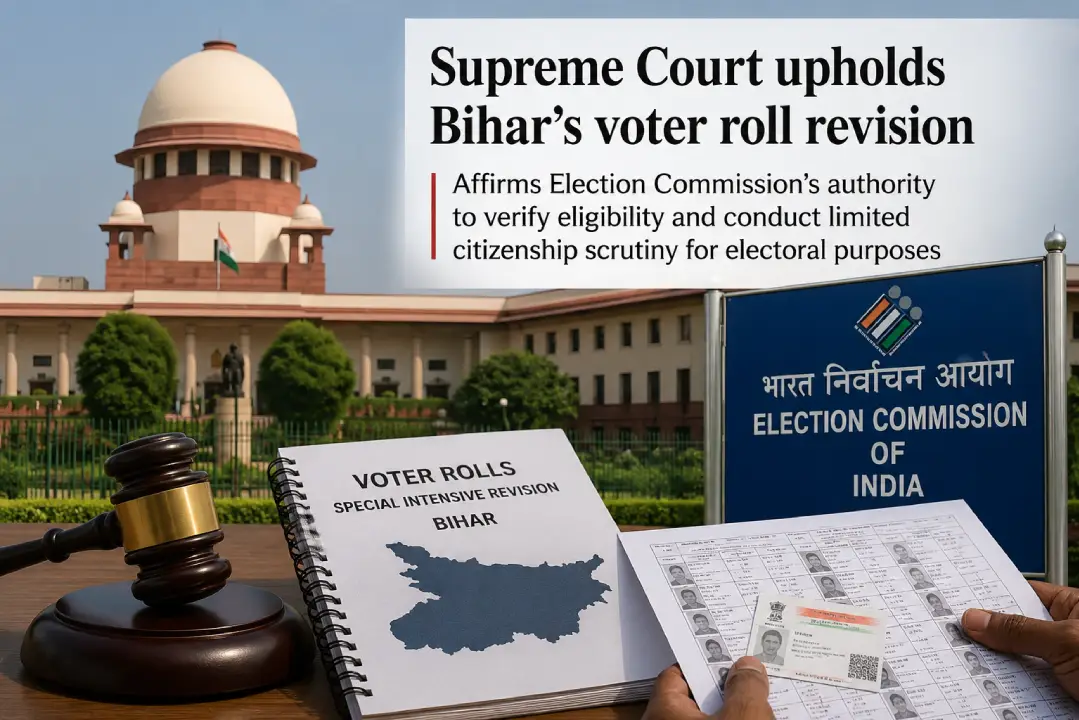
The Supreme Court upheld Bihar’s Special Intensive Revision of voter rolls, affirming the Election Commission’s authority to verify electoral eligibility and conduct limited citizenship scrutiny for electoral purposes.
New Delhi, May 27: The Supreme Court on Tuesday upheld the Election Commission of India’s (ECI) Special Intensive Revision (SIR) of electoral rolls in Bihar, ruling that the constitutional body has the authority to conduct large-scale voter verification exercises and scrutinise citizenship status for electoral purposes while maintaining the integrity of the democratic process.
The 124-page judgment, delivered by Chief Justice of India Surya Kant and Justice Joymalya Bagchi, dismissed a batch of petitions challenging the ECI’s June 24, 2025 order that initiated a statewide revision of Bihar’s electoral rolls before the Assembly elections held later that year.
The petitioners, including the Association for Democratic Reforms and several activists, politicians and civil society groups, had argued that the exercise was unconstitutional, arbitrary and likely to disenfranchise lakhs of voters. They claimed the Election Commission exceeded its powers and imposed burdensome documentation requirements on ordinary citizens.
Rejecting those arguments, the Supreme Court held that the revision exercise was legally valid, proportionate and aimed at ensuring “free and fair elections” through accurate electoral rolls.
The judgment is expected to have significant implications for future electoral roll revisions across India, especially in states where concerns have repeatedly been raised over duplicate entries, migration-related discrepancies and alleged inclusion of ineligible voters.
Court examines ECI’s constitutional authority
A major issue before the court was whether the Election Commission could invoke Article 324 of the Constitution to undertake such a large-scale exercise.
The petitioners argued that once Parliament had legislated through the Representation of the People Act, the Commission could not rely on its constitutional powers to create a parallel framework for voter verification. They contended that Article 324 only operated in areas not covered by statutory law.
The Supreme Court, however, disagreed with that interpretation. The bench held that Article 324 and parliamentary laws governing elections are complementary and not mutually exclusive. It observed that the Election Commission remains a constitutional authority with broad supervisory powers over elections and electoral rolls, provided its actions do not violate any express statutory prohibition.
The judgment referred to earlier Supreme Court rulings including Mohinder Singh Gill, Kanhiya Lal Omar and Association for Democratic Reforms, reiterating that the Commission possesses wide powers necessary to ensure free and fair elections.
“The Commission retains the absolute constitutional mandate to step into vacuous areas left unoccupied by legislation,” the court observed while discussing the scope of Article 324.
The bench also upheld the use of Section 21(3) of the Representation of the People Act, 1950, which empowers the Commission to direct a “special revision” of electoral rolls “in such manner as it may think fit.”
Petitioners had argued that the provision only permitted constituency-specific revisions and not a statewide exercise. The court rejected that claim and interpreted the word “any” in the provision to include “many” or “all” constituencies when the Commission records adequate reasons.
Why the Bihar revision was conducted
The Election Commission had argued that Bihar’s last Special Intensive Revision was conducted in 2003 and that the electoral rolls had since been updated only through summary revisions. According to the Commission, rapid urbanisation, migration, duplicate registrations and failure to remove names of deceased voters had gradually weakened the accuracy of the rolls.
The court accepted these concerns as legitimate and said the ECI was constitutionally obligated to maintain clean and accurate electoral rolls. The judgment noted that the Commission had specifically referred to large-scale migration, repeated entries and the need to ensure that only Indian citizens remained on the voter list.
Under the June 2025 order, voters whose names appeared in the 2003 electoral rolls were treated as presumptively eligible unless contrary material emerged. Those not listed in the 2003 rolls were required to submit supporting documents from a prescribed list to establish eligibility.
The process involved house-to-house enumeration by Booth Level Officers (BLOs), pre-filled forms and document collection. Electors who failed to submit enumeration forms before July 25, 2025 were omitted from the draft rolls.
When the draft electoral rolls were published in August 2025, around 65 lakh names were excluded due to non-submission of forms.
The Supreme Court later directed the Commission to publicly release the names of excluded electors along with reasons for exclusion and allow them to submit claims using Aadhaar cards as supporting identity documents.
Aadhaar not proof of citizenship, says court
One of the most debated aspects of the case was the treatment of Aadhaar cards. The petitioners argued that excluding Aadhaar, EPIC voter cards and ration cards from the accepted documents list unfairly burdened ordinary voters, especially the poor and migrant workers.
The Election Commission countered that Aadhaar does not establish citizenship or domicile under the Aadhaar Act, while EPIC cards are themselves derived from electoral rolls and therefore cannot independently verify eligibility.
The Supreme Court agreed in part with both sides. The bench clarified that Aadhaar cannot be treated as proof of citizenship because the Aadhaar framework itself does not certify citizenship status. However, it held that Aadhaar may still be accepted as proof of identity during the electoral verification process.
Following earlier interim directions, the court ordered that Aadhaar be treated as an additional document for identity verification in the revision process.
At the same time, the judgment upheld the Commission’s power to decide which documents possess adequate evidentiary value for voter verification.
Presumption of existing voters not absolute
Another important issue was whether voters already enrolled in the electoral roll were entitled to a presumption of validity that could not be disturbed without strong evidence.
The petitioners relied on earlier Supreme Court rulings which held that inclusion in the electoral roll creates a presumption that legal requirements had been fulfilled.
The court acknowledged that such a presumption exists but clarified that it is rebuttable and cannot prevent the Commission from conducting a fresh verification exercise.
The bench distinguished between adjudicatory proceedings involving individual objections and a broader “systemic, inquisitorial exercise” aimed at ensuring the overall integrity of electoral rolls.
According to the judgment, electoral rolls are dynamic documents that require periodic revisions to reflect changes in residence, migration, deaths and eligibility.
Citizenship inquiry allowed for electoral purposes
The Supreme Court also examined whether the Election Commission could scrutinise citizenship status during electoral revisions. Petitioners argued that citizenship determination lies exclusively with authorities under the Citizenship Act and the Ministry of Home Affairs.
The bench, however, drew a distinction between a formal adjudication of citizenship and a limited inquiry conducted for electoral purposes.
The court held that since Section 16 of the Representation of the People Act disqualifies non-citizens from voter registration, the Commission necessarily has the power to examine whether a person satisfies that condition while preparing or revising electoral rolls.
At the same time, the judgment clarified that deletion from electoral rolls does not amount to cancellation of citizenship itself. Final adjudication on citizenship questions must still be made by the competent authority under the Citizenship Act.
The court directed that cases involving suspected non-citizens whose names were deleted from the 2003 rolls be referred to the competent authority within four weeks for formal adjudication.
It also said such authorities should preferably decide the cases before the next Parliamentary, Assembly or local body elections.
Court says safeguards were sufficient
The Supreme Court acknowledged concerns regarding possible exclusion of vulnerable groups including migrants, rural populations, elderly voters and economically weaker sections. However, it concluded that adequate procedural safeguards existed in the system.
The judgment pointed to repeated visits by BLOs, opportunities for claims and objections, notice before deletion, speaking orders by electoral officers, appellate remedies and legal aid support provided during the exercise.
The court also noted that political party booth agents and para-legal volunteers were directed to assist voters in submitting forms and claims.
Ultimately, the bench ruled that the Special Intensive Revision exercise met constitutional standards of proportionality and procedural fairness.
The Bihar Assembly elections conducted in November 2025 were held using the revised electoral rolls prepared through the SIR process.