Thadou Community International has issued a detailed 30-point statement rejecting narratives surrounding the killing of TBAI leaders in Manipur and seeking a wider NIA probe.
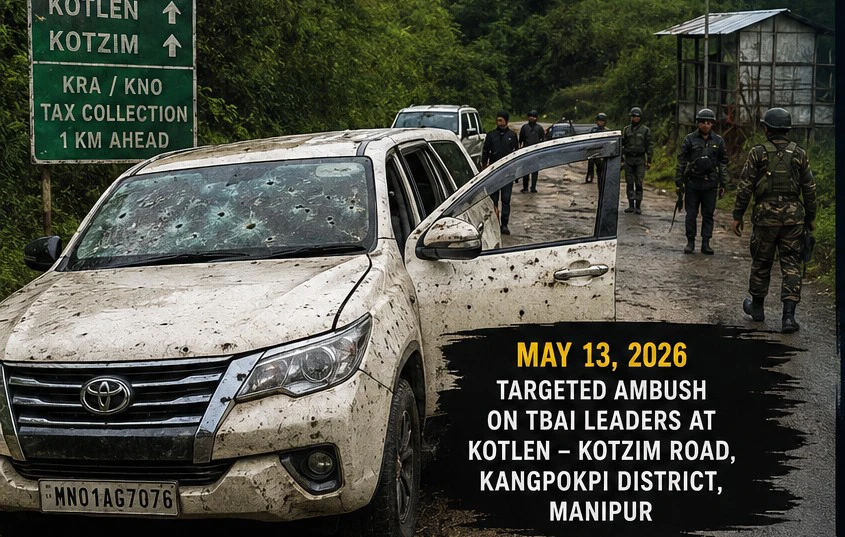
AI generated representative image
Imphal, May 29:
Thadou Community International (TCI) has issued a detailed 30-point media release rejecting what it described as “false narratives” surrounding the May 13 ambush on leaders of the Thadou Baptist Association India (TBAI), in which three church leaders were killed and five others injured.
In the statement issued on May 28, TCI accused “radicalised Kuki propagandist” Tony Singsit and certain Kuki organisations of spreading misinformation regarding the attack. The organisation said that the claims made in an interview with Aizawl-based media outlet ZONET distorted facts surrounding the killings of Rev. Dr. Vumthang Sitlhou, President of TBAI, Rev. Kaigoulun Lhouvum, Finance Secretary of TBAI, and Pastor Paogoulun Sitlhou.
TCI described the incident as a “targeted and coordinated attack” on prominent Thadou Christian leaders and demanded a comprehensive investigation by the National Investigation Agency (NIA).
According to the media release, the organisation traced the roots of present tensions between Thadou and Kuki groups to developments dating back several decades.
TCI referred to the 1971 rebranding of the Thadou Bible as the “Kuki Bible” by Rev. T. Lunkim of the Kuki Christian Church (KCC), claiming this marked the beginning of what it called a campaign to erase distinct Thadou identity. The statement said the Bible launch at Molvom in Nagaland took place amid legal disputes and controversy.
The organisation also referred to the 1992–93 Kuki–Thadou violence in Assam. It alleged that the Chin Kuki Resistance Force (CKRF), later renamed the Kuki Liberation Army (KLA), attacked Thadou communities in Karbi Anglong and Dima Hasao during disputes linked to replacement of the All India Radio Thadou programme with a Kuki programme.
TCI claimed that many Thadous became caught in later Kuki–Naga conflicts due to misidentification, lack of distinct leadership structures, and limited understanding between Thadou and Naga communities.
The release further stated that Thadou Inpi Manipur (TIM), successor to the Thadou National Council, has opposed what it called “Kuki ideological influence” since the 1950s. It accused some organisations using the Thadou name in Kangpokpi and Tuibong of functioning within “Kuki supremacist militant structures”.
TCI asserted that the TBAI remains institutionally separate from Kuki church bodies such as the Kuki Christian Church and Kuki Baptist Convention. It alleged that Thadou Christians have faced pressure from Kuki political, religious, social, and militant networks.
The statement highlighted the role of slain TBAI president Rev. Vumthang Sitlhou in promoting the Thadou language and Bible translation work. TCI said he continued the legacy of Pu Ngulhao Thomsong, who translated and published the Thadou New Testament in 1942.
TCI also referred to peace initiatives between Thadou and Meitei communities, including a meeting held in Imphal on August 6, 2025 involving TIM and civil society organisations. According to the statement, KNF leader Jangboi Kipgen allegedly opposed these initiatives and threatened Thadou leaders over their participation.
The media release alleged that Jangboi Kipgen, identified as Home Secretary of the KNF, exercised influence over both SoO and non-SoO Kuki militant networks operating in Kangpokpi and beyond.
TCI stated that the organisation itself was formed on August 3, 2024 by members of the Thadou community from India and several foreign countries including the United States, United Kingdom, Australia, Malaysia, Singapore, Macau, Norway, and Myanmar. It said the body was created in response to violence, intimidation, and alleged discrimination against Thadou people.
The organisation further said two of the injured pastors had attended the Thadou Convention held in Guwahati on November 1, 2024, where a declaration reaffirmed that “Thadou identity is not Kuki”. According to TCI, the Kuki National Front (KNF) later issued a statement threatening Thadou leaders, leading to registration of an FIR at Kangpokpi Police Station.
The release accused Jangboi Kipgen of promoting “Kuki supremacist ideology” and maintaining close links with Kuki Christian Church leadership.
TCI also noted that Rev. Vumthang had been working to strengthen ties among Thadou Christian fellowships across India and abroad through a proposed Congress initiative.
The organisation raised concerns over Kuki Worship Service (KWS) centres outside Manipur, alleging that some had become spaces for political mobilisation and radicalisation. It cited a viral video from a KWS congregation in Guwahati during observance of “Separation Day” on May 3, 2026.
The statement further said TBAI had petitioned the Bible Society of India to remove the term “Kuki” from the Thadou-Kuki Bible and rename it simply as “In Thadou”. TCI claimed the move was opposed by Kuki church organisations.
According to the release, slain pastor Paogoulen had recently circulated remarks criticising leaders over changing positions on “separate administration”. TCI also said Rev. Vumthang spoke publicly against illegal poppy cultivation, corruption, drug abuse, and violence.
The organisation claimed that shortly before the attack, Rev. Vumthang declined participation in a “Kuki flag” hoisting programme held on May 9 in Kangpokpi. It alleged his name had been used without consent as principal minister for the event.
TCI maintained that the May 13 ambush specifically targeted the two TBAI vehicles while other vehicles travelling ahead and behind them were left untouched. It said the victims were returning from the General Assembly of the United Baptist Convention in Churachandpur when they were attacked between Kotlen and Kotzim villages.
According to the release, the area is dominated by armed Kuki militant groups operating under the Suspension of Operations (SoO) arrangement, including the Kuki Revolutionary Army (KRA) under the Kuki National Organisation (KNO). The statement alleged that all vehicles travelling through the route were stopped and registered at a KRA/KNO checkpoint before the attack.
TCI questioned why there was no intervention or pursuit despite the presence of militant checkpoints and nearby security forces, including an Assam Rifles post.
The organisation described the killings as “premeditated” and claimed the attackers possessed prior knowledge of the convoy and identities of the victims. It said the attack represented not only an assault on individuals but also on the wider Thadou community.
The release further stated that the three deceased leaders “lived and died as Thadou”, alleging that they were targeted because of their roles as defenders of Thadou identity and Christian institutions.
TCI claimed Rev. Vumthang’s vehicle came under particularly heavy fire and alleged that attempts were later made by some Kuki groups to portray the deceased as “Kuki martyrs”. The organisation said they were instead buried as Thadou Christian martyrs at the TBAI Centre in Motbung.
The media release also linked the incident to the reported abduction of several Naga and Kuki civilians on the same day. TCI referred to allegations that six abducted Nagas were feared killed, while noting that Kuki organisations had denied involvement.
According to TCI, questions remain over the absence of “timely and effective action” by security forces following both the ambush and abduction incidents.
The organisation additionally referred to the August 30, 2025 killing of Thadou Literature Society Assam chairman Nehkam Jomhao in Karbi Anglong. TCI alleged that Kuki militant groups later admitted involvement in the killing.
TCI claimed that subsequent Kuki–Naga clashes shifted public attention away from the killings of the TBAI leaders.
In the release, the organisation listed several “probable motives” behind the attack, including suppression of Thadou identity, retaliation against Thadou Bible translation work, weakening independent Thadou Christian institutions, and attempts to force Thadous into broader Kuki–Naga conflicts.
The statement also said the ZUF (Kamson) and NSCN-IM, named by Tony Singsit and Kuki Inpi Manipur, had denied involvement in the killings. TCI alleged that militant groups operating in the area had not responded to allegations directed at them.
TCI strongly criticised Tony Singsit, accusing him of spreading disinformation and promoting “Kuki supremacist ideology”. It also noted that police complaints had reportedly been filed against him in Nagaland.
Reaffirming that the Thadou community possesses a distinct identity, language, and history predating the colonial-era “Kuki” label, TCI urged the public not to be misled by “politically motivated narratives”.
The organisation concluded by demanding that the NIA investigate all possible angles, including the role of militant groups operating in the area, affiliated organisations, and individuals claiming knowledge of the perpetrators.
TCI said all those involved in the killings, including masterminds and conspirators, must be identified and brought to justice without delay.