The BJP's 206-seat supermajority in West Bengal 2026 ended fifteen years of TMC dominance, driven by historic 92.9% turnout, anti-incumbency surge, communal polarisation, and the symbolic defeat of Chief Minister Mamata Banerjee in her Bhabanipur stronghold.
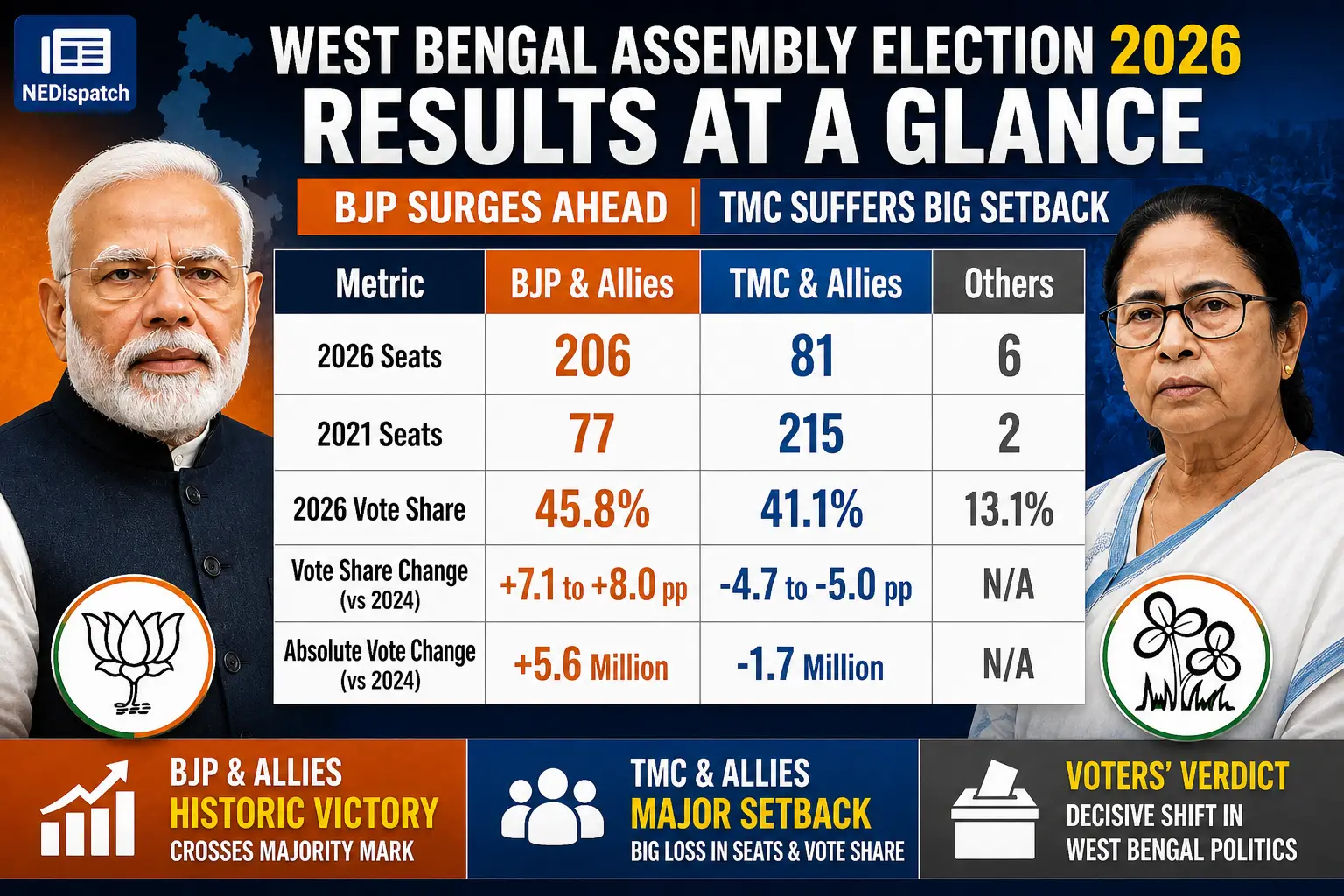
In what analysts are already describing as the most consequential state election in a generation, the Bharatiya Janata Party secured 206 of 293 declared seats in the 2026 West Bengal Assembly election, building a supermajority that few had predicted even a year before polling day. The Trinamool Congress, which had commanded 215 seats just five years prior, collapsed to a mere 81 — a fall so steep that it has prompted comparisons to the Left Front's implosion in 2011 that had brought the TMC to power in the first place.
The numbers carry a brutal symmetry: the BJP's vote share rose to 45.8%, gaining approximately 7 to 8 percentage points over 2024 Lok Sabha benchmarks, while the TMC's share sank to roughly 41%. The TMC lost vote share in 268 of the 293 counted constituencies — a figure that makes it impossible to attribute the outcome to localised grievances or regional idiosyncrasies. This was a statewide rejection, systematic and near-total.
The most symbolically devastating result came in Bhabanipur, the constituency Chief Minister Mamata Banerjee had long held as a personal fortress. BJP leader Suvendu Adhikari defeated her by a margin exceeding 15,000 votes, a defeat that signals the anti-incumbency wave was not merely a rural or peripheral phenomenon but had penetrated the very heart of TMC's political identity.
|
Metric |
BJP & Allies |
TMC & Allies |
Others |
|
2026 Seats |
206 |
81 |
6 |
|
2021 Seats |
77 |
215 |
2 |
|
2026 Vote Share |
45.8% |
41.1% |
13.1% |
|
Vote Share Change (vs 2024) |
+7.1 to +8.0 pp |
-4.7 to -5.0 pp |
N/A |
|
Absolute Vote Change (vs 2024) |
+5.6 Million |
-1.7 Million |
N/A |
ALSO READ: West Bengal Complete List: BJP Surge Reshapes Political Landscape as AITC Suffers Major Losses
No aspect of the 2026 election has generated more controversy than the Election Commission's Special Intensive Revision (SIR) of electoral rolls. The process resulted in the deletion of 8.9 million voters — executed in two phases: 6.2 million general deletions and a further 2.7 million during the highly contentious adjudication phase. Political activist Yogendra Yadav, among the most prominent critics, argued that the adjudication-phase deletions — representing approximately 4.3% of the total electorate — were communally and regionally targeted, designed to neutralise the TMC's demographic base.
The argument is not without surface plausibility. The adjudication deletions, critics note, broadly corresponded to the BJP's eventual margin of advantage in several key constituencies. For those who view the SIR as a tool of targeted disenfranchisement, the process represents what one commentator termed 'a bad sign for democracy,' raising fundamental questions about the neutrality of the electoral machinery.
However, granular data analysis complicates this narrative significantly. A clinical audit of constituency-level figures reveals that deletion density varied wildly — from 2.1% to 38.6% across individual assembly constituencies — and showed next to no statistical correlation with actual vote share swings for either party. More tellingly, the BJP's highest strike rates were recorded in the industrial and tribal belts of Bardhaman, Jalpaiguri, and Medinipur — regions that recorded SIR deletion rates below the state average. If roll manipulation were the primary engine of the BJP's victory, one would expect the party's gains to cluster in high-deletion zones. The data does not support that conclusion.
The BJP gained 5.6 million more votes compared to 2024 Lok Sabha totals, while the TMC lost 1.7 million. A gain of that magnitude, spread across 270 of 293 constituencies, is not arithmetically achievable through roll manipulation alone. The SIR's constitutional and political morality problems, analysts conclude, are real — but they did not manufacture the BJP's win. Deep-rooted popular sentiment did.
The election recorded a voter turnout of 92.9% — one of the highest in India's democratic history. This figure presents what analysts have termed a 'Participation Paradox': despite the electorate having been reduced by 8.9 million names through the SIR process, the absolute number of votes cast rose sharply. The remaining voters turned out with an intensity that overwhelmed the numerical reduction in the voter base.
In the vocabulary of electoral science, a turnout spike of this magnitude carries an unmistakable signature: extreme mobilisation driven by high-intensity anti-incumbency. While the Election Commission attributed the surge to cleaner rolls and improved security, the dramatic increase in participation within Kolkata's urban precincts — traditionally TMC territory — tells a different story. Urban voters, historically more insulated from anti-TMC sentiment, participated in exceptional numbers and contributed to the incumbent's erosion.
The demographic composition of the surge was revealing. Women voters outnumbered men in turnout figures, mirroring the pattern seen in the 2026 Assam election. This signals a pan-Indian trend in which women voters, energised by welfare delivery and social accountability expectations, have become decisive swing constituencies rather than reliable incumbent supporters.
A historical efficiency comparison sharpens the magnitude of the TMC's collapse. In 2011, the Left Front lost approximately 11 percentage points of vote share before being swept from power. In 2026, the TMC's popular loss was a comparatively modest 4.7 points — yet its seat tally collapsed from 215 to 81. This disparity indicates not merely a loss of votes, but a catastrophic failure of voter efficiency: the TMC's remaining support is geographically concentrated and no longer distributed in a pattern capable of winning individual contests.
For over a decade, the TMC's electoral dominance rested on a network of 'strongholds' — constituencies held consistently across the 2011, 2016, and 2021 cycles. In 2026, this defensive architecture did not merely crack; it collapsed. The party lost 78 of its 124 consistent strongholds, a haemorrhage that stripped it of the geographic anchors around which any recovery strategy would need to be built.
The BJP's counter-strategy was a textbook exercise in retention and expansion. The party defended 100% of the 54 seats it had carried across the last three electoral cycles — 2019, 2021, and 2024 — demonstrating absolute base stability even under the pressure of a TMC incumbent mobilisation. From that secure foundation, it then expanded aggressively into 65 entirely new constituencies where it had never previously won.
The geographic concentration of the BJP's gains underlines the structural nature of the swing. In Bardhaman, the party won 41 of 54 seats — a 76% strike rate. In Jalpaiguri, it captured 25 of 27 seats (93%). In Medinipur, 49 of 56 seats (87%). These are not marginal gains at the edges of the political map; they are the wholesale capture of entire electoral belts, many of which the TMC had considered impenetrable.
Crucially, all three of these regions recorded SIR deletion rates below the state average. The BJP's dominance here was built on voter migration and superior ground-level mobilisation, not roll manipulation — a finding that reinforces the data-driven case for genuine anti-incumbency as the primary driver of the result.
Communal polarisation functioned as a strategic force multiplier throughout the campaign. The rhetoric was neither subtle nor incidental. Suvendu Adhikari's campaign style — observers noted he referenced Hindu-Muslim dynamics fifteen times in a single fifteen-minute interview — exemplified the BJP's deliberate effort to consolidate a broad Hindu vote across caste and class lines, while the TMC increasingly appeared to lean on its Muslim support base as a defensive anchor.
The resulting shift in the legislature's composition has prompted analysts to describe the outcome as the 'Assam-ification' of Bengal politics. While the total number of Muslim MLAs remained stable at 40 — consistent with 2021 — they are now concentrated almost entirely within the TMC's drastically reduced legislative group, accounting for 42.5% of its total MLAs. The TMC is hardening into a party defined by minority support, while haemorrhaging the Hindu voters it needs to be a governing force.
Tactical vote-splitting compounded the TMC's losses in Muslim-majority constituencies. In five such seats won by the BJP, the presence of additional Muslim candidates divided the TMC's base, allowing the BJP to win on a plurality in territory it might otherwise have lost. Meanwhile, the central government's withholding of MGNREGA and Gram Awas Yojana funds — characterised by critics as a 'resource starvation strategy' — systematically undermined the TMC's welfare-delivery model, converting economic disappointment into political anger at the ballot box.
The 2026 mandate does not simply end the TMC's fifteen-year reign; it raises fundamental questions about whether the party can survive as a viable political force in the medium term. Three structural challenges now define its predicament.
First, the exodus of Hindu voters appears nearly total in the industrial and rural belts that once formed the TMC's backbone. Rebuilding that coalition without the resources of incumbency — welfare programmes, patronage networks, and organisational infrastructure — will be structurally difficult in the short term.
Second, demographic isolation poses an existential risk. A party that draws 42.5% of its legislative caucus from Muslim MLAs, in a two-party polarised state, will find it increasingly difficult to make a credible pitch to Hindu swing voters. The logic of polarisation, once set in motion, tends to be self-reinforcing.
Third, the collapse of 78 strongholds represents not merely a loss of seats but a loss of the organisational nodes through which the TMC exercised local power, delivered patronage, and recruited future candidates. Rebuilding from 81 seats — without the levers of state power — is a project that will define the party's next decade.
For West Bengal as a whole, the 2026 result marks the beginning of a genuinely competitive two-party era. Whether that competition produces better governance, or merely more intense polarisation, remains the central question of the state's democratic future.