Across Bosnia, Belfast, Colombo, and Manipur, ethnic conflicts share a hidden grammar: how suffering is narrated shapes who wins politically, long after the guns fall silent.
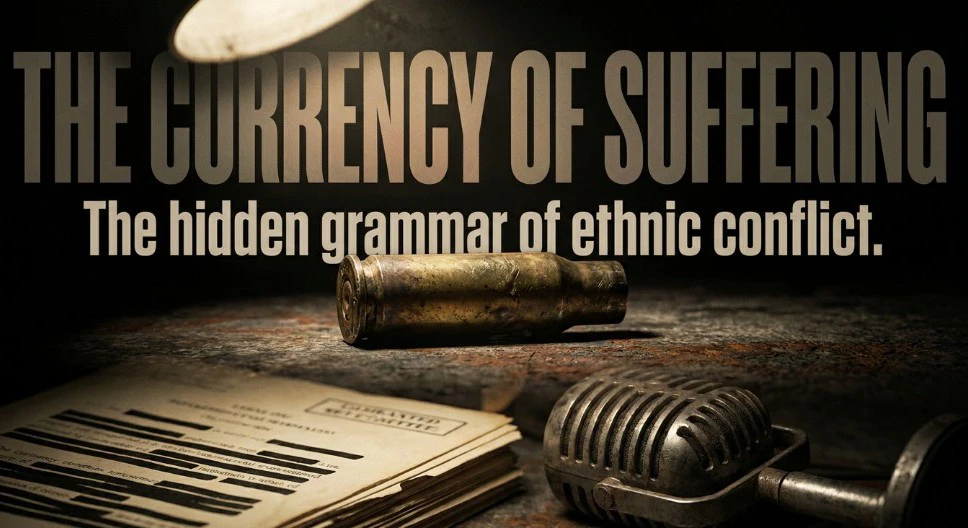
In the summer of 1992, as Sarajevo came under siege, something else began alongside the shelling: a war of narratives. Each community — Bosniak, Serb, Croat — mobilised its own account of who had been wronged first, who was suffering most, and whose survival was most imperilled. The facts of physical violence were real and brutal. But the narration of that violence — who controlled it, how it was timed, what it omitted — became a weapon in its own right. Decades later, the pattern repeats itself in conflicts separated by geography and culture but united by a common grammar: suffering, when strategically framed, becomes political capital.
Manipur, the landlocked northeastern Indian state that has been convulsed by ethnic violence between the Meitei and Kuki-Zo communities since May 2023, offers a contemporary instance of this grammar in operation. But to understand what is happening there requires stepping back from the specific and examining the structural. Manipur is not an anomaly. It is an iteration.
I. The Distinction That Changes Everything
Any serious analysis of ethnic conflict must begin with a distinction that is almost never made in public discourse: the difference between victimisation and victimhood.
Victimisation is what happens to people — displacement, death, sexual violence, the destruction of homes and livelihoods. It is a material reality. Victimhood, by contrast, is the political and narrative identity constructed around that material reality. It is shaped by who speaks, when they speak, what they emphasise, and — crucially — what they leave out.
This distinction matters because victimhood is not automatic or inevitable. It is produced. And in the production process, suffering is translated from private experience into public claim, from wound into argument. The production can be sincere. But it can also be strategic, and in conflict environments characterised by prolonged instability and competing political objectives, it almost always becomes both at once.
Victimhood is not automatic. It is produced — shaped by who speaks, when they speak, what they emphasise, and what they leave out.
Scholars of ethnic conflict have noted this distinction across vastly different theatres. In Sri Lanka, both Sinhalese nationalist movements and Tamil separatist organisations developed sophisticated victimhood repertoires that emphasised specific historical grievances while systematically marginalising the other community's losses. In Northern Ireland, the decades-long competition between Unionist and Republican communities over whose suffering was more legitimate — whose dead counted more — became as politically consequential as the violence itself. In Myanmar, Bamar Buddhist nationalism reframed structural dominance as existential threat, a rhetorical manoeuvre that converted a majority into a persecuted minority in public perception.
What these cases share is not equivalence of suffering, but equivalence of mechanism: the transformation of pain into leverage.
II. The Mechanics of Narrative Capital
How does victimhood become political capital? The process follows a recognisable sequence across conflict contexts.
First, suffering is framed as exclusive. For victimhood to generate maximum political leverage, it must be presented not as mutual — which it almost always is in ethnic conflicts — but as unilateral. This requires the suppression or minimisation of the other community's losses from one's own narrative. Acknowledgement of mutual suffering weakens moral authority; selective acknowledgement strengthens it. In the former Yugoslavia, each nationalist project produced its own casualty lists, its own maps of atrocity, each telling a story of singular persecution.
Second, political demands are recast as humanitarian imperatives. Separation, autonomy, or exceptional governance arrangements that would ordinarily face significant political scrutiny become harder to contest when they are presented as survival requirements. The demand is no longer we want more power, but we cannot survive without separation. This reframing is strategically valuable because it shifts the burden of proof: opponents of the demand must now argue against survival itself.
Third, moral insulation is activated. Once a victimhood narrative is sufficiently established, scrutiny of its claims can be reframed as an attack on the victims themselves. Questions about timelines, evidence, or statistical methodology are met not with answers but with accusations: of denial, of hostility, of taking the oppressor's side. This insulation mechanism does not require coordination to function — it emerges organically from the emotional logic of the narrative.
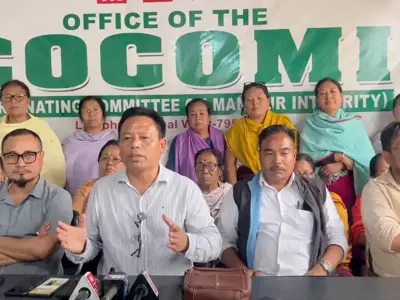
In Manipur, these mechanics are visible in the asymmetry of acknowledgement between communities: one side's civil society organisations explicitly recognise losses across both communities and kept those victims not directly killed in the conflict but are byproducts separate; while the other's construct narratives of largely exclusive suffering and include all those byproducts to inflate the number. Neither side's physical losses are trivial. The asymmetry exists in the narration, not in the dying.
III. Time as a Political Resource
One of the most underappreciated dimensions of strategic victimhood is the role of timing — not just of violence, but of narrative activation.
In many ethnic conflicts, political demands that would ordinarily require years of democratic deliberation are compressed into the acute phase of crisis, when institutional capacity is degraded, public attention is captured by immediate suffering, and the political cost of opposition is highest. The speed of articulation is itself a signal: it suggests not a response to breakdown, but a prepared framework awaiting a trigger.
The Balkans offer instructive precedents. In the early 1990s, territorial and administrative demands were rapidly formalised in the initial weeks of violence, when reconciliation remained structurally possible but politically inconvenient. The framing of conflict as irreconcilable, introduced early, made resolution harder to pursue later — because by then, institutions, international actors, and populations had oriented around the assumption of incompatibility.
Prolonged instability rewards those who benefit from the proof that coexistence has failed. Resolution threatens to devalue the political capital that suffering has accumulated.
Time, in this context, functions as a political resource in a second sense as well. The longer a crisis persists, the more suffering accumulates, and the more that accumulated suffering can be narrativised. Each additional month of displacement or insecurity compounds the victimhood archive, deepens the emotional investment of external sympathisers, and strengthens the argument that the original breakdown was not temporary but structural.
This creates what might be called a peace disincentive: when victimhood underwrites political legitimacy and instability sustains narrative relevance, then resolution threatens to devalue accumulated capital. Peace becomes, for certain actors, politically inconvenient. The conflict risks entering a self-perpetuating equilibrium, where suffering continues not because resolution is impossible, but because resolution is costly for those who have learned to profit from its absence.
IV. The Media Ecosystem and the Freezing of Narratives
No victimhood narrative sustains itself without an amplification infrastructure. In modern conflicts, this infrastructure typically consists of civil society organisations, diaspora networks, sympathetic journalists, and digital platforms that together constitute what might be called a narrative economy — a space where suffering is translated into statements, reports, images, and demands.
Within this economy, not all suffering circulates equally. Some experiences are amplified, some ignored, some deliberately delayed in their release for maximum political impact. The pattern has been documented across multiple conflict environments. In Sri Lanka, the Liberation Tigers of Tamil Eelam maintained a sophisticated global communications apparatus that shaped international perception for decades. In the Balkan wars, competing nationalist movements cultivated relationships with foreign journalists, feeding them selective access and curated imagery.
A recurring feature of these ecosystems is what might be called the freezing of narratives: once an account achieves sufficient circulation, it becomes resistant to correction. Repetition substitutes for verification. Evidentiary updates that might complicate the narrative are absorbed without altering it, or simply not reported. Journalists and outlets that have made reputational investments in earlier reporting face structural incentives to continue amplifying rather than questioning.
The mechanism does not require conspiracy. It operates through the ordinary incentives of media ecosystems: access, sources, emotional resonance, and the path of least resistance. The result, in Manipur as in Belfast or Colombo before it, is that the narrative record of a conflict can diverge significantly from its evidentiary record, and that divergence tends to favour those who invested earliest in narrative infrastructure.
V. The Internal Cost: Pluralism Suppressed
Strategic victimhood carries internal costs that are rarely examined. When victimhood becomes a community's primary political resource, internal dissent becomes dangerous — not merely impolitic, but potentially treasonous in the communal moral economy.
Questions about leadership decisions, financial accountability, strategic alternatives, or the desirability of coexistence are reframed as betrayal of collective suffering. Whistleblowers and moderates are delegitimised. The community is reduced, in its public representation, to a single voice — which is almost never as unanimous as it appears.
Northern Ireland offers a partial model of what happens when this suppression eventually lifts. As the peace process matured and the acute phase of violence receded, internal pluralism within both communities gradually reasserted itself, making compromise politically viable in ways that had seemed impossible during the height of the conflict. The moderates had existed throughout; they had simply been silenced by the moral authority of victimhood narratives that left no room for complexity.
In Manipur, as in other contemporary conflicts, the question of internal pluralism — of the civilians who may not share their leaders' objectives, who might prefer negotiation to separation, coexistence to partition — remains largely invisible in public discourse. Victimhood narratives speak about communities without necessarily being accountable to them.
VI. What This Analysis Does Not Argue
It is necessary to be explicit about what a structural analysis of this kind does not claim.
It does not argue that suffering is fabricated, or that victims are not victims. People die in ethnic conflicts because they are killed. Communities are displaced, traumatised, and bereaved. These realities require acknowledgement and redress.
It does not argue for false symmetry. Conflicts are rarely perfectly balanced, and analysis should not manufacture equivalence where none exists. The claim is not that all communities suffer identically, but that the narration of suffering in all communities follows recognisable patterns of selection, emphasis, and strategic deployment.
It argues, instead, for what might be called the re-humanisation of suffering: the recognition that when pain is converted into political capital, the people who suffered most are often the last to benefit. They become symbols in arguments made by others, fuel for conflicts that outlast the original violence, and inheritors of a grievance identity that can persist for generations after the material conditions that produced it have changed.
When pain is converted into political capital, the people who suffered most are often the last to benefit. They become symbols in arguments made by others.
Conclusion: The Grammar Beneath the Headlines
From Sarajevo to Colombo, from Belfast to Manipur, the grammar of victimhood in ethnic conflicts is remarkably consistent. Suffering is real; its narration is strategic. Losses are comparable; their representation is asymmetrical. Civilian pain is genuine; the political benefit accrues elsewhere.
Understanding this grammar does not diminish the suffering it describes. It clarifies why conflicts persist long after the conditions that ignited them have changed, why resolution is harder to achieve than continuation, and why the civilians most harmed by protracted violence are so rarely empowered to end it.
In Manipur, as in every conflict where this grammar has operated, the deepest question is not who suffered more. It is who controls the account of suffering, to what end, and at what cost to those whose pain they are claiming to represent.
The answers to those questions are not found in any single community's narrative. They are found in the structure beneath all of them.
This piece is a structural analytical essay. References to the Manipur crisis are illustrative of general patterns observed across multiple ethnic conflict environments globally and do not constitute judicial or forensic findings about any specific individual, organisation, or community.
(Keithellakpam Manikanta Meetei is a seasoned journalist and a former educator. He also writes under his pen name Keicha Chingthou Mangang instead of his actual name. You can contact him at chingthouheiya@gmail.com)