For forces seeking political separation or administrative fragmentation, prolonged instability strengthens the argument that coexistence has irreversibly collapsed.
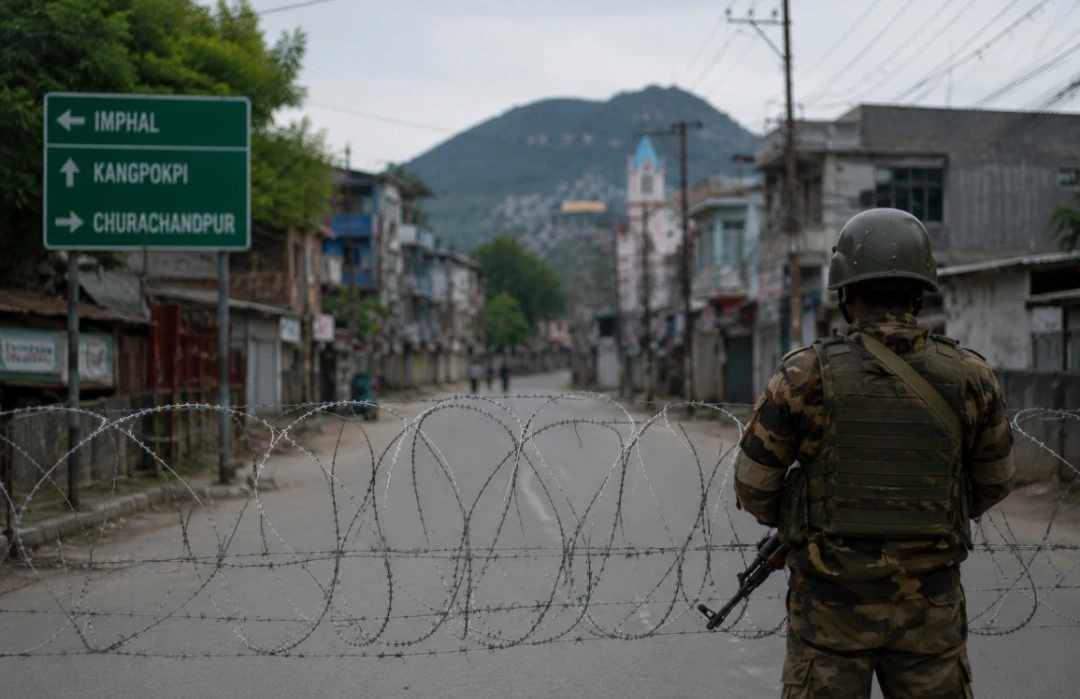
For nearly three years now, Manipur has remained trapped in a cycle of violence, distrust and political paralysis. Yet from the very beginning of the crisis in May 2023, one reality was already visible within days: the conflict was not merely about an isolated trigger or temporary law-and-order breakdown. Two sharply divergent political imaginations had emerged almost immediately.
On one side, Kuki-Zo organisations began demanding separate administration, arguing that coexistence within the present political structure had become impossible due to alleged persecution and insecurity.
On the other side, Meetei organisations and many indigenous Naga voices framed the crisis as a defence of Manipur’s territorial integrity, historical identity and demographic security. Their discourse increasingly revolved around resisting what they viewed as externally driven destabilisation, cross-border demographic pressure and armed militancy.
These two narratives were not designed to converge. They were moving in opposite directions from the start.
That is why one difficult but necessary question now deserves honest examination: who benefits from prolonging the conflict, and who stands to lose the most if instability becomes permanent?
The answer may not be morally comfortable, but politically it is becoming increasingly visible.
For forces seeking political separation or administrative fragmentation, prolonged instability strengthens the argument that coexistence has irreversibly collapsed. Every new killing, every buffer zone, every displaced family and every failed reconciliation effort reinforces the claim that normal governance can no longer function within a unified framework.
Time, in such a situation, becomes politically useful.
The longer communities remain physically segregated, psychologically alienated and administratively disconnected, the easier it becomes to institutionalise division as the “practical reality.” Temporary arrangements slowly begin resembling permanent structures.
History shows that prolonged ethnic conflicts often reshape political geography not through formal declarations initially, but through gradual normalization of separation on the ground.
That is why prolonged instability inherently weakens the idea of shared civic space.
By contrast, those defending Manipur’s territorial integrity carry a far heavier burden during prolonged conflict. They are attempting to preserve coexistence while simultaneously living through the daily erosion of the very conditions that make coexistence possible.
This contradiction is becoming increasingly severe.
Every month of continued violence deepens mistrust between communities. Children are growing up inside segregated narratives. Entire populations now consume completely different versions of reality. Emotional separation is becoming more entrenched than physical separation.
And unlike territorial separation demands, the defence of unity requires functioning institutions, inter-community trust, economic interdependence and movement across social boundaries. Conflict destroys all of these foundations.
In other words, unity weakens in prolonged instability while separation hardens.
This does not automatically mean one side is “winning” politically in a conventional sense. In reality, almost every ordinary civilian in Manipur is losing economically, psychologically and socially. Entire generations are inheriting trauma, disrupted education, militarised thinking and deep fear.
But conflicts are not sustained only by public suffering. They are also shaped by political incentives.
For armed groups, prolonged instability creates operational relevance. For hardline actors, compromise becomes dangerous because peace weakens mobilising narratives. For political entrepreneurs, fear often consolidates support more effectively than reconciliation.
This is why conflicts frequently develop self-sustaining ecosystems where instability itself becomes politically productive for certain actors.
The tragedy in Manipur is that moderation now carries diminishing political space.
Voices advocating reconciliation are increasingly viewed with suspicion by their own constituencies. Any attempt at dialogue risks being labelled betrayal. Every violent incident immediately pulls communities back into hardened positions.
The longer this continues, the narrower the path back becomes.
Another uncomfortable reality is that demographic anxiety now sits at the core of the conflict’s political psychology. Meetei and many indigenous Naga groups increasingly interpret the crisis through fears of territorial fragmentation, demographic alteration and weakening indigenous control over land and governance structures.
Meanwhile, Kuki-Zo groups interpret the same conflict through existential insecurity and fears of majoritarian domination.
These fears are mutually reinforcing. Each side’s defensive posture validates the other side’s insecurity.
That is precisely why prolonged conflict benefits maximalist narratives on all sides while weakening the political centre.
The role of the Indian state also becomes increasingly consequential in such circumstances. A prolonged vacuum of credible political resolution creates space for parallel authorities, armed influence and competing sovereignties to emerge informally.
Once populations begin relying more on ethnic mobilisation than constitutional institutions for survival and protection, rebuilding state legitimacy becomes extraordinarily difficult.
This is perhaps the greatest danger now facing Manipur.
Because beyond the visible violence lies a slower transformation: the gradual replacement of civic identity with siege identity.
When communities stop imagining a shared future, every negotiation becomes zero-sum, every concession becomes surrender, and every incident becomes historical proof.
At that point, even peace initiatives struggle because the psychological architecture necessary for coexistence has already collapsed.
And yet, despite everything, one fact remains unavoidable: geography has not changed. Manipur’s communities remain historically intertwined through land, trade, memory and shared civilisational history far older than the present conflict.
No durable future can emerge purely from permanent hostility.
The deeper question therefore is not simply who gains from prolonging the crisis in the short term. The more important question is whether any community can truly emerge secure from a permanently fractured Manipur where fear replaces trust as the organising principle of politics.
Because history also shows something else: conflicts that begin with competing insecurities often end by consuming the very social fabric that all sides originally claimed to defend.