Nearly three years after the unresolved May 2023 ethnic violence, the Manipur crisis has spread into Ukhrul and Kamjong districts, where escalating unrest between February and May 2026 has claimed at least 14 lives.
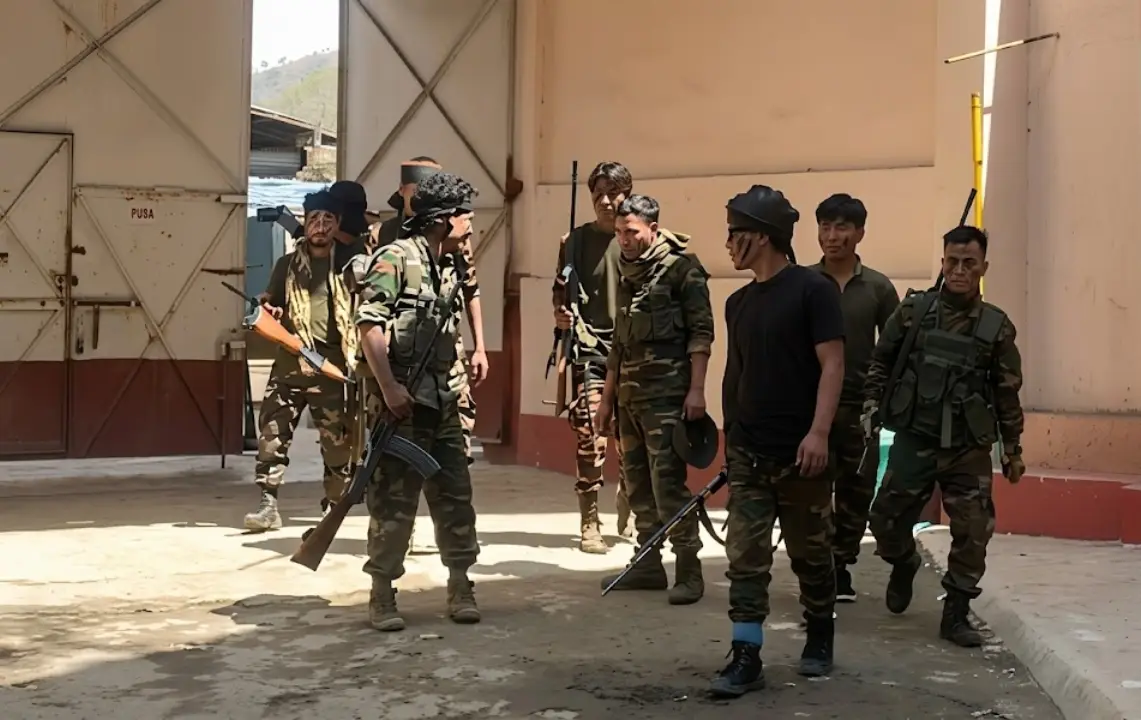
On May 3, 2023, while the Vice-President of India was in an official visit to Imphal, ethnic violence erupted across Manipur in a manner and at a scale that neither the state government nor the central government has been able to contain. Nearly three years later, the conflict has not been resolved. It has expanded. The government's failure to restore peace and normalcy has allowed the crisis to metastasise, spreading its geography, deepening its humanitarian consequences, and drawing communities and districts that were not the original locus of violence into its destructive orbit.
Ukhrul and Kamjong are the clearest current example of this expansion. These hill districts, home predominantly to the Tangkhul Naga people, were not at the centre of the May 2023 violence, which initially pitted the Meetei community in the valley against the Kuki-Zo communities in the hills. But the unresolved conflict has created conditions, hardened ethnic militias, eroded institutional authority, collapsed inter-community trust, a government perceived as partisan or paralysed, in which violence can ignite between new pairs of communities in new locations. Between February and early May 2026, that is precisely what has happened. At least 14 people have been killed in multiple separate incidents involving Kuki-Zo and Tangkhul Naga armed groups in Ukhrul and Kamjong districts. Scores have been injured. Villages have come under sustained fire.
This analysis examines what is happening in Ukhrul and Kamjong, its immediate dynamics, its humanitarian consequences, its economic and psychological toll, and its deeper causes. But it does so with a clear understanding of the frame: this is not a separate crisis. It is a chapter in a larger, ongoing crisis that the state has failed to end.
The government's failure to restore peace after May 2023 has allowed the conflict to metastasise. Ukhrul and Kamjong are not the origin of this crisis. They are its latest, expanding frontier.
The Manipur ethnic conflict that erupted on May 3, 2023, was fundamentally a confrontation between the Meetei community, the valley's demographic majority and political centre of gravity, and the Kuki-Zo communities who resides in both the valley and hill districts. The triggering factors included disputes over Scheduled Tribe status, encroachment in reserved and protected forests, the perceived encroachment of valley interests into hill territories, large scale illegal poppy cultivation that has effectively changed the ecology and weather pattern of the state, and uncontrolled influx of Myanmarese nationals, which many argues that it begins as early as the 60s. Within days of the initial violence, dozens were killed, hundreds of villages attacked, and tens of thousands displaced. The state administration effectively collapsed as a neutral arbiter, with the Union Home Minister instructing the state Chief Minister to control the valley while the Centre manage the hills.
The cumulative toll of that larger Manipur crisis, from May 2023 through early 2026, has been staggering: around 300 deaths, 58,821 internally displaced persons living in 174 relief camps, 7,894 permanent homes destroyed, and 2,646 partially demolished. These numbers, drawn from official government data and an RTI filed by Hareshwar Goshwami, are the figures for the entire Manipur conflict, not for any single district or episode.
Core Indicators: The Larger Manipur Crisis (May 2023 – March 2026)
|
Indicator |
Total (State-Wide) |
|
Deaths (ex-gratia records) |
~300 |
|
Total Internally Displaced Persons (IDPs) |
~58,821 |
|
Permanent Houses Destroyed |
7,894 |
|
Partially Destroyed Houses |
2,646 |
|
Designated Relief Camps |
174 |
|
Pre-fabricated Houses Constructed |
3,000 (Manipur Police Housing Corporation) |
For nearly three years, the government has been unable — or unwilling — to take the measures necessary to restore peace. No durable ceasefire has held. No credible political negotiation between communities has produced a framework for coexistence. No accountability process for the crimes of the early violence has been initiated that commands cross-community confidence. Into this vacuum of governance, new cycles of violence have entered. The expansion into Ukhrul and Kamjong is the most recent and most visible of these cycles.
ANALYTICAL NOTE:
The expansion of conflict into Ukhrul and Kamjong is not incidental. It is the predictable result of a protracted unresolved crisis in which armed groups have proliferated, institutional legitimacy has eroded, and the perception has hardened — across all communities — that security can only be secured by one's own ethnic group rather than by the state. When a government fails to enforce peace, communities militarise. When communities militarise, new confrontations become not just possible but probable.
The violence now afflicting Ukhrul and Kamjong represents a distinct but directly related dynamic within the larger Manipur crisis. The primary confrontation here is between Kuki-Zo and Tangkhul Naga armed groups — two hill communities that share broadly similar grievances against valley dominance but whose proximity in the hills has now generated its own territorial and ethnic tensions, fuelled and intensified by the atmosphere of generalised conflict that has prevailed since May 2023.
Between February and early May 2026, at least 14 people have been killed across multiple separate incidents in these two districts. The violence has not been a single event but a sustained pattern: exchanges of fire in contested hill areas, attacks on villages, retaliatory operations, and the progressive fortification of positions by armed groups from both communities. In the hills above Sinakeithei in Ukhrul district, armed groups have established bunkers and trenches in the Lungter hill range. Gunfire into the village is a daily occurrence.

The Litan village incident in Ukhrul district — a 'local misunderstanding' involving a small number of individuals — is illustrative of how the broader atmosphere of conflict transforms minor friction into serious violence. In a context of peace and functioning institutions, such a dispute might have been resolved through community elders or local administration. In a context of armed militias, deep ethnic distrust, information blackouts, and a state apparatus perceived as partisan, the same dispute escalates into gunfights, village evacuations, and sustained hostilities extending to neighbouring settlements like Mullam.
Security Situation: Ukhrul and Kamjong Districts (Feb – May 2026)
|
Feature |
Ukhrul District |
Kamjong District |
|
Primary Communities |
Tangkhul Naga (majority) |
Tangkhul Naga; Kuki-Zo settlements; Myanmar refugees |
|
Reported Fatalities (Feb–May 2026) |
Part of 14-fatality regional count across both districts |
Part of 14-fatality regional count across both districts |
|
Key Villages Affected |
Sinakeithei, Litan, Mullam |
Phaikoh, Namlee, Haijang, Gampal |
|
Armed Group Activity |
Bunkers/trenches on Lungter hills; daily gunfire into Sinakeithei |
Active exchanges of fire; BSF and Assam Rifles deployed |
|
Restrictions |
Army convoy obstructions; Phungyar sub-div. internet ban |
Lhungtin sub-div. internet ban (extended Feb 2026) |
|
External Compounding Factor |
Internal displacement (IDPs) |
Myanmar refugee influx (~6,000 since Nov 2023) |
ANALYTICAL NOTE:
It is important to be precise about what the Litan incident is and is not. It is not the cause of the crisis in Ukhrul and Kamjong. It is an accelerant within a pre-existing crisis environment. The underlying conditions — armed group proliferation, ethnic hardening, institutional collapse — were created by the unresolved larger Manipur conflict. The incident at Litan ignited violence that those conditions made inevitable sooner or later.
No single location illustrates the human cost of this conflict more vividly than Sinakeithei, a Tangkhul Naga village in Ukhrul district that sits at the intersection of 11 Kuki-Zo settlements. Before the spread of the Manipur crisis into this area, Sinakeithei was what analysts of inter-ethnic coexistence would call a functioning model: a trade centre where Naga and Kuki farmers exchanged agricultural produce and groceries across ethnic lines, and a school where children from Tangkhul, Kuki, and Nepali backgrounds studied together in a shared space that local educators described as a 'neutral zone.'

That model has been dismantled. Armed groups have established positions in the Lungter hills overlooking the village. Gunfire is constant enough that farming has become life-threatening. On March 22, 2026, a mother and her young son spent over three hours lying flat in a cabbage field while bullets passed overhead. They were eventually rescued by the Mahar Regiment. The cabbage harvest — the economic staple of the local economy — was abandoned.
In Sinakeithei, school enrolment has fallen from 450 to 138 students. Only families who can afford to flee to Ukhrul town can continue their children's education. The poorest children remain — and often cannot go to school at all.
The school, once a neutral zone, has been closed for two-month stretches. Enrolment has collapsed from 450 students to 138. The children who remain are predominantly those whose families lack the resources to relocate to Ukhrul town. The conflict has created a two-tier education system: one for those who can afford to leave, and effectively none for those who cannot. In an act of civic desperation, the remaining students staged a peaceful protest demanding that the government restore enough safety for them to study without fear.
The inter-community trade that once made Sinakeithei economically viable has dissolved entirely. Kuki farmers no longer sell in the village market. Naga buyers no longer purchase from Kuki vendors. The mutualistic economic arrangement has been replaced by isolation, suspicion, and the daily arithmetic of survival. Livestock are being slaughtered prematurely because families cannot access feed. Local reports confirm that stray fire has killed domestic animals in the village — evidence of how completely the boundary between residential space and active battlefield has collapsed.
ANALYTICAL NOTE:
Sinakeithei is not just a humanitarian case study. It is a measure of what protracted, unresolved conflict destroys beyond lives and buildings. It destroys functioning inter-ethnic systems — economic, educational, social — that took decades to build and cannot be reconstructed simply by ending the shooting. Any peace process in Manipur that does not include an explicit agenda for rebuilding inter-community economic life will leave the underlying conditions for future violence intact.
Kamjong district faces a compounding of crises that distinguishes it even from the difficult situation in Ukhrul. The violence between Kuki-Zo and Tangkhul Naga groups is being overlaid on a separate but interacting humanitarian emergency: the influx of approximately 6,000 refugees from Myanmar since November 2023, driven across the border by that country's own armed conflict.

In specific border villages, the refugee presence has reached a scale that fundamentally alters local social and resource dynamics. Phaikoh village has registered 1,591 immigrants — a number that exceeds the local resident population. Namlee hosts 1,087. Authorities have collected biometric data from 5,173 of these refugees, but registration and effective management are very different things. The Tangkhul Naga Aze Longphang (TNAL) has documented conflicts between refugees and local workers over daily wages, strains on food and water resources, and a demographic pressure that local governance structures were never designed to absorb.
Myanmar Refugee Presence in Kamjong District
|
Location |
Registered Immigrants |
Notable Impact |
|
Phaikoh Village |
1,591 |
Refugees exceed local resident population |
|
Namlee Village |
1,087 |
Resource strain; wage conflicts documented |
|
Kamjong District (Total) |
~6,000 |
5,173 biometrically registered as of 2026 |
The government's response — scrapping the Free Movement Regime (FMR) that previously allowed border residents to cross without a visa — has been met with scepticism from the TNAL and local communities. The TNAL's argument is practical: determined illegal crossings through forested mountain terrain are not deterred by legal instruments alone. What the FMR abolition primarily achieves, they argue, is inconveniencing law-abiding local citizens with legitimate cross-border ties, while doing little to stop the movement of those who do not travel through official channels anyway.
ANALYTICAL NOTE:
Kamjong is experiencing two simultaneous displacement dynamics operating in opposite directions: its own residents are being displaced outward by internal conflict, while foreign nationals are being displaced inward from Myanmar. Both dynamics compete for the same scarce local resources and amplify the same underlying anxieties. The political fuel this provides for nativist mobilisation — already visible in the TNAL's calls for deportation — is significant and requires careful, calibrated governance that the state has so far been unable to provide.
The psychological toll of this conflict — not just in Ukhrul and Kamjong but across the displaced population of Manipur — has been documented with clinical precision in a landmark 2026 study titled “Measurement Of Internally Displaced Persons’ Mental Health Status, Their Perception Of Stress And Posttraumatic Stress Disorder In Manipur” published in the April 2026 issue of the “Journal Of Advance And Future Research”. Conducted by Dr. Chongtham Khogendra Singh, an Assistant Professor with the D.M. College of Teacher Education, Imphal, and Irungbam Manisana Singh, a Research Scholar at the Department of Teacher Education, Manipur University Canchipur, the research surveyed 400 internally displaced persons across six relief camps. Its findings represent the most comprehensive clinical evidence yet of what prolonged displacement from an unresolved conflict does to human mental health.
The central finding is a probable PTSD prevalence of 64% among the IDP sample. The general population rate in India is approximately 3.5%. The calculated odds ratio is 48.95 — meaning a displaced person from the Manipur conflict is nearly 49 times more likely to have PTSD than someone in the general population. One in four of those who test positive for PTSD falls into the 'severe' category. These are not marginal findings. They describe a population in acute clinical distress.
Clinical Mental Health Indicators: IDP Sample vs. General Population (April–May 2026)
|
Metric |
IDP Sample |
General Population |
Clinical Significance |
|
General Health (GHQ-12 Mean) |
17.8 |
10.5 |
70% above distress cut-off |
|
Perceived Stress (PSS-10 Mean) |
21.4 |
13.0 |
47.5% in 'high/very high' stress band |
|
Probable PTSD (PCL-5) |
64% |
3.5% |
Odds Ratio: 48.95 |
|
Severe PTSD (within positive cases) |
25% |
— |
Require immediate clinical care |
|
Stress–PTSD Correlation |
r = .84 |
— |
Very large bidirectional relationship |
The study's most operationally significant finding is the correlation of r = .84 between perceived daily stress and PTSD symptoms. This is a 'very large' statistical relationship, and it has a direct policy implication: the ongoing environmental stressors — gunfire from the Lungter hills, overcrowded relief camps, loss of livelihood, uncertainty about return — are not separate from the trauma. They are maintaining it. The brain's stress-response system cannot begin to regulate itself while the threat environment remains active. This means that conventional trauma therapy, applied in isolation, will have limited impact as long as the daily stressors of displacement and conflict continue.
A displaced person from the Manipur conflict is nearly 49 times more likely to have PTSD than a non-displaced peer. The research is unambiguous: restoring a safe environment is not separate from mental health recovery. It is the prerequisite for it.
ANALYTICAL NOTE:
The r = .84 correlation makes a clinical case for infrastructure restoration as a mental health intervention. The Bailey bridge over the Ihang River is a logistics problem — but restoring it also reduces the daily stress of isolation for communities cut off from supplies. Restoring internet access is a communications issue — but it also reduces the hyper-vigilance that comes from information deprivation. Humanitarian agencies advocating for these interventions should make this clinical link explicit: stress reduction is trauma reduction. They are not separate policy domains.
One of the most consequential consequences of the government's failure to resolve the Manipur crisis is the erosion of institutional legitimacy. Security forces, administrative bodies, and elected governments that are perceived as biased — or simply as unable to protect — lose their capacity to project neutral authority. In Ukhrul and Kamjong, as across much of Manipur, that erosion is now severe.
The evidence is behavioural and widespread. In the valley, Meetei groups have obstructed and stopped Army and central paramilitary convoys. In Ukhrul, Naga women have frisked military vehicles at community roadblocks. This is not random civil disobedience. It is a structured, community-organised response rooted in the perception that the forces being stopped are not neutral actors. When populations feel safer blocking security convoys than cooperating with them, institutional trust has not merely weakened. It has inverted.
The internet shutdowns — extended in February 2026 to cover the Lhungtin sub-division in Kangpokpi and the Phungyar sub-division in Kamjong — were intended to prevent the spread of inflammatory content on social media. The operational consequence has been the opposite. Without access to official information, residents rely on physical word-of-mouth networks and informal channels that are far more easily captured by partisan narratives and far less susceptible to correction. The shutdown has not stopped misinformation. It has made misinformation uncheckable.
ANALYTICAL NOTE:
The internet blackout has created what analysts call a 'parallel information ecosystem' — a closed information environment in which unverified accounts travel through village networks, each retelling adding detail that confirms existing fears. This is the mechanism that transforms a local misunderstanding at Litan into a state-wide cycle of ethnic retaliation. Restoring reliable official information channels is not a luxury. In a conflict where misinformation is itself a weapon, it is a de-escalation tool. The government's continued use of blanket internet bans suggests it has not understood this — or does not prioritise it.
The ethnic confrontation now playing out between Kuki-Zo and Tangkhul Naga communities in the hills of Ukhrul and Kamjong has an arresting feature: both communities are predominantly Christian. They share not just a broad religious affiliation but specific theological traditions, denominational structures, and ecclesiastical heritage. In many conflicts, religious difference is the fault line. Here, shared religion has failed to prevent violence between communities that 'worship the same God.'
The Kuki Christian Leaders' Forum (KCLF) has confronted this directly. In recent statements, the organisation warned that the 'unity of Christians in India' is at risk, and called on both communities to choose 'dialogue over destruction' and 'truth over propaganda.' The KCLF has been explicit and unambiguous: the Bible must not be used to incite hatred or legitimate violence among fellow Christians, and 'ethnocentric interpretations of Holy Scriptures in a multiethnic society directly contradict the teachings of Jesus Christ.'
The fact that the KCLF feels compelled to issue such warnings is itself analytically significant. It indicates that religious identity is being filtered through — and subordinated to — ethnic identity. The gospel of peace is being co-opted by ethnic territoriality rather than transcending it. When religious institutions lose their capacity to mediate across ethnic lines, one of the most powerful non-governmental instruments for conflict resolution is disabled. The church's voice remains important, and the KCLF's interventions are both courageous and necessary. But without broader institutional and governmental support, their capacity to shift the community hierarchy of belonging — in which ethnicity now sits above faith — is severely limited.
There is no short path to peace in Ukhrul and Kamjong, because the crisis there is not a local problem with a local solution. It is a symptom of a state-wide governance failure. Addressing the symptoms without addressing that failure will produce temporary relief at best. What a genuine response would require — in Ukhrul and Kamjong specifically, and in Manipur more broadly — is a combination of immediate stabilisation measures and longer-term structural commitments.
In the immediate term, four interventions are both clearly necessary and clearly within the government's capacity. First, reconstruction of the Bailey bridge over the Ihang River to restore the alternative supply route serving villages in Ukhrul that can no longer safely use the main highway. Second, deployment of additional security forces — such as India Reserve Battalion units — to establish protected agricultural corridors, so that farmers can return to their fields without risking their lives. Third, ensuring uninterrupted internet access in affected sub-divisions. The operational justification for the blackout has not been demonstrated, and its humanitarian and informational costs are significant. Fourth, initiation of impartial, transparent investigations into the specific incidents — at Litan and Gampal — that escalated the current cycle of violence, with findings made public and accountability enforced.
Over the medium term, the most critical need is the explicit reconstruction of inter-community economic life. The collapse of the mutualistic trade that characterised villages like Sinakeithei is not a byproduct of the conflict that will automatically reverse when shooting stops. It will require structured, supported initiatives to rebuild the economic interdependencies between Kuki-Zo and Tangkhul Naga communities that once made coexistence not just possible but mutually beneficial. The education emergency in affected villages — illustrated by the collapse of Sinakeithei school enrolment from 450 to 138 — demands parallel attention as both a humanitarian and a developmental priority.
The mental health crisis documented by Dr Chongtham Khogendra Singh and Irungbam Manisana Singh (2026) requires a scaled, integrated Mental Health and Psychosocial Support (MHPSS) response embedded within the broader humanitarian operation — not as an add-on, but as a core pillar. The research is clear that psychological recovery cannot be separated from environmental stabilisation: reducing daily stressors is itself a clinical intervention. And above all, the larger Manipur crisis demands a political process — a genuine, good-faith attempt to negotiate a framework for coexistence between communities — without which every local stabilisation effort will remain vulnerable to the next cycle of escalation.
Peace in Manipur cannot be defined as the absence of immediate violence. It must be a proactive condition of reconciliation — one that heals the economy, the school, and the mind, not just the battlefield.
The violence in Ukhrul and Kamjong districts is not where the Manipur crisis began. It is where it has spread. That distinction matters. It means that what is happening in these hills is not a discrete problem to be managed in isolation. It is evidence of how an unresolved, protracted ethnic conflict — left without political resolution, without accountability, and without a credible peace architecture — will always find new communities to draw in, new geographies to consume, and new human lives to destroy.
The Manipur government and the central government have had nearly three years since May 2023 to demonstrate the political will to end this crisis. The evidence on the ground — 217 dead in the larger conflict, nearly 59,000 displaced, and now at least 14 more lives lost in the specific theatre of Ukhrul and Kamjong between February and May 2026 — is an unambiguous verdict on how that time has been used.
The Tangkhul Naga communities of Ukhrul, the Kuki-Zo and Naga communities of Kamjong, the children studying under gunfire in Sinakeithei, the farmers trapped in their own fields, the 58,000 people living in relief camps with PTSD rates nearly 49 times the national norm — these are not abstractions. They are the human cost of governance failure. They deserve more than management. They deserve resolution.