A community gave 84 acres of land to help keep Imphal clean. Two decades later, they are living next to mountains of untreated garbage, breathing toxic air, and drinking polluted water — with a June 1 deadline that could bring the city's waste management to a standstill.
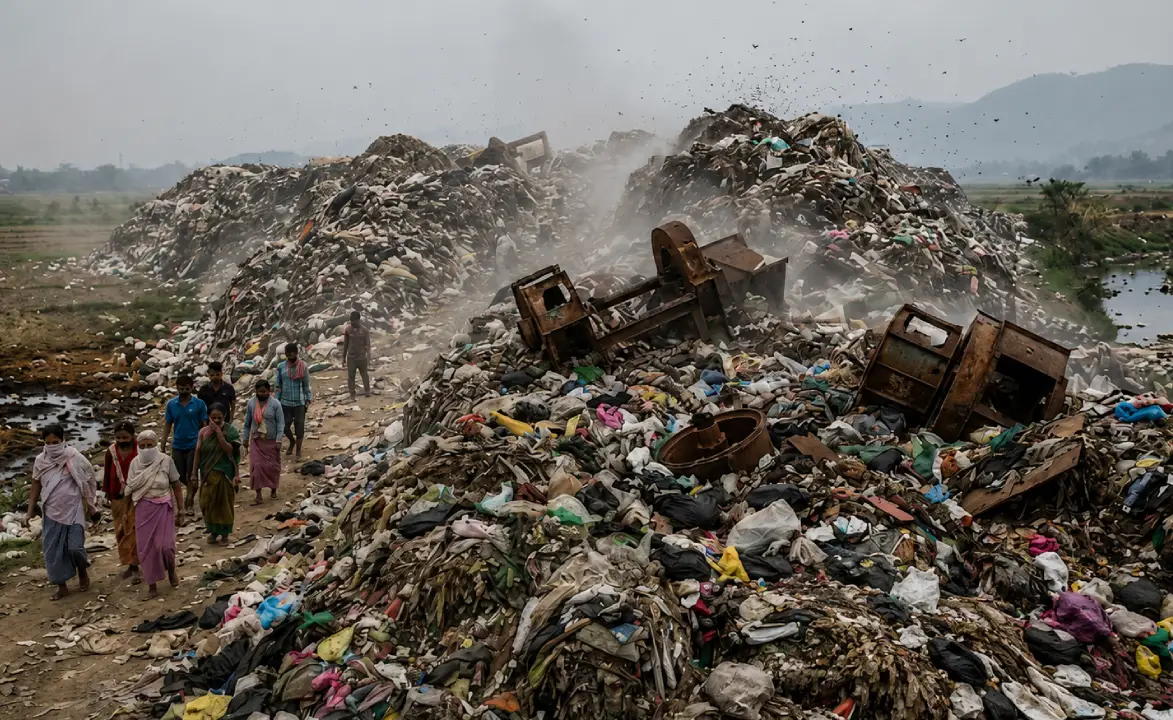
AI generated representational image
|
KEY FACTS AT A GLANCE |
|
|
Location |
Lamdeng village, Imphal West, Manipur |
|
Plant established |
2007 — promised fertilizer and electricity from 27 IMC wards |
|
Land surrendered |
84 acres by Lamdeng community on government assurances |
|
Daily waste intake |
130+ tons (from 2015); plant capacity: 20 tons/day |
|
Machines functional |
Zero — non-functional since ~2017, buried under waste |
|
Duration of harm |
10+ years of polluted water, toxic air, and destroyed farmland |
|
Deadline |
June 1, 2026 — plant closure if government does not respond |
|
Issuing body |
Lamdeng Apunba Lup (clubs + meira paibis of three localities) |
In 2007, the people of Lamdeng did something that most communities would not: they surrendered 84 acres of their land to the government — willingly, and on the strength of a promise. The Solid Waste Management Plant to be built there would process refuse from 27 wards of the Imphal Municipal Corporation (IMC), converting it into fertilizer and electricity. Lamdeng would help make Imphal clean. The community would benefit from the enterprise.
That promise has not been kept. Not partially, not eventually — not at all. What stands on those 84 acres today is not a model waste treatment facility. It is one of northeast India's most conspicuous examples of infrastructure abandonment: mountains of untreated garbage taller than the machinery they have buried, fields that have not grown paddy in years, waterways too toxic for fishing, and a community that has spent two decades being treated as a municipal dustbin.
"The government has turned the Solid Waste Management Plant, which could have been as productive as a golden egg, into a mere dustbin." — Thoudam Netrajit, Advisor, Lamdeng Apunba Lup
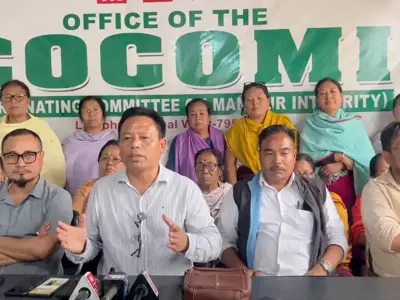
On May 10, 2026, the Lamdeng Apunba Lup — a civil society body formed by local clubs and meira paibis (women's groups) from three localities — held a press conference at the plant campus and announced a firm deadline. If the state government does not provide a positive response to their seven-point memorandum by June 1, the community will shut down the plant. The waste from 130 or more tons of daily intake will have nowhere to go.
The plant's failure did not happen overnight. It followed a predictable cascade that officials had years to interrupt — and chose not to.
At its founding, the plant's design was plausible for its stated purpose. Treating solid waste from 27 IMC wards to produce compost and generate power was an ambitious but achievable goal for the time. The first inflection point came in 2015, when the intake load expanded dramatically. More than 130 tons of waste per day began arriving from Imphal West, Imphal East, and other parts of Manipur. The plant had been built to handle 20 tons per day. It was now receiving more than six times that volume, every day, indefinitely.
Equipment that could barely manage its design load could not survive this overload. By approximately 2017, the machines stopped working entirely. Rather than being repaired or replaced, they were left in place. The waste kept coming. The garbage mountain grew. Today, machinery that has been non-functional for nearly a decade sits beneath piles of refuse. The compound has overflowed its boundaries, with waste reaching the upper sections of the premises.
This is not a story of insufficient funding or an unlucky failure. It is a story of a facility deliberately overloaded, then abandoned, then buried.
The consequences for Lamdeng's 20-year ordeal are severe across multiple dimensions and will not be easily reversed even if the plant is remediated tomorrow.
The most immediate and pervasive impact is air quality. The decomposing waste mountains permanently emit a foul smell across the three Lamdeng localities, and the area is chronically swarming with flies. This is not a nuisance — it is a sustained public health crisis. Leachate, the toxic liquid that seeps from landfills as organic matter decomposes, contains heavy metals, pathogens, and chemical compounds linked to respiratory disease, gastrointestinal illness, and long-term organ damage.
Water contamination compounds the damage. Polluted water from the treatment plant has been running through the agricultural fields of Lamdeng and into the Chaobi Loukhong waterway for over ten years. The Chaobi Loukhong feeds into the Nambul river, raising contamination concerns that extend well beyond the immediate area. For Lamdeng itself, the consequences have been devastating and binary: fishing is no longer possible, and paddy can no longer be harvested from the fields adjacent to the plant.
Two traditional livelihoods — farming and fishing — have been rendered completely non-viable. The people affected are not receiving compensation. They are not being relocated. They are being asked, implicitly, to simply endure.
"The people of Lamdeng have been enduring this for 20 years. The government cannot turn the people of Lamdeng into a dustbin as well."
The April 26 memorandum submitted by the Apunba Lup to the Chief Minister, Chief Secretary, and concerned officials contains seven specific demands. Read together, they constitute not a radical platform but a baseline remediation checklist:
• Removal of the accumulated waste mountains by mechanical means
• Repair and revival of all non-functional machinery
• Remediation of water flowing from Langol hills that has become unusable after passing through the plant
• Proper drainage infrastructure to restore clean water access to residents
• Treatment of foul water from the plant — or construction of a 3 km pipe to discharge it into the Chaobi Loukhong
• Fencing of the plant compound to prevent further uncontrolled overflow
• Mandatory consultation with the Lamdeng Apunba Lup before any development inside or around the plant
The final demand is particularly telling. It reflects a community that has learned through hard and repeated experience that it has no formal seat at the table when decisions about the facility on its own land are made. The Apunba Lup is not asking for veto power — it is asking to be consulted. That such a request must be made formally, as a memorandum to the Chief Minister, speaks to the degree to which host communities are structurally excluded from governance of the infrastructure they bear.
The political framing of the Lamdeng Apunba Lup's statement is pointed, and deserves careful attention. The body's Advisor specifically drew attention to Chief Minister Y Khemchand's prior role as MAHUD (Municipal Administration, Housing and Urban Development) Minister — a position he held for seven years before assuming the chief ministership.
The MAHUD ministry carries direct responsibility for the Imphal Municipal Corporation and, by extension, the urban waste management infrastructure of the state. In practical terms: the person who now leads the Manipur government was, for seven years, the minister specifically accountable for the Lamdeng plant's condition. He was not a passive observer of the crisis. He presided over it.
This is not an anomaly in Indian state governance — it is a pattern. Successive chief ministers have received representations from Lamdeng residents and taken no action. The problem outlasts individual political careers because accountability for infrastructure failure is diffuse, long-cycle, and concentrated on communities that lack political capital. Lamdeng residents cannot make this a ballot issue. They can stage press conferences and issue ultimatums. So far, that has not been enough.
The government's invocation of the Smart City designation for Imphal makes the gap between official narrative and ground reality particularly stark. A Smart City framework — with its connotations of technology-enabled efficiency and livability — is calibrated for consumption by planners, investors, central government reviewers, and national media. It is not calibrated for communities living adjacent to a decades-old open dump that the government built on their land.
The Lamdeng Apunba Lup's announcement of a June 1 plant closure represents the exhaustion of conventional petition-and-wait strategies. The community submitted its memorandum on April 26, 2026, and gave the government two months to respond — a period it has already exceeded by over a month and ten days.
Shutting the plant is not a solution to Lamdeng's waste problem. It is a forcing mechanism. By cutting off the intake of 130-plus tons per day, the community is essentially making Imphal experience the immediate consequences of its own waste management dysfunction. The garbage that currently ends up at Lamdeng will back up into the municipal collection system, overflow onto city streets, or be dumped illegally elsewhere in the peri-urban belt.
The Apunba Lup is almost certainly aware of the collateral damage this will cause. Their calculation appears to be that two decades of diplomatic failure leave them no alternative — that only by making the crisis visible to the whole city will they compel the government to act.
The risk is real in both directions. If the government calls the bluff and the Apunba Lup does not close the plant on June 1, the community's leverage evaporates and the status quo resumes. If the plant is actually closed, Imphal faces an acute waste crisis with no immediate infrastructure alternative in place. The government's most likely response — based on historical patterns in similar standoffs — is a round of meetings and assurances sufficient to delay the closure without committing to structural remediation.
"While Imphal is being proclaimed as a Smart City, Lamdeng has become a dustbin for all sorts of filth."
The Lamdeng crisis is, at its core, a question about how the costs and benefits of urban infrastructure are distributed. Every city that processes waste transfers the environmental burden of urban consumption onto the communities located nearest to treatment, storage, and disposal sites. These communities are typically chosen because they lack the political power to say no — or, as in Lamdeng's case, because they were persuaded to say yes on the basis of promises that were never honoured.
Lamdeng gave 84 acres. It received two decades of pollution, health damage, and the destruction of its agricultural economy. The people who produce the waste — residents of 27 IMC wards, consumers across Imphal West and East — live elsewhere. The garbage mountains are not in their backyards.
This is not unique to Manipur. It is the standard model of waste governance in rapidly urbanising Indian cities, where the infrastructure of modernity is built on the periphery, in low-income and politically marginal communities, with insufficient investment in operation and no meaningful accountability to host populations.
The Lamdeng Apunba Lup's seven demands, and the June 1 ultimatum that backs them, represent a community insisting that this model must change — or that it will at least cost the city something visible. Whether the Manipur government has the capacity or the will to respond meaningfully within 20 days remains the central question as the deadline approaches.