WHO has declared a global health emergency after a rare Bundibugyo Ebola outbreak spread across DR Congo and Uganda, killing at least 87 people.
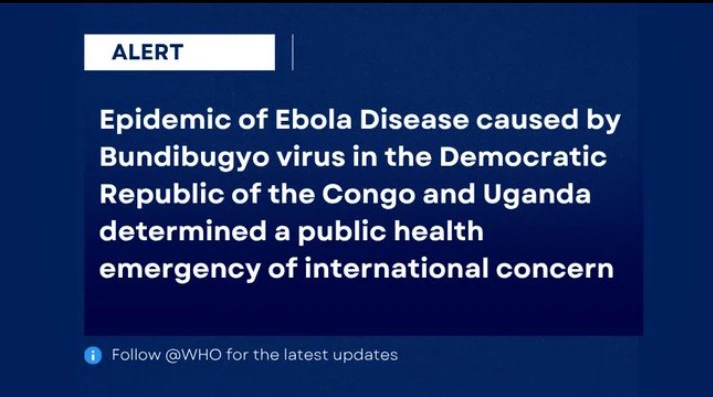
Geneva, May 17: The World Health Organization (WHO) on Sunday declared the ongoing Ebola outbreak in the Democratic Republic of the Congo (DRC) and Uganda a Public Health Emergency of International Concern (PHEIC), raising alarm over the rapid spread of the rare Bundibugyo strain of the virus across borders in Central and East Africa.
The declaration came as health authorities confirmed 87 deaths and 336 suspected infections linked to the outbreak as of May 16. Officials warned that the actual number of infections could be significantly higher because the virus may have circulated undetected for weeks in remote and conflict-affected regions before authorities formally identified the outbreak.
— World Health Organization (WHO) (@WHO) May 17, 2026
The outbreak is centered in Ituri Province in northeastern DRC, particularly in the Mongbwalu, Rwampara and Bunia health zones. However, the disease has already spread beyond the region.
Ugandan authorities confirmed two laboratory-confirmed Ebola cases in Kampala within a 24-hour period between May 15 and 16. One of the patients, a 59-year-old Congolese man who had travelled from the DRC, died after being admitted to Kibuli Muslim Hospital in the Ugandan capital earlier this month. Health teams have since launched emergency contact tracing operations involving healthcare workers, patients and family members who may have been exposed.
A separate confirmed case was also reported in Kinshasa, the capital of the DRC, involving a traveller returning from Ituri Province. The emergence of infections in major urban centres has heightened fears among epidemiologists that the outbreak could spread further if surveillance and containment efforts fail to keep pace.
Laboratory testing conducted by the DRC’s National Institute of Biomedical Research identified the virus as Bundibugyo ebolavirus, a relatively rare strain first detected in Uganda in 2007. Unlike the more common Zaire strain of Ebola, there are currently no approved vaccines or specific antiviral treatments available for Bundibugyo infections.
Medical teams are therefore relying largely on supportive treatment, including hydration, oxygen support and electrolyte management, while attempting to isolate infected patients and prevent further transmission.
ALSO READ: Ebola Symptoms, Treatment and Prevention in Focus as Bundibugyo Outbreak Spreads
Public health experts say the unusually high number of deaths recorded before the outbreak was officially declared indicates that surveillance systems may have failed to detect the spread early enough.
When authorities announced the outbreak on May 15, they also reported around 80 suspected community deaths linked to unexplained illnesses. Epidemiologists noted that recent Ebola outbreaks are usually detected after a few dozen suspected infections, making the scale of this outbreak at the time of discovery particularly concerning.
Researchers and global health specialists believe the delay may have allowed the virus to spread through communities for several weeks, complicating efforts to trace contacts and contain transmission chains.
The current outbreak is already considered the largest recorded Bundibugyo Ebola outbreak in history. Previous outbreaks involving the strain recorded 131 cases in 2007 and 38 cases in 2012.
Conditions in Ituri Province have further complicated emergency response operations. The region remains heavily affected by armed violence and militant activity, limiting the ability of health workers to safely conduct surveillance and community outreach.
Mongbwalu, one of the worst-hit areas, is also a major mining town with high levels of population movement. Public health officials fear that constant travel between mining communities and nearby urban centres could accelerate the spread of infections across provincial and national borders.
Residents in Bunia have described growing fear and confusion as deaths continue to rise. Reports from the ground suggest that many communities initially struggled to identify the illness because symptoms resembled other common diseases.
Health authorities are also investigating possible hospital-based transmission after at least four healthcare workers reportedly died while treating patients with symptoms consistent with viral haemorrhagic fever. The deaths have raised concerns about gaps in infection prevention and protective equipment inside local health facilities.
In response, regional and international health agencies have intensified emergency coordination efforts.
The Africa Centres for Disease Control and Prevention (Africa CDC) convened urgent meetings involving officials from the DRC, Uganda and South Sudan, along with partners including WHO, UNICEF and the United States Centers for Disease Control and Prevention.
Africa CDC has deployed emergency response teams to affected regions and activated a special incident management structure to support surveillance, laboratory testing and medical logistics.
WHO’s Regional Office for Africa has meanwhile dispatched emergency preparedness teams to Ituri Province and begun airlifting medical supplies from Kinshasa to Bunia. According to officials, the shipment includes laboratory materials, infection prevention equipment and temporary treatment facilities.
WHO Regional Director for Africa Dr Mohamed Janabi said the organisation was mobilising resources and technical expertise to help contain the outbreak and reduce fatalities.
The PHEIC declaration is among the highest levels of international public health alerts issued by WHO and is intended to mobilise global cooperation, funding and emergency response coordination.
Despite the seriousness of the outbreak, WHO clarified that the situation does not currently qualify as a pandemic emergency. Experts maintain that while regional spread remains a major risk, the likelihood of sustained transmission outside Africa remains low at present.
The DRC has experienced repeated Ebola outbreaks since the virus was first identified near the Ebola River in 1976. This marks the country’s 17th recorded Ebola outbreak.
However, health experts say the combination of a rare viral strain, delayed detection, armed conflict and the absence of vaccines has created one of the most difficult Ebola emergencies in recent years.
Containment efforts are now focused on rapid case detection, strict isolation measures, safe burial practices and public awareness campaigns aimed at encouraging communities to report symptoms early and cooperate with health authorities.
WHO has advised countries against imposing blanket travel or trade restrictions, warning that border closures often push movement into informal crossings that are harder to monitor. Instead, the agency has urged governments in the region to strengthen screening procedures at airports, land borders and transport hubs to identify travellers showing symptoms of illness.