112 prominent citizens from across India have appealed for an immediate peace process in Manipur, warning that the state's violence has entered a more dangerous phase involving multiple communities.
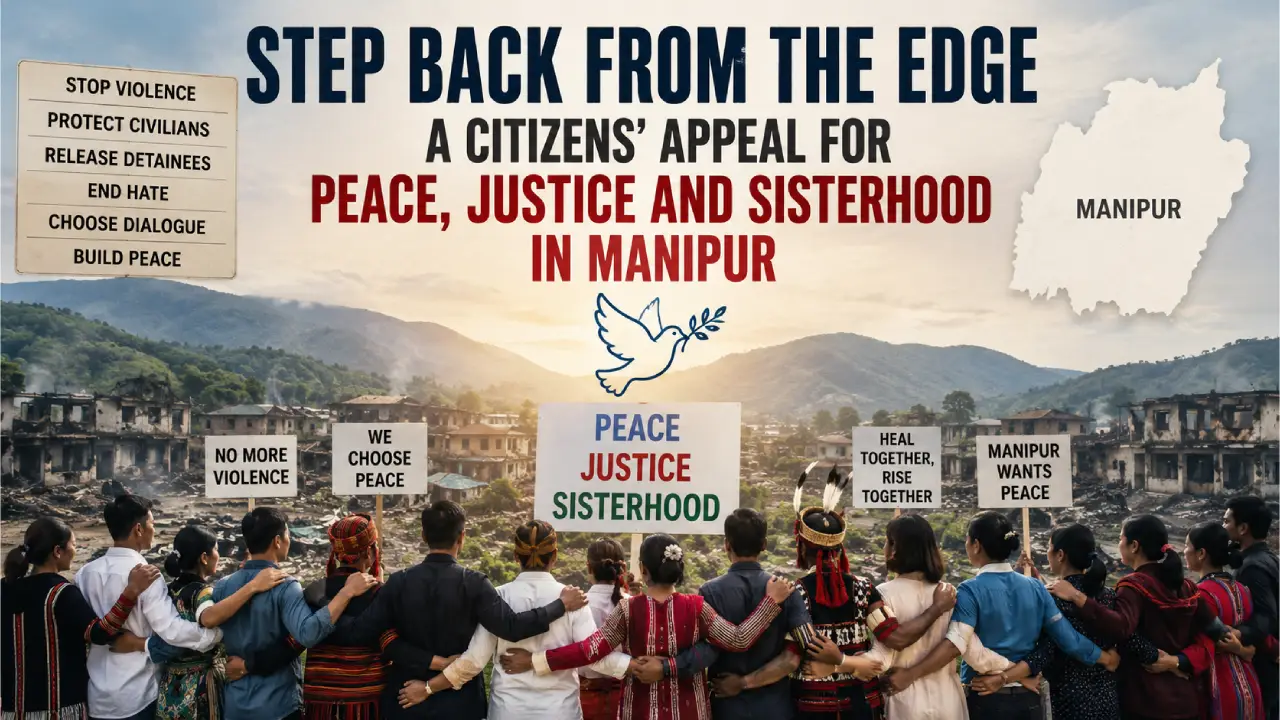
Imphal, June 26: A group of 112 writers, filmmakers, journalists, academics, economists, women's rights activists and civil society representatives from across the country has issued a fresh appeal urging the Government of India and the Manipur government to take immediate steps to halt the continuing violence in Manipur, warning that the conflict has entered a "wider and more dangerous phase" involving multiple communities.
Released in New Delhi on Friday to coincide with the 51st anniversary of the declaration of the Emergency in India, the statement titled "Step Back from the Edge: A Citizens' Appeal for Peace, Justice and Sisterhood in Manipur" has been facilitated by the South Asian Solidarity Collective, Friends of the Earth India and Delhi Solidarity Group.
The appeal comes amid renewed tensions in parts of Manipur following recent incidents involving Naga and Kuki communities, which the signatories said risk expanding what began as the Meetei-Kuki-Zo conflict in May 2023 into a broader confrontation.
According to the statement, Manipur has endured more than three years of violence, displacement, militarisation, fear and social division.
"What began in May 2023 as a devastating Meetei-Kuki-Zo conflict has now entered a wider and more dangerous phase, with recent escalation involving Naga and Kuki communities," the appeal states, adding that this must not be allowed to become "a war of all against all."
The signatories emphasised that the appeal was not intended to blame any particular community but instead sought to protect civilians irrespective of ethnicity.
It mourns the loss of lives among Kuki-Zo, Meetei, Naga and other communities and calls for the release of detainees and hostages, tracing of missing persons, dignified return of mortal remains, humanitarian access, safe relief corridors, rebuilding of homes and restoration of education.
The statement says, "This is not the time for competitive victimhood or collective blame."
It further states: "No political claim, historical grievance, ethnic wound, territorial dispute or religious identity can justify the killing of civilians, hostage-taking, attacks on places of worship, burning of homes, targeting of women, or collective punishment of any community."
The appeal also acknowledges recent efforts by sections of civil society aimed at reducing tensions.
It specifically refers to the intervention by Naga civil society organisations that helped secure the release of 14 Kuki detainees from Naga custody despite what it described as intense public anger.
According to the statement, such actions demonstrate that community institutions can still prioritise responsibility over revenge during periods of conflict.
A major concern raised in the appeal is the possible impact of the continuing violence on long-running peace negotiations across the Northeast.
The signatories note that over the past three decades, the Government of India has entered into several ceasefire agreements and political negotiations with different armed organisations and communities in the region.
The statement specifically highlights the Indo-Naga peace process, initiated through the 1997 ceasefire agreement with the NSCN-IM, describing it as one of the region's most significant political processes.
It warns that if communities lose confidence in ceasefires and negotiated settlements, the entire region could face renewed instability and insecurity.
The appeal has drawn support from a wide cross-section of public figures.
Among the signatories are filmmakers Anand Patwardhan, Suhasini Mulay, Meghanath and Asha A. Joseph; writers and poets K. Satchidanandan, Sara Joseph, Badri Raina, P.N. Gopeekrishnan, Anwar Ali and Peggy Mohan; journalists John Dayal, Pamela Philipose and Latha Jishnu; former Planning Commission member Dr Syeda Hameed; former civil servants Harsh Mander and V. Venugopal; economists Amit Bhaduri, Prof Manoranjan Mohanty and Dr Ghanshyam Shah.
The list also includes feminist scholars and activists such as Uma Chakravarti, Rita Manchanda, Nandini Sundar, Radha Kumar, Ruth Manorama, Vibhuti Patel, Chayanika Shah, Kalyani Menon Sen, Lara Jesani, Gabriele Dietrich and Sujata Gothoskar, along with environmental activists, public health professionals and leaders of people's movements from different parts of the country.
The organisers noted that women's rights organisations constitute a significant proportion of the signatories, including activists associated with Sahiyar (Stree Sanghathan), Stree Mukti Sanghatana, Indian Christian Women's Movement, Muslim Women's Forum, National Alliance of People's Movements (NAPM), People's Union for Civil Liberties (PUCL), AIUFWP, NFF, Friends of the Earth India and other independent feminist researchers and organisations.
Political women's rights activist Annie Raja said women had historically played a central role in preserving social harmony in Manipur.
"Woman of Manipur have historically held communities together in moments of crisis; today, women's organisations across Kuki-Zo, Naga, Meetei and other communities must be enabled to become the first custodians of peace," she said.
Former Planning Commission member Dr Syeda Hameed said the situation in Manipur had national significance.
"Manipur is not a distant borderland; it is a test of the Indian republic's constitutional morality, and the Union Government must act before faith in peace itself collapses," she said.
Nicholas Chinnappan, President of Friends of the Earth India, said the conflict was closely linked to issues relating to land, resources, militarisation and dignity.
"The violence in Manipur cannot be separated from questions of land, resources, militarisation and dignity; peace must be built on justice, not silence," he said.
The appeal urges both the Centre and the Manipur government to protect lives without discrimination, prevent further armed mobilisation, recover looted and illegal weapons from all groups, investigate killings, ensure safe movement of civilians and rebuild public trust.
It also seeks a credible, impartial and time-bound peace process involving Kuki-Zo, Meetei, Naga, Pangal, Mising, Hmar and other affected communities, with participation from women's organisations, church bodies, tribal institutions, student organisations, human rights groups, displaced persons, youth representatives and independent mediators.
Additionally, the signatories have called for an independent judicially monitored investigation into all major incidents of violence since May 2023, including killings, sexual violence, arson, destruction of places of worship, abductions, enforced disappearances, hostage-taking, custodial abuse, targeted attacks and the role of armed groups, security forces and political actors.
Concluding the appeal, the signatories state that peace cannot simply mean an absence of violence.
"Peace cannot mean silence. Justice cannot mean revenge. Fraternity and sorority cannot mean erasing historical grievances. Democracy cannot survive if communities are left to negotiate life and death through armed formations while elected governments and constitutional institutions fail in their duty," the statement says.