Tributes were paid to the martyrs of the June 18, 2001 uprising at Kekrupat as civil society groups and student leaders renewed calls for unity and peaceful coexistence in Manipur.
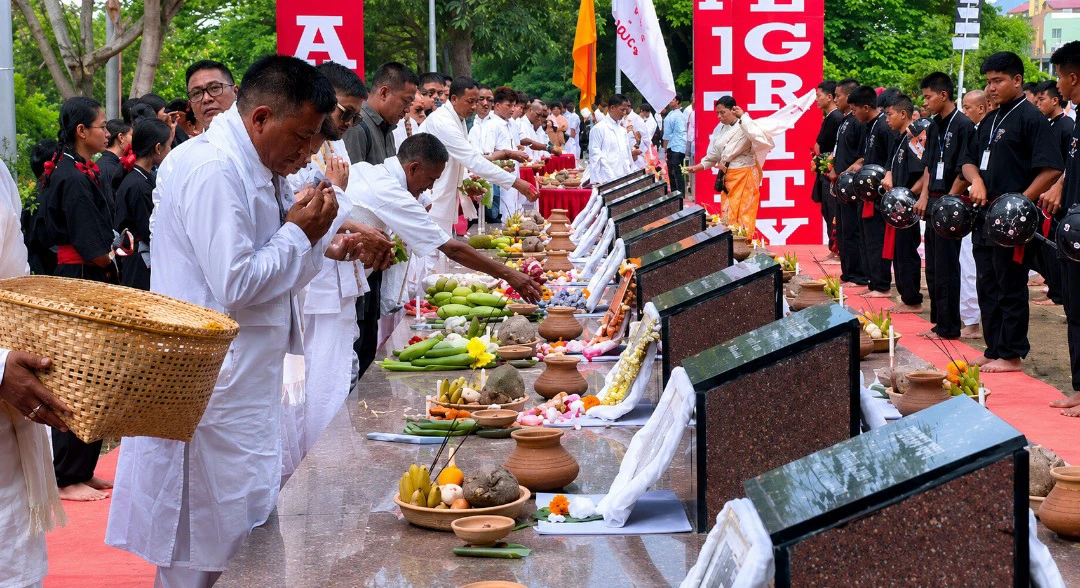
Imphal, June 19: The 25th Great June Uprising, Unity Day was observed at Kekrupat in Imphal on Thursday, with civil society leaders, student organisations, women's groups, family members of martyrs and members of the public paying homage to those who lost their lives during the June 18, 2001 movement against the extension of the ceasefire between the Government of India and the National Socialist Council of Nagalim-Isak-Muivah (NSCN-IM) beyond Nagaland.
The annual observance, organised by the Great June Uprising, Unity Day Observation Committee, commemorates one of the most significant mass movements in Manipur's recent history and honours the sacrifices made during the protests that erupted over concerns regarding the state's territorial integrity.
The programme began in the early hours of the morning with the sounding of a traditional bugle at Kekrupat, followed by the hoisting of a half-mast flag by Observation Committee chairman YK Dhiren and vice chairman S Sanjay. Thang-Ta practitioners then performed a ceremonial salute in honour of the martyrs.
As in previous years, the event drew participation from representatives of various civil society organisations, student bodies, women's groups and members of the public who gathered to remember those who lost their lives during the uprising.
Addressing the gathering, YK Dhiren said the observance is held every year to honour those who sacrificed their lives in defence of Manipur and to preserve the memory of a movement that, according to him, reflected the collective will of the people.
Dhiren spoke at length about the historical and political developments surrounding the June 18 movement. He claimed that since Manipur's merger with India, different communities in the state had continued to coexist despite possessing distinct social and political identities. However, he alleged that policies pursued by the Government of India since the 1990s had contributed to divisions among communities.
According to Dhiren, efforts to create communal tensions failed to achieve their intended objectives, leading to the emergence of policies that intensified mistrust among communities living together in the state. He said the people of Manipur eventually recognised that the conflicts affecting society were not rooted in mutual hostility but in policies that encouraged division.
Referring to the events of June 18, 2001, Dhiren described the uprising as a historic expression of public unity. He recalled how large numbers of people came onto the streets in protest against the ceasefire extension and targeted government establishments and political offices associated with the Centre.
"The uprising demonstrated the collective determination of the people to protect Manipur," he said.
Dhiren further stated that the annual observance is not only meant to remember the martyrs but also to remind future generations of the values of unity and collective responsibility.
Drawing parallels with the present situation in Manipur, Dhiren alleged that the policies responsible for creating divisions in the past have continued to influence developments in the state.
Referring to the violence that erupted on May 3, 2023, he claimed that indigenous communities had suffered extensive losses, including deaths and destruction of property. He alleged that external elements were involved in aggravating tensions.
Despite the ongoing crisis, Dhiren stressed the importance of peaceful coexistence among communities.
"There is no history of any community progressing or gaining strength by harbouring mutual hatred, division or communal warfare. We must coexist together," he said.
He urged leaders from all communities that have lived together for generations in Manipur to initiate dialogue and work collectively towards rebuilding trust. He also cautioned that movements based on division would ultimately prove detrimental to society.
Dhiren said the government must acknowledge and address the suffering experienced by people in the state and appealed to all communities to use the occasion to renew their commitment towards restoring peace and unity.
Vice chairman S Sanjay also addressed the gathering and emphasised the need for unity in the face of what he described as attempts to divide the people of Manipur.
He said the people of the state take pride in a history stretching back more than two millennia and asserted that the identity of Manipur had been shaped by generations of sacrifices.
According to Sanjay, the people have endured numerous hardships throughout history without surrendering their aspirations or identity.
He alleged that the Government of India had supported both Suspension of Operations (SoO) and non-SoO militant groups operating in the region and claimed that efforts to divide communities would not succeed.
Sanjay further alleged that attempts were being made to use smaller communities as instruments in larger political conflicts and compared such approaches to colonial-era divide-and-rule tactics.
"The people of Manipur are determined not to live under subjugation and will continue to defend their rights and identity," he said.
Referring to the conflict that began in May 2023, Sanjay said many people had lost their lives while others remained missing. He alleged that forces working behind the scenes were encouraging divisions within the state and urged people across communities to come together.
"This is the time for everyone to collectively save our motherland," he said.
He further stated that delays in collective action would only strengthen those seeking to exploit the situation and urged people to organise themselves and confront challenges together.
The function was attended by several prominent civil society leaders who served as presidium members.
Among them were AMUCO advisor Ito Tongbram, United Committee Manipur consultative members Yumnamcha Dilipkumar and Khomdram Ratan, All Manipur Kanba Ima Lup president Lourembam Nganbi, Poirei Leimarol Meira Paibi Apunba Manipur president Soraisam Memcha and Kanglei Ima Lup president RK Sanahanbi.
Following the formal programme, family members of the martyrs, representatives of various ethnic communities, student organisations, women's groups and members of the public offered floral tributes at the martyrs' memorial at Kekrupat.
The solemn ceremony served as a moment of remembrance for those who lost their lives during the movement and reaffirmed the significance of June 18 in the collective memory of the state.
Meanwhile, the Manipuri Students' Federation (MSF) also observed the occasion by paying homage to the June Uprising martyrs and reiterating the need for unity among the indigenous communities of Manipur.
Members of the student organisation visited the martyrs' graves at Kekrupat and offered floral garlands in remembrance of those who died during the 2001 movement.
In a statement issued on the occasion, the organisation appealed to all indigenous communities of the state to stop engaging in conflicts among themselves and instead focus on addressing the challenges confronting Manipur collectively.
According to the MSF, the present circumstances require greater cooperation and dialogue among communities.
"The time has come for us to unite and collectively face the massive challenges looming over us to emerge victorious," the organisation stated.
The student body said communities must work together to safeguard Manipur's territorial integrity and collective identity while remaining vigilant against efforts to create divisions along communal lines.
The MSF also cautioned the public against leaders who, it alleged, seek to promote divisions while claiming to represent the interests of the people.
According to the organisation, people must remain alert to attempts that could weaken social cohesion and undermine the interests of the state.
The federation further alleged that external forces continue to employ strategies aimed at weakening unity in Manipur and called upon all communities to remain prepared to confront any threat to the state's territorial integrity.
The organisation maintained that safeguarding unity remained essential for addressing the challenges currently facing the state.
Recalling the circumstances that led to the June Uprising, the MSF noted that the inclusion of the phrase "without territorial limits" in the ceasefire agreement signed in Bangkok between the Government of India and the NSCN-IM triggered widespread concern in Manipur.
According to the organisation, many people perceived the move as a threat to the state's territorial integrity, leading to widespread protests across Manipur.
The federation stated that 18 people lost their lives during the movement while five others later succumbed to injuries sustained during the agitation. Many more were injured.
MSF said the events of June 18, 2001 demonstrated the willingness of the people of Manipur to make sacrifices in defence of their land, territorial integrity and collective identity.
The organisation added that memories of the uprising remain deeply embedded in public consciousness and continue to inspire future generations.
It also acknowledged the role played by the All Manipur United Clubs' Organisation (AMUCO), the United Committee Manipur (UCM) and the people of Manipur in preserving the history of the movement through annual observances and tributes to the martyrs.
The June 18 uprising remains one of the defining moments in Manipur's contemporary political history. Triggered by opposition to the extension of the ceasefire agreement between the Government of India and the NSCN-IM beyond Nagaland, the movement drew thousands of protesters onto the streets and resulted in the deaths of 18 people.
Over the past 25 years, the day has evolved into both a memorial and a political reminder of the widespread public mobilisation that took place in defence of Manipur's territorial integrity. Every year, civil society organisations, student groups and members of the public gather at Kekrupat to honour the martyrs and reflect on the lessons of unity, solidarity and collective action associated with the movement.