Union Home Minister Amit Shah unveiled the Vision Document on Drug Control 2026–2029, launching a three-year roadmap to dismantle drug networks and strengthen anti-narcotics enforcement.
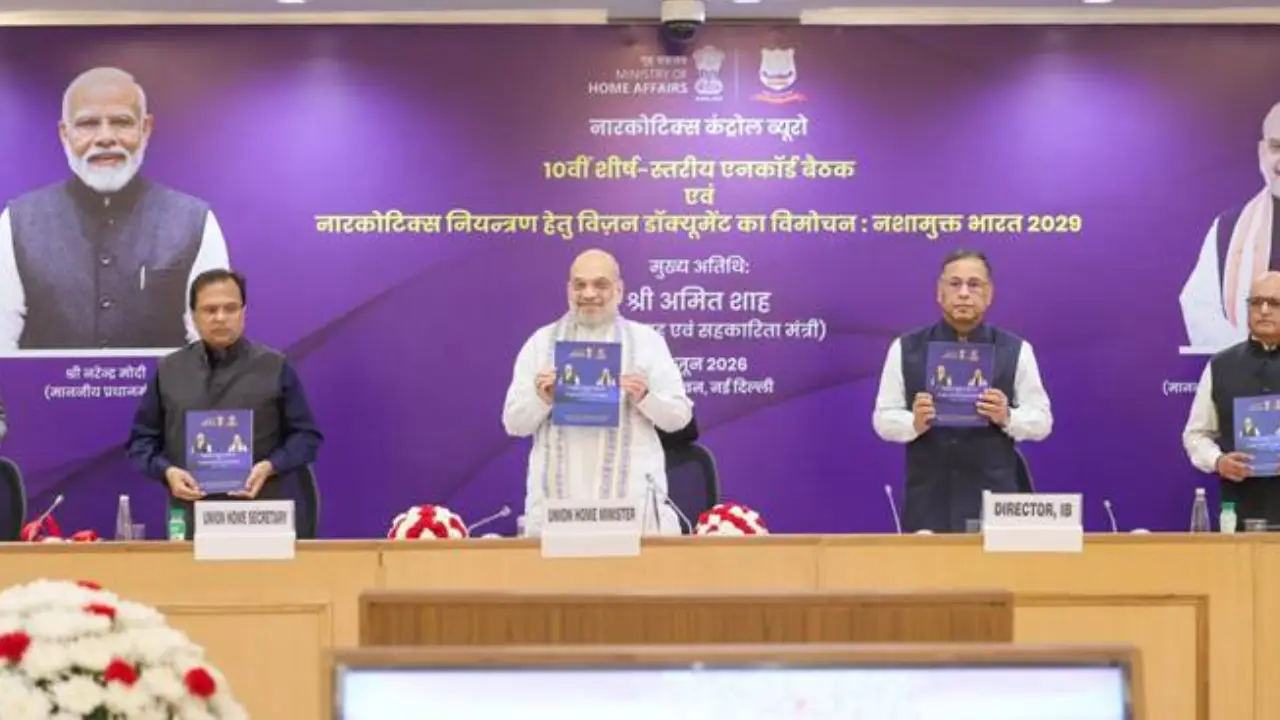
New Delhi, June 26: Union Home Minister and Minister of Cooperation Amit Shah on Friday unveiled the Vision Document on Drug Control (2026–2029) and called for a coordinated national campaign to dismantle drug trafficking networks, saying the next three years would determine whether India succeeds in defeating the menace of narcotics.
Chairing the 10th apex-level meeting of the Narco-Coordination Centre (NCORD) in New Delhi, Shah also released the NCB Annual Report-2025, inaugurated the Narcotics Control Bureau's new zonal offices in Jammu and Guwahati through virtual mode, and launched the Online Drugs Disposal Fortnight Campaign for the destruction of 2,09,500 kilograms of seized narcotics valued at around Rs.6,000 crore.
Addressing senior officials from the Centre and states, Shah said India has reached a decisive stage in its fight against drugs.
"Today our country stands at a critical turning point in the fight against narcotics, where the next three years will decide whether addiction will defeat us or we will defeat addiction," he said.
He stressed that the fight against narcotics cannot be won by a single ministry, department or state government. Instead, it requires coordinated action involving governments, law enforcement agencies, civil society, women, youth and public influencers.
Shah said the drug problem extends beyond law enforcement and public health, affecting national security, economic stability and the future of young people. He noted that drug trafficking is increasingly linked with organised crime, narco-terror financing and cross-border terrorist networks, creating what he described as an "evolving narco-terrorism ecosystem."
The Home Minister pointed out that India faces additional challenges because of its geographical location between the "Death Triangle" and the "Death Crescent"—two major international drug-producing regions. He said traffickers have adopted advanced methods including drone deliveries, containerised sea cargo, darknet marketplaces, cryptocurrency payments, parcel shipments and technology-driven distribution systems.
To counter these emerging threats, Shah said India's response must be intelligence-led, technology-driven and based on strong inter-agency coordination.
He emphasised that enforcement agencies should adopt a "ruthless approach" against drug traffickers while extending compassion and rehabilitation to individuals struggling with addiction.
"We must maintain a ruthless approach towards those involved in drug trafficking and a sympathetic approach towards the victims of drugs," he said.
The newly released Vision Document outlines a three-year roadmap built around four strategic pillars: Enforcement, Intelligence and Operations; Precursors and Synthetic Drug Control; Demand and Harm Reduction; and Capacity Building, Coordination and Monitoring.
According to Shah, the roadmap adopts both a "Whole of Government" and "Whole of Society" approach, assigning responsibilities to various ministries, state governments and citizens.
The Home Minister summarised the national anti-drug strategy in three words—Detect, Disrupt and Destroy.
Under this framework, agencies have been directed to identify and eliminate drug cartels operating at every stage of the supply chain, from international traffickers and border-based suppliers to state-level distributors. He called for greater use of human intelligence, technical surveillance and community policing, particularly in border and vulnerable districts.
He also stressed the need for coordinated monitoring of darknet activities, hawala transactions, cryptocurrency payments, ports and airports, while directing agencies to identify and destroy illegal drug laboratories and cultivation sites.
Shah said financial investigations under the Prevention of Money Laundering Act (PMLA) should become mandatory in major NDPS cases to dismantle the financial backbone of trafficking syndicates.
Calling for stronger prosecution, he urged state governments to establish exclusive NDPS courts, appoint Special Public Prosecutors and ensure real-time sharing of intelligence among enforcement agencies.
The Home Minister also assigned responsibilities to various ministries. The Ministry of Social Justice and Empowerment was asked to expand awareness campaigns, rehabilitation and de-addiction programmes, while the Ministry of Health was directed to strengthen monitoring of pharmaceutical diversion and online pharmacies. The Ministry of Education was tasked with implementing the Drug-Free Campus framework across educational institutions.
He further urged states to strengthen their Anti-Narcotics Task Forces (ANTFs) by converting them into dedicated, fully equipped full-time units and making district and state-level NCORD meetings more outcome-oriented.
Highlighting the government's achievements in combating narcotics, Shah said the scale of enforcement has increased significantly over the past decade.
Between 2004 and 2014, authorities seized drugs worth Rs.40,000 crore, amounting to about 26 lakh kilograms. From 2014 to 2026, however, agencies seized drugs worth Rs.1.84 lakh crore, totalling approximately 1.18 crore kilograms.
Similarly, while drugs worth Rs.8,000 crore weighing 3.26 lakh kilograms were destroyed between 2004 and 2014, the figure rose to drugs worth Rs.89,896 crore weighing 42.47 lakh kilograms during the period from 2014 to 2026.
Shah also said the destruction of illegal opium cultivation has expanded considerably. Around 10,000 acres of illicit cultivation were destroyed in 2020, compared to 42,282 acres in 2025.
He further stated that NDPS-related cases registered across the country increased from 1.73 lakh between 2004 and 2014 to 8.75 lakh cases between 2014 and 2026, while arrests rose from 1.95 lakh to 10.97 lakh during the same period.
Concluding his address, Shah expressed confidence that India could significantly weaken drug trafficking networks over the next three years through coordinated efforts, strict enforcement and timely implementation of the national roadmap.