As Manipuri cinema moves beyond 50 years, filmmakers and institutions are focusing on mentorship, script development and global engagement to shape its future.
Imphal, June 19: More than five decades after the release of Matamgi Manipur marked the beginning of modern Manipuri cinema, the state's film industry is entering a new phase defined by experimentation, mentorship and efforts to build a sustainable creative ecosystem.
While Manipuri cinema has earned national and international recognition over the years, filmmakers and cultural institutions continue to grapple with familiar challenges, including limited funding, a small market, inadequate distribution networks and changing audience preferences. Yet recent developments suggest that the industry is actively seeking new ways to strengthen itself and remain relevant in an increasingly competitive global landscape.
The journey of Manipuri cinema formally began in 1972 with the release of Matamgi Manipur, widely regarded as the state's first feature film. Since then, the industry has experienced multiple transformations, navigating political instability, economic constraints and technological shifts while continuing to produce films that reflect the region's culture, history and social realities.
Today, as the industry moves beyond its golden jubilee, attention is increasingly focused on creating opportunities for emerging filmmakers and nurturing projects from the earliest stages of development.
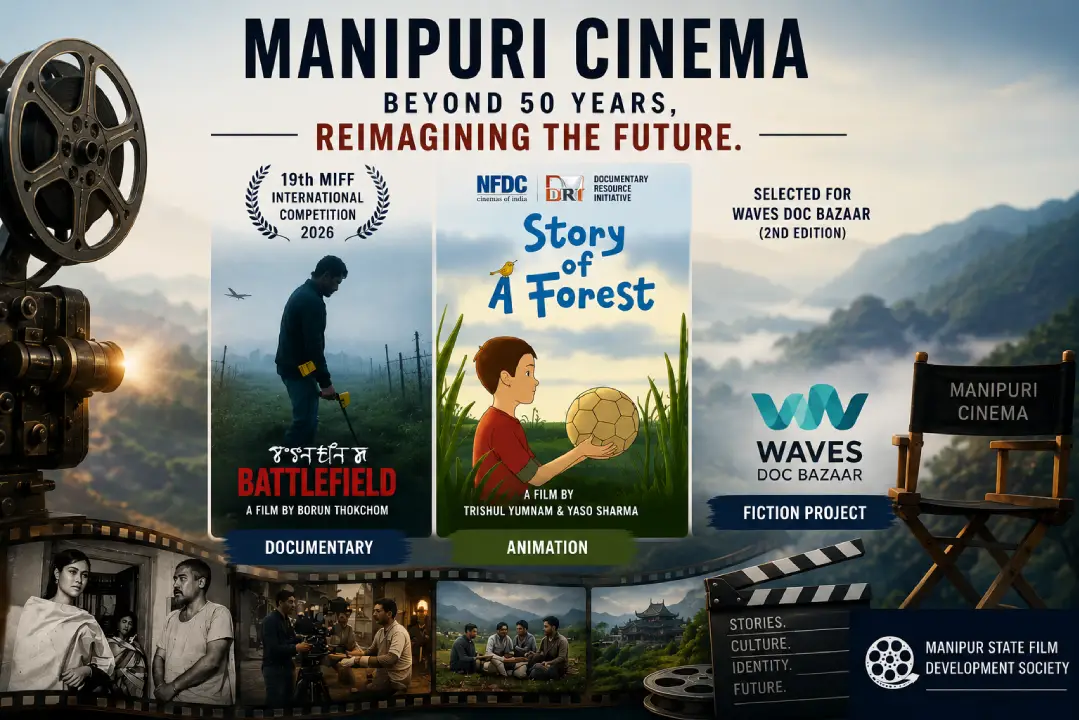
Recent participation at the 19th Mumbai International Film Festival (MIFF) 2026 highlighted this evolving landscape. Manipuri filmmakers secured representation across documentary, animation and fiction categories, reflecting the diversity of contemporary filmmaking practices emerging from the state.
Among the projects that attracted attention was Battlefield, a documentary by filmmaker Thokchom Borun that was selected for the International Competition section of the festival. The documentary revisits Manipur's World War II history and explores the long-lasting consequences of conflict. The project reportedly took more than a decade to complete and has been recognised as a significant contribution to documentary filmmaking from the region.
Manipuri representation at the festival extended beyond documentary cinema. The animated short film Story of a Forest, directed by Trishul Yumnam and Yaso Sharma, competed in the National Animation section. Meanwhile, filmmaker Dingko Thingnam's fiction project Eche was selected for the second edition of the WAVES Doc Bazaar, a platform designed to connect filmmakers with potential collaborators, producers and industry professionals.
These achievements are being viewed not merely as isolated successes but as evidence of a gradual effort to strengthen the foundations of the industry.
A central role in this process has been played by the Manipur State Film Development Society (MSFDS), which has increasingly focused on capacity-building initiatives aimed at supporting filmmakers during the development stage of their projects.
For many regional film industries, one of the biggest obstacles is not a lack of talent but the absence of structured guidance and mentorship. Promising ideas often struggle to evolve into fully developed screenplays or well-structured documentary projects due to limited access to professional feedback and development opportunities.
Recognising this challenge, MSFDS has introduced programmes that focus on strengthening storytelling and project development rather than concentrating solely on production assistance.
One of its notable initiatives is Imphal-Documentor, a documentary project development and mentorship programme conducted in collaboration with Documentary Resource Initiative, Kolkata. The programme seeks to help filmmakers refine their ideas, improve narrative structure and prepare projects for wider audiences.
The impact of the initiative has already become visible through several projects. According to the organisers, Battlefield benefited significantly from the mentorship process, helping its creator develop a clearer approach to telling a complex historical story. Another acclaimed documentary, Andro Dreams by filmmaker Meena Longjam, also emerged through the same platform and went on to receive critical appreciation.
Beyond documentaries, efforts have also been directed toward fiction filmmaking. Through its Screenwriter's Project Development and Mentorship Lab, MSFDS has encouraged writers and directors to strengthen scripts and prepare projects for larger national and international opportunities.
The initiative aims to equip filmmakers with skills required to compete in co-production markets, development labs and festival platforms where strong storytelling and project presentation are often as important as technical execution.
Projects such as The Scent of a Ripening Field and Night & Day have already begun attracting attention outside Manipur, demonstrating how focused mentorship and script development can help regional stories reach broader audiences.
Film observers note that while infrastructure remains important, long-term growth in cinema often depends on investment in people, ideas and creative processes. Mentorship, script consultations and project development support can play a crucial role in helping filmmakers transform concepts into compelling cinematic works.
For Manipuri cinema, such initiatives are particularly significant given the limitations under which many filmmakers continue to operate. Production budgets remain modest, theatrical exhibition opportunities are limited and commercial returns are often uncertain. In such an environment, institutional support for creative development becomes an important tool for sustaining artistic momentum.
The history of Manipuri cinema itself reflects a tradition of resilience and adaptation. From its pioneering years in the 1970s to the rise of the video-film era and the emergence of contemporary independent filmmakers, the industry has repeatedly adjusted to changing circumstances.
Despite ongoing challenges, the sector continues to produce filmmakers willing to experiment with new forms of storytelling while maintaining strong connections to local realities and cultural identity.
As Manipuri cinema enters its post-50 phase, stakeholders believe its future will depend not only on celebrating past achievements but also on creating opportunities for the next generation of filmmakers. Strengthening mentorship networks, encouraging innovation and expanding access to national and international platforms are increasingly being viewed as essential components of that journey.
While the road ahead remains challenging, recent developments indicate that Manipuri cinema is steadily building the foundations needed for its next chapter—one driven by creativity, collaboration and a commitment to nurturing new voices.