The bodies of six Naga civilians abducted in May were recovered near a Kuki village after a major search operation, a day after 14 Kuki hostages were released.
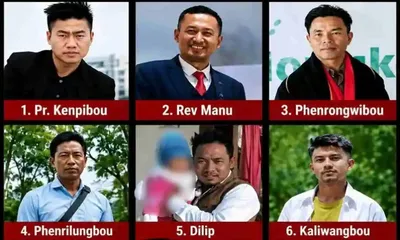
Imphal, June 10: The bodies of six Naga civilians who had been missing since May 13 were recovered on Wednesday following an extensive search operation by security forces in Manipur, bringing a tragic end to a case that had triggered widespread protests, legal intervention and growing concern across Naga-inhabited areas of the state.
The recovery came less than a day after 14 Kuki civilians, who had been held captive for nearly four weeks, were released in Senapati district, adding a dramatic and troubling new dimension to an already tense hostage crisis involving communities from both sides of Manipur's ethnic conflict.
In a statement posted on X, Manipur Police said that the mortal remains of six persons were recovered on the afternoon of June 10 after nearly 24 hours of continuous search operations involving around 450 personnel drawn from the Manipur Police, Central Reserve Police Force (CRPF) and Assam Rifles.
The operation was supported by sniffer dogs and forensic expert teams.
"After nearly 24 hours of sustained search operations involving around 450 personnel of the Manipur Police, CRPF, and Assam Rifles, assisted by sniffer dogs and forensic expert teams, the mortal remains of six persons were recovered afternoon of June 10. The deceased are believed to be among those taken hostage from Leilon Vaiphei on 13 May 2026," the police statement said.
Police added that legal formalities are underway and that an investigation has been launched into the incident.
The six victims were reportedly among a group of Naga civilians who were abducted from Leilon Vaiphei village on May 13.
Their disappearance had sparked growing anxiety across Senapati district and other Naga-inhabited areas. Family members, civil society organisations and village authorities repeatedly appealed to the government and security agencies to intensify efforts to trace the missing villagers.
As days turned into weeks without any confirmed information regarding their whereabouts, frustration and anger grew among local communities.
Since May, large protests were organised demanding immediate action from the government. Community leaders warned that prolonged inaction could deepen tensions and further erode public confidence in the state's ability to protect civilians living in conflict-affected areas.
Protesters had accused authorities of failing to make meaningful progress in locating the abducted villagers despite repeated appeals from affected families and community organisations.
The issue later reached the Manipur High Court through a Public Interest Litigation (PIL).
Earlier this month, the High Court sought an Action Taken Report (ATR) from the state government regarding the disappearance of the six villagers. The court's intervention reflected the seriousness of the case and the growing public concern surrounding the fate of the abducted civilians.
At the time, neither security agencies nor government officials had publicly disclosed any breakthrough in the investigation.
The bodies were recovered during a large-scale search operation launched after fresh intelligence inputs, according to security sources.
While authorities have not officially disclosed the exact circumstances surrounding the deaths, the recovery reportedly took place in the vicinity of a Kuki village.
Police have not yet released details regarding the condition of the bodies, the cause of death, or whether any arrests have been made in connection with the case.
Forensic examinations and other legal procedures are expected to play a crucial role in determining what happened after the victims were abducted nearly a month ago.
Officials have also not formally identified the deceased pending completion of legal procedures, although police indicated they are believed to be among the six persons taken hostage from Leilon Vaiphei.
The discovery is likely to intensify demands for accountability and answers from investigating agencies.
The recovery has drawn particular attention because it occurred barely a day after the release of 14 Kuki hostages who had spent 27 days in captivity.
The 14 Kuki civilians were released on June 9 following negotiations and intervention by local leaders, community organisations and security agencies.
Chief Minister Yumnam Khemchand Singh had welcomed their release, describing it as a humanitarian gesture and expressing hope that similar efforts would contribute to peace and reconciliation.
The release had briefly generated optimism that hostage-related incidents arising from the ethnic conflict could be resolved through dialogue and humanitarian intervention.
However, the discovery of the bodies of the six missing Naga civilians the following day has dramatically altered the atmosphere.
Instead of closure, the development has reopened difficult questions about civilian safety, accountability and the continuing cycle of retaliatory violence in parts of the state.
The case highlights one of the most troubling aspects of the ongoing conflict in Manipur: the increasing vulnerability of ordinary civilians.
Since ethnic violence erupted in May 2023, incidents involving kidnappings, disappearances, hostage-taking and killings of non-combatants have repeatedly complicated efforts to restore normalcy.
Security operations have often focused on armed groups and volatile buffer zones. However, civilians living in villages located near contested areas continue to face significant risks.
The disappearance of the six villagers and the captivity of the 14 Kuki civilians illustrate how local populations can become trapped between competing armed actors, ethnic tensions and weak communication channels across conflict zones.
The hostage crisis also exposed the limitations of existing security arrangements.
Despite the deployment of multiple security agencies across Manipur, abducted civilians remained untraced for weeks, raising concerns among residents regarding intelligence gathering, coordination and response mechanisms.
The recovery of the six bodies is likely to have implications far beyond the immediate criminal investigation.
First, it may deepen mistrust between communities already divided by years of violence and displacement. The fact that the bodies were recovered shortly after the release of Kuki hostages risks being interpreted through competing ethnic narratives, potentially complicating reconciliation efforts.
Second, the development places additional pressure on the state government and security agencies. Public expectations had risen following the successful recovery and release of the 14 Kuki captives. The discovery of the six deceased hostages now raises difficult questions about whether earlier intervention could have changed the outcome.
Third, the incident is expected to increase demands for a more transparent mechanism to deal with missing persons and hostage situations in conflict-affected areas. Families of missing individuals have repeatedly complained about the absence of regular updates and coordinated communication from authorities.
Fourth, the case may become a significant test for the criminal justice system. A thorough investigation, backed by forensic evidence and credible prosecution where necessary, will likely be viewed as essential to maintaining public confidence.
Beyond the immediate legal questions, the tragedy serves as a reminder that many of the deepest wounds of the conflict remain unresolved. While political discussions often focus on territorial disputes, security arrangements and negotiations, incidents such as this underscore the human cost borne by ordinary villagers.
With the recovery of the bodies, attention has now shifted from search and rescue efforts to demands for justice and accountability.
For the families who spent nearly a month waiting for news, the discovery brings an end to uncertainty but also the beginning of a difficult search for answers.
For many in Manipur, the fate of the six villagers has become more than an isolated criminal case. It has emerged as a symbol of the insecurity, fear and unresolved tensions that continue to shape life in parts of the state more than three years after the outbreak of ethnic violence.