Cabinet approves Rs 10,000 crore ATF price stabilisation support for airlines to manage fuel volatility and sustain air connectivity.
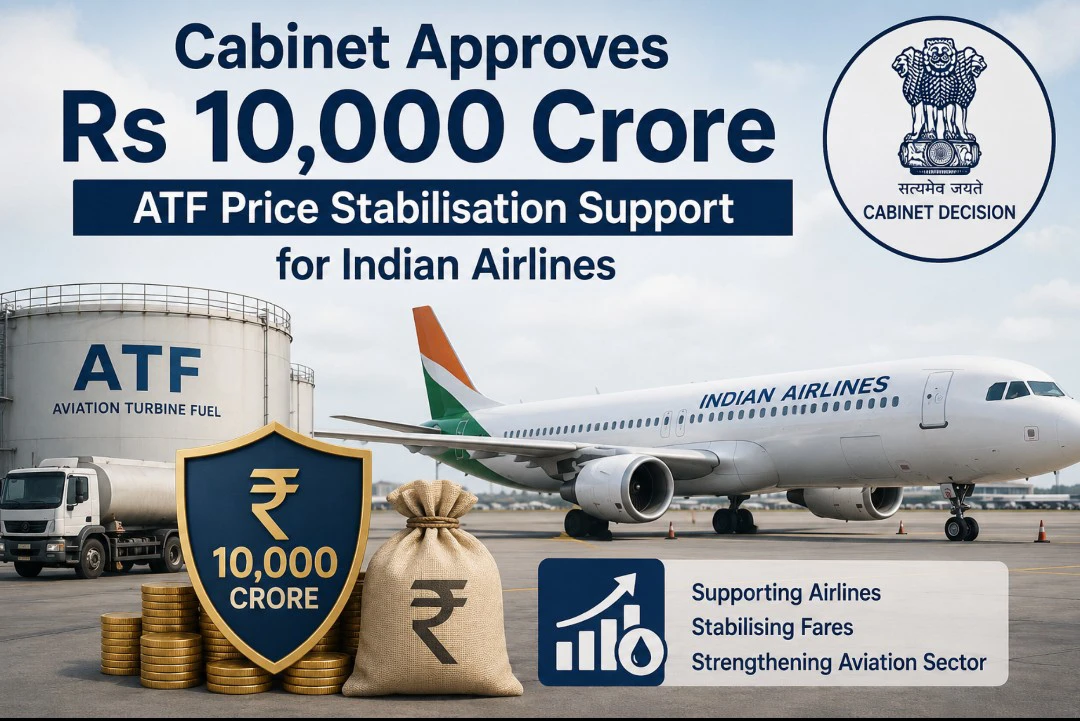
New Delhi, June 3: The Union Cabinet, chaired by Prime Minister Narendra Modi, has approved a one-time budgetary support of up to Rs 10,000 crore to help stabilise Aviation Turbine Fuel (ATF) prices for Scheduled Indian Airlines amid sharp volatility in global fuel markets linked to the ongoing West Asia crisis.
According to the government, the support will be provided to Oil Marketing Companies (OMCs) in the form of interest-free advances through the Ministry of Petroleum and Natural Gas. The assistance is intended to enable OMCs to offer a fixed-price ATF arrangement to participating Indian carriers operating both domestic and international services.
The Cabinet-approved mechanism seeks to reduce airlines’ exposure to sudden fuel price spikes, improve cost predictability and help maintain air connectivity across the country and international routes.
Under the scheme, OMCs will be compensated when the prevailing Import Parity Price (IPP) of ATF exceeds a benchmark price determined under the approved framework. The government said the support corpus would cover losses incurred by OMCs during periods of elevated international fuel prices.
A recovery and settlement mechanism has also been built into the arrangement. When global ATF prices decline, the differential amount will be recovered from OMCs and returned to the Consolidated Fund of India. The process will continue until the entire support amount is fully recovered and reconciled.
The scheme will be open to all willing Scheduled Indian carriers for both domestic and international operations. Participating airlines will enter into a memorandum of understanding with OMCs, with the Ministry of Civil Aviation and the Ministry of Petroleum and Natural Gas acting as signatories.
As part of the arrangement, airlines opting into the scheme will procure ATF exclusively from OMCs for a period of up to three years, subject to annual review or until the advance amount is fully recovered, whichever is earlier.
The government has also put in place a monitoring framework. A committee comprising representatives from the Ministry of Civil Aviation, the Ministry of Petroleum and Natural Gas and the Department of Expenditure will oversee implementation, claim verification, reconciliation and settlement. All claims and recoveries will be subject to audit.
The ATF price stabilisation support will remain in force for 36 months, with provision for annual review. The duration may be extended with approval from the competent authority if the corpus has not been fully settled within the prescribed period.
The government said the initiative is expected to provide greater financial certainty to airlines, support operational planning and help moderate fare volatility for passengers. It is also intended to protect OMCs from losses arising from unusually high fuel prices during the current geopolitical crisis.
Officials noted that the aviation sector has been facing severe pressure following a sharp rise in global ATF prices. International ATF prices increased from Rs 60.50 per litre in March 2026 to around Rs 142 per litre in May 2026, according to official data. Fuel accounts for nearly 40 per cent of airline operating costs and can rise to as much as 60 per cent during periods of extreme volatility.
The government also pointed to the impact of the closure of Pakistan’s airspace for Indian carriers, which has resulted in longer flight paths to Europe, North America and Central Asia, increasing fuel consumption and operating costs. Higher costs have contributed to rising international airfares and reduced demand on some long-haul routes.
According to the Cabinet decision, the support mechanism is expected to help sustain domestic and international connectivity, including services to remote and regional destinations, while generating positive effects for tourism, trade, logistics, hospitality and related sectors.