Manipur Chief Minister Yumnam Khemchand Singh told the NITI Aayog Governing Council that the state is steadily recovering from conflict and sought greater Central support for rehabilitation, border security, education, healthcare and connectivity.
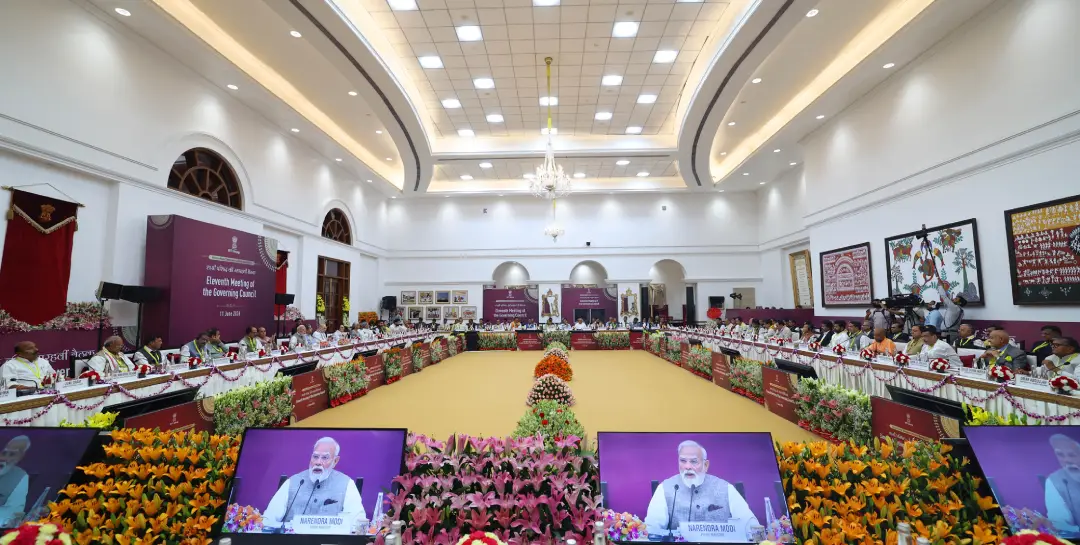
Imphal, June 11: Chief Minister Yumnam Khemchand Singh on Thursday used the platform of the 11th Governing Council Meeting of NITI Aayog to present Manipur’s ongoing recovery efforts, seek additional Central assistance for conflict-hit communities and press for stronger investments in border security, infrastructure, education and employment generation.
Addressing the meeting chaired by Prime Minister Narendra Modi in New Delhi, Khemchand said Manipur was gradually emerging from one of the most difficult periods in its recent history and was moving towards peace, reconciliation and development with support from the Centre.
The meeting, held under the theme “Inclusive Human Development for Viksit Bharat@2047”, was attended by Union ministers, state chief ministers, lieutenant governors and senior officials of NITI Aayog.
In his address, the Chief Minister thanked the Prime Minister and Union Home Minister Amit Shah for their support in improving the law and order situation in Manipur.
He said the combined efforts of the Central and State governments had helped create conditions for gradual normalisation across the state.
A significant portion of his speech focused on the rehabilitation of internally displaced persons (IDPs), many of whom have remained in relief camps since the outbreak of ethnic violence in May 2023.
According to the Chief Minister, phased resettlement under the state's Rehabilitation and Resettlement Package is progressing with Central assistance. He informed the council that around 11,000 displaced families have already been resettled and that efforts are underway to rehabilitate the remaining families as quickly as possible.
Khemchand also welcomed the Centre’s approval of 5,000 additional houses under the PMAY-G scheme for 2026-27, describing the support as crucial for restoring normal life among affected communities. He, however, urged the Central Government to provide further assistance to accelerate rehabilitation and ensure long-term livelihood security for displaced families.
The Chief Minister stated that since his government assumed office on February 4, 2026, it has worked not only to restore peace but also to rebuild trust among communities divided by the conflict.
He highlighted a series of outreach efforts undertaken over the past few months, including visits to relief camps in Imphal and Jiribam and interactions with communities in hill districts.
According to Khemchand, he travelled to Senapati through Kangpokpi district and met members of both Naga and Kuki communities. He also interacted with displaced persons from Kangpokpi and Churachandpur districts through video conferencing.
These engagements, he said, were intended to encourage dialogue, confidence-building and reconciliation.
The Chief Minister devoted particular attention to developments in Jiribam district, which he described as a promising example of grassroots peace building.
Recalling his visits to the district, first by helicopter and later by road, Khemchand said Jiribam had demonstrated that communities affected by violence could coexist peacefully and rebuild mutual trust.
He noted that members of Meitei, Kuki, Paite and Hmar communities had come together peacefully and shared a meal, describing the event as a powerful symbol of reconciliation.
The Chief Minister further informed the council that displaced residents from Jiribam had started returning to their original homes, a development he described as encouraging for the broader peace process.
He expressed hope that the “Jiribam model” could be replicated across other conflict-affected districts and requested greater Central assistance to support rehabilitation, restore dignity and strengthen livelihoods for returning families.
Khemchand also highlighted security concerns arising from the prolonged instability in neighbouring Myanmar.
Sharing Manipur’s strategic concerns, he stressed the importance of stronger management of the Indo-Myanmar border and called for improved surveillance infrastructure.
The Chief Minister said enhanced coordination between agencies was necessary to combat drug trafficking, arms smuggling and human trafficking networks operating across the international border.
He informed the Governing Council that the Ministry of Home Affairs had completed 50 kilometres of border fencing and that work on an additional 80 kilometres had already begun.
The issue assumes particular importance for Manipur because of its long and porous international boundary with Myanmar, which has increasingly become a focus of national security and anti-narcotics operations in recent years.
His remarks reflected the state government's view that lasting peace within Manipur is closely linked to effective border management and efforts to curb illegal cross-border activities.
On healthcare, the Chief Minister pointed to several achievements that he said reflected improvements in public service delivery despite the challenges posed by the conflict.
He informed the meeting that more than 1.4 lakh free treatments worth over ?181 crore had been provided under the Ayushman Bharat programme and the Chief Ministergi Hakshelgi Tengbang scheme.
The Chief Minister also stated that Manipur currently records the lowest Infant Mortality Rate in the country.
The healthcare sector has remained under pressure since the outbreak of violence, with many medical institutions facing disruptions. Against this backdrop, the state government has repeatedly emphasised the importance of expanding access to healthcare services and strengthening public health infrastructure.
Khemchand also used the meeting to advocate for greater Central investment in higher education and research infrastructure.
He said Manipur’s Gross Enrolment Ratio in higher education stood at 35.5 per cent, significantly higher than the national average of 28.4 per cent.
According to him, the state is carrying out mission-mode recruitment of teaching faculty while universities are aligning themselves with reforms under the National Education Policy (NEP) 2020 and the National Credit Framework.
Seeking additional support, the Chief Minister requested that Manipur be included in the proposed national Research and Innovation Parks and Mega Educational Hubs initiative.
He proposed the establishment of a regional innovation node linking universities, technical institutions such as NIT and IIIT, and local industry clusters.
Such an initiative, he argued, would help create stronger connections between academic institutions, research activity and economic development.
The Chief Minister also highlighted ongoing efforts to improve employment opportunities for Manipuri youth through skill development programmes.
He informed the meeting that youths trained in the Japanese language through partnerships involving the state's Skill Development Department and the National Skill Development Corporation had secured employment in Japan’s healthcare and hospitality sectors.
In addition, he said young people from Manipur have also obtained placements in Dubai, Abu Dhabi, Portugal and the United States through the Deen Dayal Upadhyaya Grameen Kaushalya Yojana (DDU-GKY).
Seeking further support, Khemchand requested Central assistance for the modernisation of Industrial Training Institutes (ITIs) and polytechnics under an industry-linked hub-and-spoke model.
According to him, such reforms would help ensure that trained youth are able to transition directly into productive employment.
The Chief Minister also called for accelerated investments in transport and trade infrastructure, arguing that connectivity remains central to Manipur’s long-term economic future.
He urged the Centre to expand the coverage of the Aspirational Districts and Aspirational Blocks programmes to include more areas of the state.
Khemchand further sought faster implementation of national highway, railway and border trade projects, particularly those linked to Moreh, Manipur’s key trading gateway with Myanmar.
He argued that improved connectivity would allow the state to fully realise its strategic importance under India’s Act East Policy and strengthen its role as a bridge between India and Southeast Asia.
For decades, policymakers have viewed Manipur as a critical component of India’s eastward economic engagement strategy. The Chief Minister’s appeal reflects continued efforts to position the state as a major connectivity and trade hub in the region.
Concluding his address, Khemchand presented an optimistic assessment of Manipur’s recovery trajectory.
He said visible signs of normalcy were returning across both hill and valley regions, citing the reopening of schools, revival of businesses, resumption of festivals and restoration of government services.
“Offices are working, schools are reopening, festivals have returned, businesses are reviving and citizens are walking with hope once again,” he told the gathering.
The Chief Minister reiterated that his government remains committed to moving Manipur beyond conflict and towards lasting peace and development.
While acknowledging the challenges that remain, particularly in rehabilitation, reconciliation and security, he said the state was steadily progressing towards stability and economic growth.
His address at the NITI Aayog meeting was both a status report on Manipur’s recovery efforts and a detailed appeal for continued Central support, reflecting the state government's attempt to combine peace-building measures with a broader development agenda.