CRPF Director General G.P. Singh defended the April 7 Gelmol firing, assured support to personnel and outlined a tougher security strategy for Manipur amid the deployment of CoBRA units.
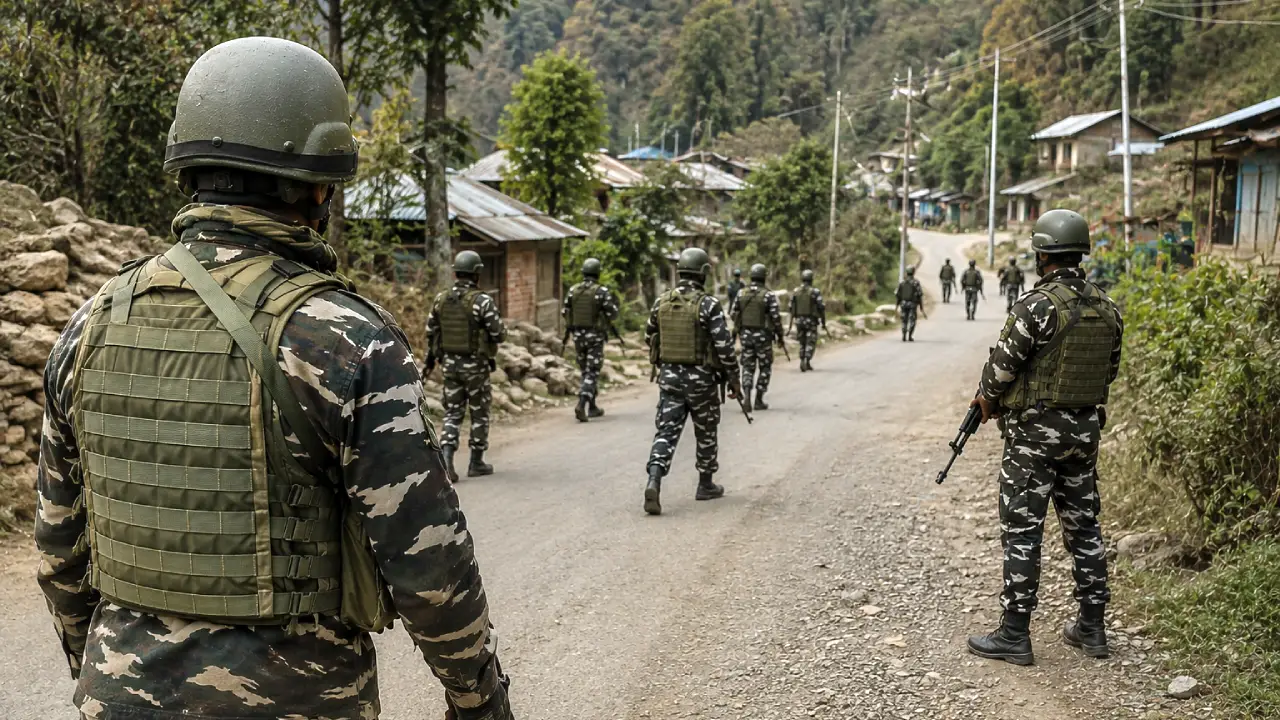
Imphal, June 8: A speech delivered by CRPF Director General G.P. Singh to personnel stationed in Manipur has come under public scrutiny after a video clip from an internal interaction with troops surfaced, revealing the force chief's strong endorsement of operational actions taken by personnel during the April 7 Gelmol firing incident and outlining an aggressive security strategy aimed at restoring normalcy in the state.
The remarks were made on June 4 during a Sainik Sammelan at the D/8 Company camp in Gelmol, Bishnupur district, as part of the first day of the CRPF chief's three-day operational tour of conflict-affected areas of Manipur from June 4 to June 6.
According to operational records and official briefings, the interaction was conducted as an internal review and morale-building session with troops deployed in the state.
Addressing the personnel, Singh praised the actions of the company during the April 7 incident.
"I should have come here a little earlier, but my operational commitments were so demanding that despite my best efforts, I could not make it. However, I want to speak about the work you all did here on April 7th at the Gelmol camp. For your actions that day, many, many congratulations and a very warm appreciation to you all," he told the troops.
The April 7 incident had generated significant controversy after security personnel opened fire during a confrontation involving a crowd near the camp. Referring to the incident, Singh suggested that officers should not hesitate to act when confronted by armed threats.
"Look, it is like this—if you do not fire bullets at armed miscreants who threaten your positions, why else has the government provided us with so much arms and ammunition?" he said.
The CRPF chief also referred to the large number of weapons looted from police armouries since the ethnic conflict began in May 2023.
"Over six thousand police weapons and thousands of rounds of ammunition have been looted from armouries since this conflict began, and the presence of these weapons in civilian hands is our biggest challenge," Singh said.
Perhaps the most striking portion of the address was his assurance to personnel regarding operational decisions taken in the line of duty.
"I have your back. As long as I am the Director General, you do not need to worry about any bona fide action taken in the line of duty," he told the gathering.
"That anxiety is not your responsibility; it is mine. Your only focus must be to do your job excellently and take the strongest lawful action required. After that, how to follow it up legally and what needs to be done to ensure no harm, blame, or inquiry touches you—that responsibility is entirely mine."
??? ??? ???????? ?? ?? ???-???? ??? ???? ???? ?? ??? ?? ???? ?? #Manipur ??? #CRPF ?? ?????? ??? ?? ???? ????? ???? ?? ??? ???DG ???? ???? ?? ???, #Cobra ?? ?? ??????? ? ???? ???? ???????, ????? ??? ?? ?????? ????, ??? ???? ???? ??? ?? ????? ?? ????, ??? ?? ????? ?????? pic.twitter.com/aIIGdJPWyn
— Jitender Bhardwaj (@journo_jitendra) June 6, 2026
Singh linked Manipur's security situation with the CRPF's recent anti-Maoist campaign, which has seen extensive deployment of specialised forces in central India.
"When we stated last year that we would eliminate Naxalism within a year, most people did not believe it, including our own CRPF officers. Our own establishment had doubts. But as you all have seen, we delivered on that front," he said.
He then delivered a message that has drawn particular attention.
"We have now deployed specialized units like the CoBRA battalions here as well. The next turn is of Manipur."
"In the coming year to a year and a quarter, we have to completely turn around and improve the situation in Manipur. We are working closely with the government at the highest levels to ensure this."
The Director General also said personnel posted in Manipur should not feel disadvantaged compared to their counterparts elsewhere in the country.
"It is our duty to ensure that whichever of our colleagues are posted here do not feel in any way that they are serving in a difficult theater without receiving the support and facilities available in other parts of the country."
During the address, Singh described what he called two interconnected security challenges in Manipur.
"The first scenario involves the armed miscreants—some from active militant groups, others from surrendered outfits—who are making unlawful use of these looted weapons to constantly vitiate the security environment."
"The second scenario is the local law and order issue, which is directly tied to these armed elements. Mobs and crowds gather to protest, but in doing so, they provide a tactical cover and a conducive environment for these armed groups to hide within and spread unrest."
He argued that security agencies must address both dimensions simultaneously.
"We cannot treat these two elements in isolation. By formulating a strategy with a very meticulous, calibrated, and joint approach alongside the local police, we will have to strike at both simultaneously."
Singh also delivered one of the strongest operational directives contained in the speech.
"Let me be absolutely clear, and there should be no doubt of any kind remaining in anyone's mind: any individual who is found roaming around with a weapon in a civilian area must be neutralized by our forces."
"I am saying this in plain, unambiguous terms—if an armed person is in a civilian area, they must be neutralized."
On crowd-control operations, he defended the actions taken at Gelmol.
"You gave sufficient warnings to the gathering. When the crowd refused to relent and charged anyway, you used force, which was completely justified under the circumstances."
"This must remain our standard operating procedure. We will give ample, clear warnings, but if people still do not reform or back down after a sufficient warning, then the use of force is entirely justified."
The CRPF chief also stressed the need to move beyond reactive security responses.
"My core observation regarding law and order is that the local police and the central forces, with the CRPF leading the effort, must jointly formulate an advanced, futuristic strategy."
"We cannot afford to be merely reactionary, responding only after an incident occurs."
"Our intelligence and planning must look ahead to foresee exactly what is likely to happen in the next 24 hours, the next 7 days, and the next 30 days, allowing us to interdict and stop these disruptions before they can materialize."
The speech comes amid a significant shift in the Centre's security approach towards Manipur.
The Ministry of Home Affairs recently approved the deployment of CRPF's elite Commando Battalion for Resolute Action (CoBRA) units in Manipur for the first time. The force, originally raised in 2008-09 for anti-Naxal operations, specialises in jungle warfare, intelligence-based targeting and deep-area counter-insurgency missions. Officials have stated that CoBRA battalions 207 and 210 have been earmarked for deployment in the state.
Reports over the past week indicate that three CoBRA units have already arrived in Manipur and are undergoing orientation and terrain familiarisation before operational deployment.
The deployment marks a notable development because CoBRA commandos have traditionally been used in Maoist-affected regions such as Chhattisgarh, Jharkhand, Odisha and Maharashtra. Their arrival in Manipur suggests that security planners increasingly view the state's armed violence through a counter-insurgency lens requiring specialised intelligence-led operations rather than solely conventional law-and-order management.
Singh's reference to the CRPF's anti-Naxal campaign is also significant. The Centre has repeatedly highlighted major gains against Left Wing Extremism and has projected March 2026 as a target for substantially ending the Maoist insurgency.
Security analysts note that the deployment of CoBRA forces could indicate an increased focus on locating armed groups operating in remote hill and forested areas, conducting targeted intelligence-based operations, and recovering looted weapons that remain in circulation across conflict zones.
At the same time, the deployment raises questions about how such specialised counter-insurgency forces will operate within Manipur's complex ethnic conflict environment, where security challenges involve not only armed groups but also civilian protests, displacement issues and deep-rooted political grievances.
For now, the CRPF chief's message to troops appears clear: the force intends to pursue a more proactive operational posture in Manipur, with intelligence-led operations and specialised units expected to play a central role in the months ahead.