A new Ministry of Panchayati Raj report highlights persistent data gaps, delays and weak institutional support affecting State Finance Commissions, and proposes reforms to strengthen fiscal decentralisation.
New Delhi, June 9: The Ministry of Panchayati Raj has released a new report that shines a spotlight on one of the least-discussed but critical weaknesses in India's decentralised governance framework, the absence of reliable and standardised data for State Finance Commissions (SFCs), the constitutional bodies responsible for recommending the flow of financial resources to Panchayati Raj Institutions.
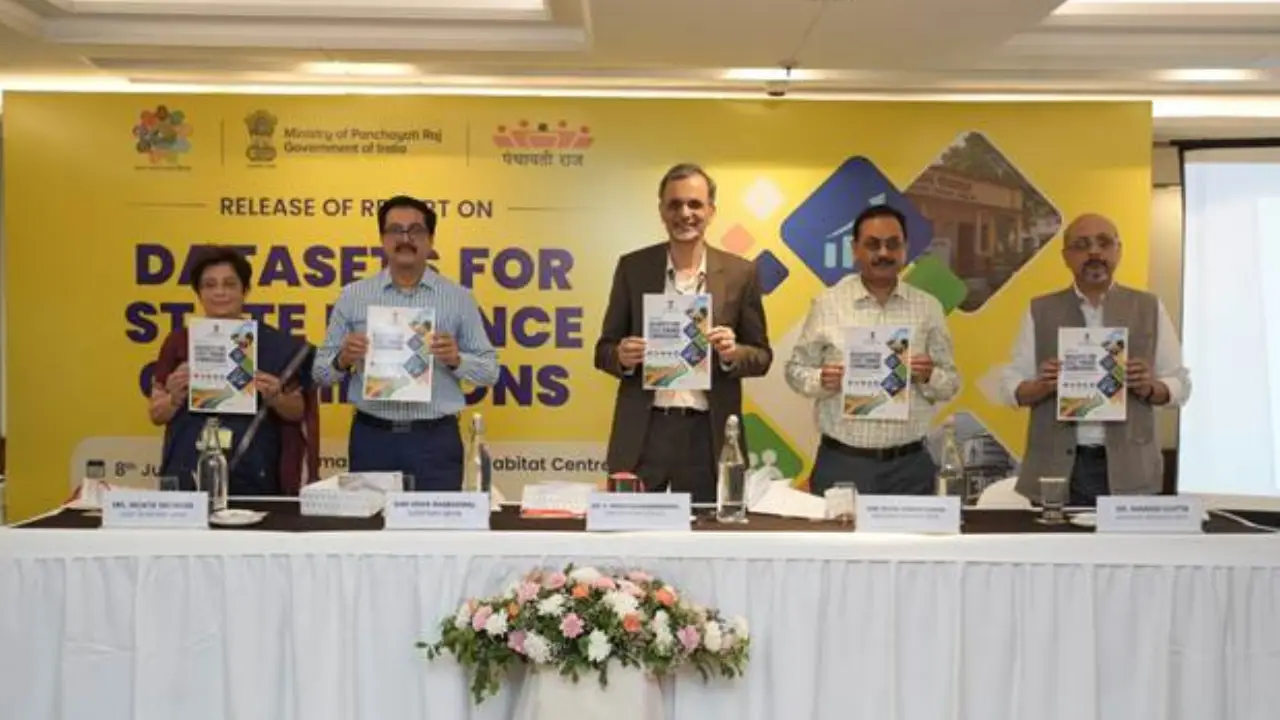
Released by Chief Economic Advisor Dr. V. Anantha Nageswaran, the Report of the Committee on Datasets for State Finance Commissions argues that the effectiveness of fiscal decentralisation depends not only on the transfer of funds but also on the availability of accurate, timely and granular information about local governments. The report was prepared by a committee constituted by the Ministry of Panchayati Raj following concerns raised during the Finance Commissions' Conclave on "Devolution to Development" held in November 2024.
The report arrives at a time when local governments are expected to play an increasingly important role in rural development, service delivery and implementation of national programmes. Yet, according to the committee, State Finance Commissions continue to function with fragmented datasets, inconsistent accounting systems and limited access to Panchayat-level financial information.
State Finance Commissions were created under Article 243-I of the Constitution through the 73rd Constitutional Amendment to periodically review the financial position of Panchayats and recommend principles governing revenue sharing, grants-in-aid and measures to improve local finances.
In theory, these commissions form the backbone of fiscal decentralisation. In practice, however, their functioning has been hindered by long-standing institutional and data-related challenges.
The committee found that financial information on Panchayats remains scattered across multiple government departments, often maintained in different formats and with varying levels of completeness. Functional and sector-wise expenditure data is frequently unavailable, making it difficult to assess whether funds are translating into improvements in drinking water supply, sanitation, roads or other local services.
The report also notes that many Gram Panchayats continue to face capacity constraints, including shortages of trained accounting and data management personnel. These limitations affect the quality of records available to State Finance Commissions and weaken evidence-based decision-making.
Beyond data availability, the report highlights persistent delays in the constitution and submission of SFC reports across states.
Citing previous Finance Commission assessments, the committee notes that the average delay in submission of State Finance Commission reports has been around 16 months. Such delays often result in outdated recommendations remaining in force long after their intended period.
The annexure to the report shows that several states took years beyond their prescribed timelines to submit reports. Assam's Fifth State Finance Commission, for instance, submitted its report after a delay of more than two years, while states such as Maharashtra and Madhya Pradesh recorded delays running into several years. Manipur's Third State Finance Commission submitted its report about one year and seven months after the scheduled date.
The Sixteenth Finance Commission has also observed that differences in methodologies, reporting formats and data quality have made many SFC reports difficult to use as a basis for national-level fiscal recommendations.
The committee acknowledges that India already possesses several digital platforms capable of supporting local fiscal analysis.
These include the eGramSwaraj portal, which integrates Panchayat planning, budgeting and accounting functions; the Panchayat Advancement Index (PAI 2.0); audit reports prepared by the Comptroller and Auditor General (CAG); AuditOnline; and state budget documents.
However, the report argues that these platforms operate largely in isolation and often fail to provide standardised Gram Panchayat-level datasets required by State Finance Commissions. In some states, expenditure reporting on eGramSwaraj remains incomplete, while other datasets continue to rely on Census 2011 and Socio-Economic and Caste Census figures that no longer accurately reflect present-day realities.
The committee therefore recommends making SFC-related expenditure reporting mandatory through eGramSwaraj and strengthening interoperability among different government databases.
A central feature of the report is its attempt to define the information architecture required for effective fiscal decentralisation.
The committee identifies a wide range of datasets that should be systematically collected and maintained at Gram Panchayat level. These include demographic indicators, poverty and human development data, own-source revenues, grants, capital expenditure, liabilities, infrastructure inventories, service delivery outcomes, digital connectivity, women's self-help groups and programme-specific information such as MGNREGA implementation.
According to the report, access to such datasets would enable State Finance Commissions to move beyond broad fiscal allocations and develop more targeted recommendations based on local needs, performance and developmental gaps.
The committee has also recommended classifying Panchayat Advancement Index indicators into categories such as needs, performance and backwardness, allowing SFCs to use them more effectively while designing devolution formulas.
Among the report's major recommendations is the establishment of permanent State Finance Commission Cells within state governments to maintain datasets and provide institutional continuity between commission cycles.
It also calls for standardised accounting heads across states to improve comparability of transfers to local bodies. Another recommendation is the inclusion of supplementary budget documents detailing all transfers to rural and urban local bodies, including Gram Panchayat-wise allocations.
The committee further recommends developing a comprehensive manual for future State Finance Commissions, strengthening training through the National Institute of Rural Development and Panchayati Raj (NIRDPR), and reviving Panchayat statistics publications to support research and policymaking.
One of the more significant proposals is a recommendation that the CAG undertake a performance audit of the implementation of the 73rd Constitutional Amendment to assess the extent of functional, financial and administrative devolution across states. The recommendation was specifically highlighted by Dr. Nageswaran during the report's release.
While the report focuses on datasets, its implications extend far beyond data management.
India's decentralisation framework has often been criticised for devolving responsibilities to Panchayats without corresponding fiscal autonomy. State Finance Commissions were designed to address this imbalance, but inconsistent functioning has limited their impact.
The committee's findings suggest that the challenge is increasingly one of information governance. Without reliable local-level data, it becomes difficult to determine which Panchayats require greater support, which have demonstrated stronger fiscal performance, and how public spending translates into developmental outcomes.
The issue is particularly relevant for northeastern states, where geographical challenges, dispersed settlements and capacity constraints often complicate local governance. Better Panchayat-level datasets could help policymakers identify infrastructure deficits, service delivery gaps and fiscal needs more accurately than broad district-level indicators.
The report also aligns with the growing emphasis on performance-linked fiscal transfers. Secretary Vivek Bharadwaj noted during the release event that the Sixteenth Finance Commission has proposed ?87,000 crore in performance-based grants for Panchayats linked to growth in own-source revenues. Such frameworks depend heavily on credible and standardised local financial data.
Ultimately, the report argues that strengthening data systems is not merely a technical exercise. It is a prerequisite for meaningful fiscal decentralisation and more effective local self-government. Whether its recommendations are adopted by states will determine whether State Finance Commissions evolve into robust fiscal institutions or continue to struggle with incomplete information and delayed decision-making.