Four people were killed and over 15 houses burnt in an attack on Kultuh village in Kamjong district. Rival organisations have issued conflicting claims over the identity of the attackers.
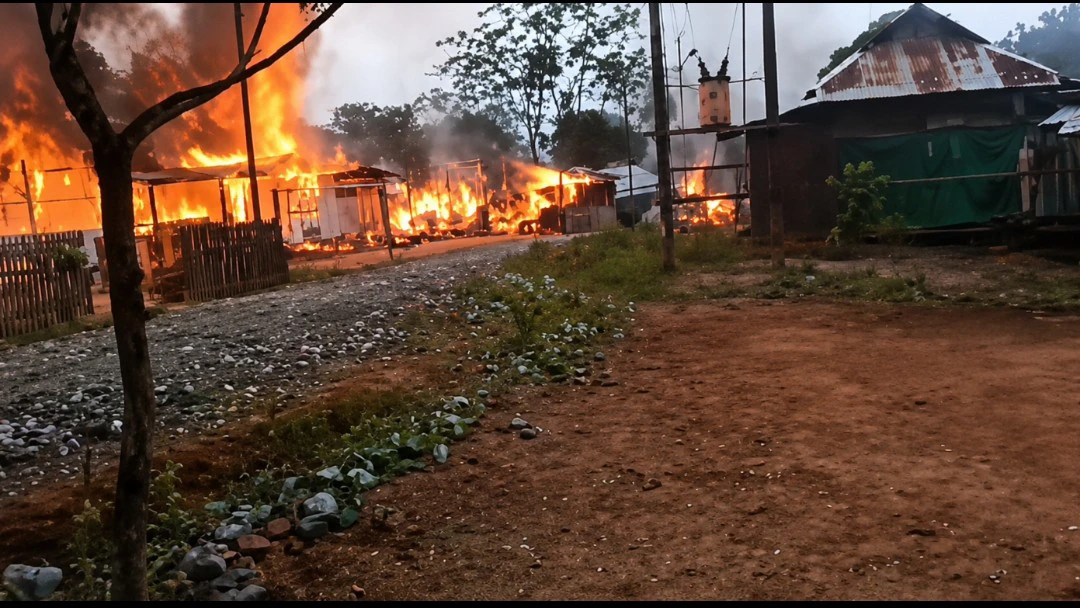
Kamjong, June 12: Four people were killed, two others injured and more than 15 houses reduced to ashes after armed men attacked Kultuh village along the Indo-Myanmar border in Manipur's Kamjong district in the early hours of Thursday.
The attack targeted the small Kuki settlement of Kultuh, located between Chahong Khunou and Thana Tangkhul villages under Kamjong subdivision. The village, situated close to the international border with Myanmar, has around 25 households.
According to the Eastern Command of the Naga Village Guard (NVG), armed cadres of the Myanmar-based Kuki National Army-Burma (KNA-B) launched the assault before dawn. The organisation alleged that the attack stemmed from tensions over territorial control along the border and disputes involving the Kuki National Front-Presidential (KNF-P).
In a statement, the NVG claimed that its personnel rushed to the village after receiving information about the intrusion and engaged the attackers in a firefight at around 3:30 am. The exchange of fire reportedly lasted around 20 minutes, during which one NVG member sustained injuries.
The organisation further alleged that the attack may have been linked to the non-payment of so-called "narco-trade taxes" to the KNA-B, though no independent agency has verified the claim.
Condemning the incident, the NVG described it as an act of external aggression on Tangkhul Naga ancestral land and expressed condolences to the families of the four victims.
"It is with deep sorrow that we convey our condolences to the bereaved families of the four Kuki villagers of Kultuh who were mercilessly killed during the cross-border terror," the statement said.
The organisation also said the attack was the second major incident in the border region in recent weeks, referring to the May 7 attacks on Choro, Wanglee and Namlee villages, which Naga groups had similarly attributed to KNA-B and allied forces operating from Myanmar.
ALSO READ: Thousands Flee Towards India as Fighting Intensifies Near Myanmar Border
However, Kuki civil society organisations have strongly disputed the allegation that KNA-B was responsible for the attack.
The Kuki Inpi Manipur (KIM) and other Kuki organisations have instead alleged that cadres of the NSCN-IM, assisted by members of the Myanmar-based Shanni Nationalities Army (SNA), carried out the assault on Kultuh village.
According to statements issued by Kuki organisations, eyewitness accounts indicated that the attackers entered the village in the early hours and set houses on fire after opening fire on residents. The organisations have demanded an independent judicial inquiry into the incident and called for accountability for those responsible.
The competing claims have added further uncertainty to an already volatile border region where multiple armed groups are active on both sides of the Indo-Myanmar boundary.
The latest violence comes amid increasing concern over security in Manipur's eastern border districts, where instability in neighbouring Myanmar has heightened fears of cross-border militant movement.
Kamjong district shares a long and porous border with Myanmar's Sagaing Region, an area affected by ongoing armed conflict involving anti-junta resistance groups, ethnic armed organisations and military forces.
In recent months, several villages in the border belt have reported incidents involving armed groups, prompting local village defence volunteers and community organisations to step up patrols and surveillance.
While rival organisations continue to trade accusations over responsibility for Thursday's attack, there has been no official statement from security agencies publicly identifying the perpetrators.
Authorities are yet to announce the findings of any formal investigation into the killings and destruction at Kultuh village.
The incident has once again drawn attention to the fragile security situation along the Indo-Myanmar frontier, where local communities continue to bear the impact of competing armed interests and unresolved territorial tensions.