National Biodiversity Authority releases SOP to help States and Union Territories scientifically identify, notify and conserve threatened species under the Biological Diversity Act.
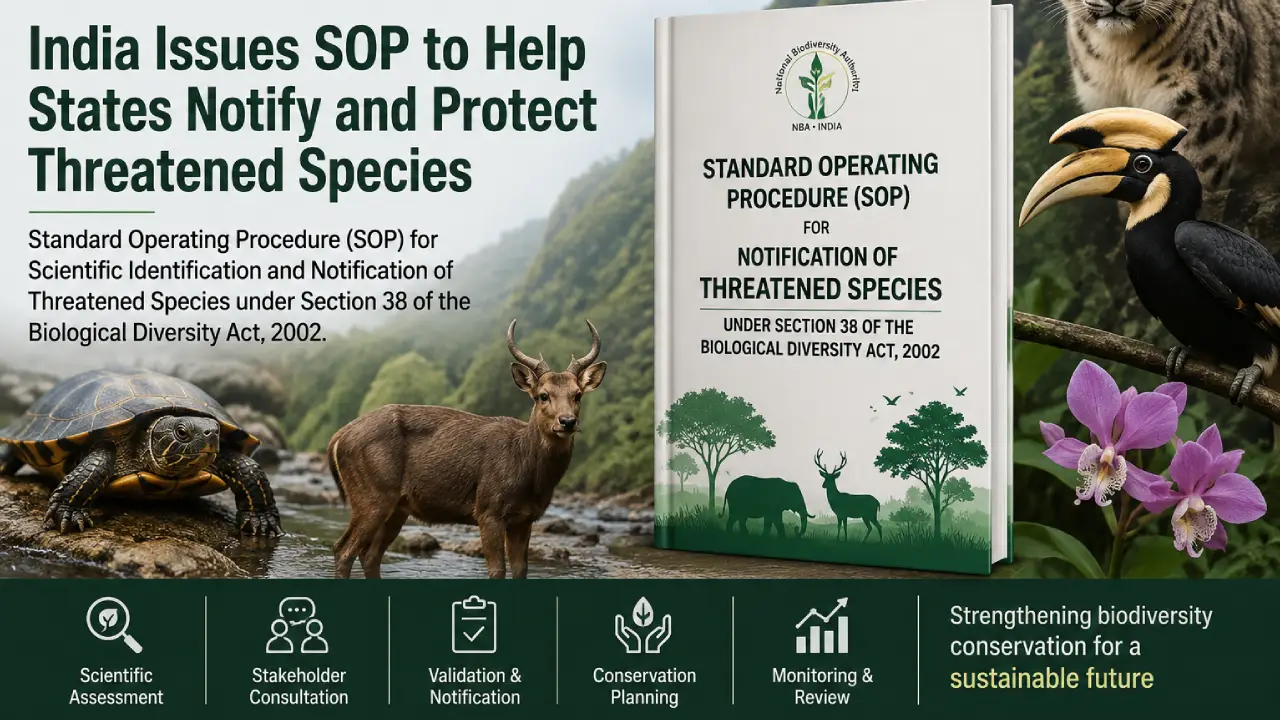
New Delhi, June 26: The National Biodiversity Authority (NBA) has released a Standard Operating Procedure (SOP) to guide States and Union Territories in the scientific identification and notification of threatened species under Section 38 of the Biological Diversity Act, 2002.
Announcing the initiative on Friday, the Ministry of Environment, Forest and Climate Change said the SOP is intended to establish a uniform, transparent and scientifically robust process for identifying, assessing and notifying species that are on the verge of extinction or are likely to become extinct in the near future.
The ministry said India, recognised as one of the world's megadiverse countries, is home to a rich variety of plants, animals and ecosystems. However, many species are facing increasing threats due to habitat degradation, overexploitation, pollution, invasive alien species and climate change. Conserving these species is essential for maintaining ecological balance, protecting ecosystem services and preserving biodiversity for future generations.
Under Section 38 of the Biological Diversity Act, 2002, the Central Government, in consultation with the concerned State Government, is empowered to notify threatened species. Such notification enables regulation or prohibition of the collection of these species and provides for measures aimed at their rehabilitation and conservation. The Act also allows the Central Government to delegate these powers to State Governments.
According to the ministry, 159 plant species and 173 animal species across 17 States and three Union Territories have already been notified as threatened species.
The newly released SOP has been designed to assist State Biodiversity Boards and Union Territory Biodiversity Councils in carrying out the identification process in a consistent and scientifically rigorous manner before recommending species to the respective State Governments for notification.
It outlines a step-by-step framework covering scientific assessment, stakeholder consultations, validation, official notification, conservation planning, monitoring and periodic review.
The ministry said the procedure encourages the use of the best available scientific evidence, field-based assessments and traditional knowledge while ensuring the participation of local communities, Biodiversity Management Committees, the Botanical Survey of India, the Zoological Survey of India, academic institutions and subject experts.
The SOP also assumes significance in light of the Biological Diversity (Access to Biological Resources and Knowledge Associated thereto and Fair and Equitable Sharing of Benefits) Regulations, 2025. These regulations provide differential treatment while determining benefit-sharing obligations where biological resources belong to species notified as threatened under Section 38 of the Act.
Following notification, the SOP calls for the preparation of species recovery and conservation action plans. It also recommends regular monitoring and periodic review to assess conservation outcomes and identify emerging threats so that timely interventions can be taken for species facing extinction risks.
The ministry said the SOP represents another milestone in India's biodiversity conservation efforts. It supports the implementation of the Biological Diversity Act, 2002, and aligns with the National Biodiversity Strategy and Action Plan 2024–2030, particularly Target 4, which focuses on halting human-induced extinction of species, promoting species recovery and maintaining genetic diversity.
The initiative is also intended to contribute to India's commitments under the Kunming-Montreal Global Biodiversity Framework, which seeks to strengthen global efforts for biodiversity conservation and sustainable use.