India and Myanmar strengthened security, border management and economic cooperation as Prime Minister Narendra Modi held talks with President U Min Aung Hlaing in New Delhi.
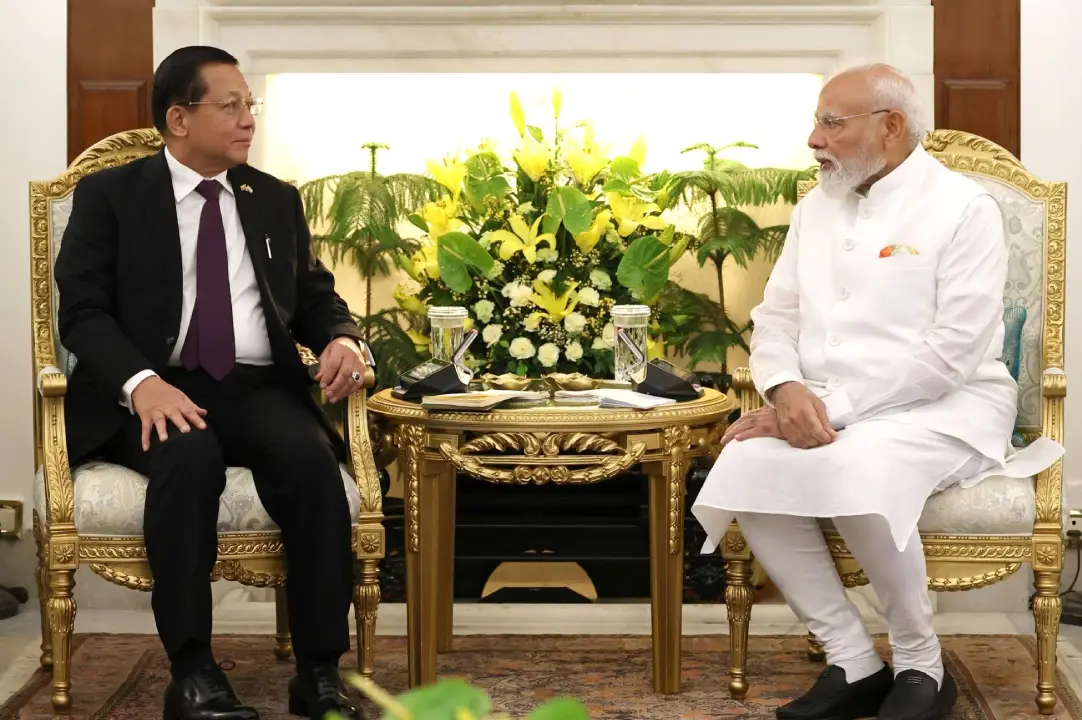
New Delhi, June 1: India and Myanmar on Monday reaffirmed their commitment to strengthening bilateral security cooperation, border management and strategic engagement as Prime Minister Narendra Modi held wide-ranging talks with Myanmar President U Min Aung Hlaing during the latter's first official visit to India as President.
Security cooperation emerged as a key focus of the discussions, alongside trade, connectivity, healthcare, rare earths, cyber security and maritime security. The two sides also reiterated their commitment to preventing the misuse of their territories for activities that could threaten each other's security interests.
Prime Minister Modi described the discussions as productive and said India was honoured that President Min Aung Hlaing had chosen India for his first foreign visit after assuming office. He also welcomed the Myanmar leader's decision to begin his India visit from Bodh Gaya, reflecting the deep civilisational and Buddhist ties shared by the two countries.
Had a productive meeting with President U Min Aung Hlaing of Myanmar. We in India are honoured that he has chosen India for his first foreign visit as President. Equally gladdening is the fact that he began the visit from Bodh Gaya, with the blessings of Lord Buddha. We reviewed… pic.twitter.com/eL1sXgsrE6
— Narendra Modi (@narendramodi) June 1, 2026
The meeting reviewed the full spectrum of bilateral relations and explored ways to further strengthen cooperation across multiple sectors. According to a joint statement issued after the talks, both leaders discussed regional and global developments while charting the future course of India-Myanmar relations.
President Min Aung Hlaing is on an official visit to India from May 30 to June 3 at the invitation of Prime Minister Modi. He is accompanied by a high-level delegation that includes ministers handling foreign affairs, finance, agriculture, industry and the President's Office, along with the Governor of the Central Bank of Myanmar and representatives from various business sectors.
At the start of his visit, the Myanmar President visited the Mahabodhi Temple, Mahabodhi Meditation Centre and Sujata Temple in Bodh Gaya, underscoring the enduring religious and cultural links between the two nations.
During the bilateral talks in New Delhi, Prime Minister Modi emphasised that Myanmar occupies a crucial position in India's foreign policy framework, particularly under the "Neighbourhood First", "Act East" and MAHASAGAR (Mutual and Holistic Advancement for Security and Growth Across Regions) initiatives.
The leaders agreed to enhance cooperation in trade, connectivity, heritage restoration, healthcare, capacity building and critical mineral sectors, including rare earths. They also agreed to work more closely in maritime security, cyber security and other strategic sectors of mutual interest.
A significant part of the discussions focused on defence and security cooperation. Both sides reaffirmed the importance of strengthening coordination on border management and maintaining peace and stability along the shared frontier.
The Prime Minister reiterated India's support for the sovereignty and territorial integrity of Myanmar and stressed the importance of ensuring that neither country's territory is used for activities harmful to the other's security interests.
President Min Aung Hlaing, in turn, assured India that Myanmar would not permit its territory to be used against India's security interests. The assurance assumes significance given the long and sensitive India-Myanmar border, which has often featured prominently in discussions relating to insurgency, cross-border crime and regional stability.
Prime Minister Modi also reaffirmed India's commitment to deepening security cooperation with Myanmar, describing India as a steadfast and trusted partner of the neighbouring country.
The leaders also discussed connectivity projects aimed at enhancing economic integration and regional development. Both sides reviewed progress on the Kaladan Multi-Modal Transit Transport Project and the India-Myanmar-Thailand Trilateral Highway, which are considered key pillars of India's Act East policy and efforts to improve connectivity with Southeast Asia.
Prime Minister Modi noted that improved connectivity would generate economic opportunities and contribute to shared prosperity across the region.
Education and capacity building also featured in the discussions. India announced that the number of Mekong Ganga ICCR scholarships available to Myanmar students would be increased from 36 to 100 beginning in 2026.
On the economic front, both countries agreed to further facilitate bilateral trade and investment. They reviewed the Rupee-Kyat trade settlement mechanism, which became operational in May 2024, and welcomed the steady increase in transaction volumes recorded under the arrangement.
The two sides also expressed support for expanding cooperation in sectors such as agro-processing, petroleum, energy and mining, subject to their respective laws and regulations.
Beyond government-level engagements, President Min Aung Hlaing participated in the India-Myanmar Business Conclave in New Delhi, jointly organised by the Union of Myanmar Federation of Chambers of Commerce and Industry (UMFCCI) and the Confederation of Indian Industry (CII). The event brought together business leaders from both countries to explore new trade and investment opportunities.
The President also visited the NTPC Energy Technology Research Alliance (NETRA) complex in Greater Noida, where he was briefed on research and development initiatives related to clean energy, renewable integration, energy efficiency and grid resilience.
Prime Minister Modi conveyed India's support for Myanmar-led efforts aimed at achieving peace, stability, national reconciliation and socio-economic development. He also offered continued assistance based on mutual respect and longstanding friendship between the two countries.
The Myanmar President expressed appreciation for India's support and cooperation and thanked Prime Minister Modi and the Government of India for the hospitality extended to him and his delegation during the visit.
The visit will continue with President Min Aung Hlaing's engagements in Mumbai, where he is scheduled to meet Maharashtra leaders and participate in business-related programmes.
The official visit is being viewed as an important step in strengthening India-Myanmar ties at a time when both countries are seeking to expand economic cooperation, enhance connectivity and deepen security collaboration in an increasingly complex regional environment.
Both sides agreed to maintain close engagement at all levels and continue working together to advance their shared interests, reflecting the strategic importance of the relationship for regional stability, economic growth and security cooperation.