The deployment of COBRA battalions and a major police reshuffle suggest Manipur’s prolonged crisis is entering a decisive and more volatile phase before elections.
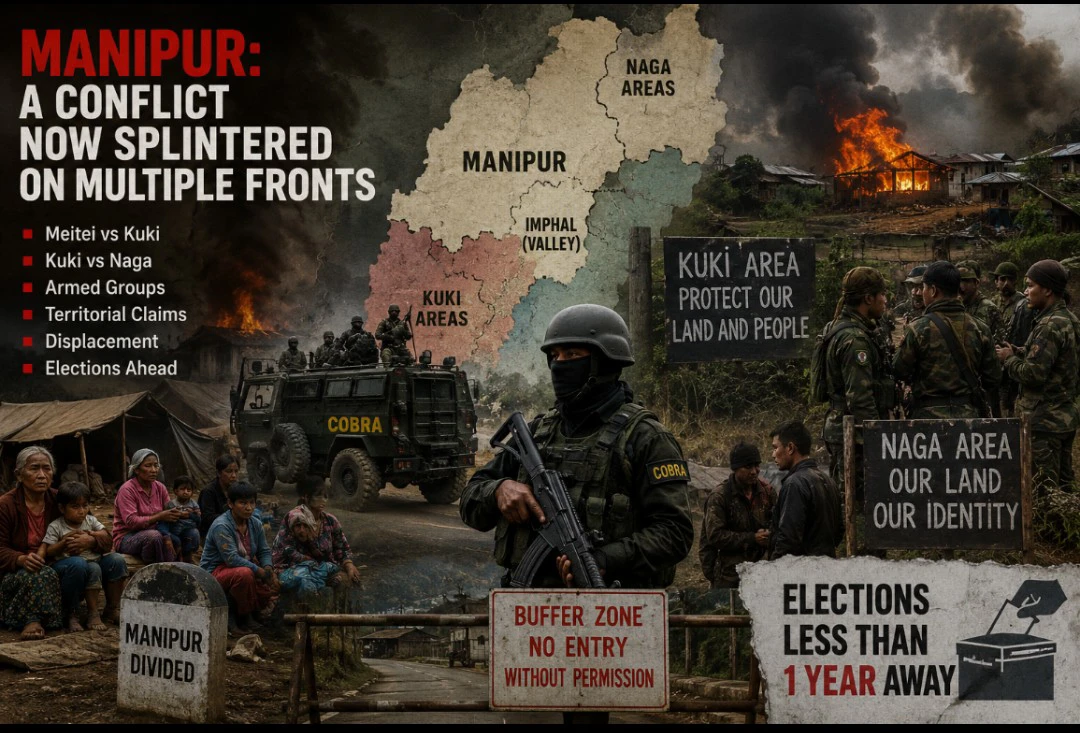
The deployment of two COBRA battalions to Manipur and the recent restructuring of the state police leadership are not routine administrative developments. They point toward a deeper reality: the Manipur conflict is entering a new and potentially more dangerous phase.
For more than three years since violence erupted on May 3, 2023, Manipur has existed in a condition of prolonged instability marked by ethnic separation, armed mobilisation, institutional breakdown and militarised containment. The conflict has already transformed the social and political geography of the state.
What appears to be unfolding now is not a delayed recognition of the crisis by the Centre. New Delhi has long understood the scale of the breakdown. The current shift appears driven instead by political timing, security recalibration and the need to regain visible control before the electoral cycle intensifies, and of course the very possibilities of the crisis spiralling out of control.
With less than a year remaining before elections, the ruling establishment faces pressure to project stability after one of the most severe internal conflicts in the Northeast in recent decades. The latest security moves therefore appear aimed not only at preventing violence, but at consolidating administrative authority over an increasingly fragmented landscape.
The deployment of COBRA commandos is particularly significant in this context. COBRA units are specialised counter-insurgency forces trained for jungle warfare, intelligence-led pursuit operations and armed engagements in difficult terrain. They are not deployed merely for static security or riot management. Their presence suggests that security agencies are preparing for a prolonged armed-security challenge rather than isolated communal disturbances. That distinction matters.
What began in 2023 as a Meetei-Kuki conflict has now evolved into a far more complex and fractured crisis. The original fault line has not disappeared, but the conflict itself has started splintering into multiple competing fronts. Most notably, the Kuki-Naga confrontation has now openly emerged across several areas of Manipur.
Armed clashes, killings, abductions, territorial confrontations and competing assertions of influence have increasingly brought Naga groups into direct conflict with Kuki organisations and armed actors. This is no longer an undercurrent or isolated tension operating quietly beneath the larger crisis. It has become part of the visible security reality of the state.
That evolution changes the nature of the conflict entirely.
The challenge before security agencies is no longer limited to managing hostility between two communities separated by buffer zones. The state is now confronting overlapping ethnic rivalries, competing territorial claims, armed civilian structures and unresolved historical grievances operating simultaneously. This fragmentation makes the situation far more unpredictable.
The danger in prolonged ethnic conflicts is that they rarely remain confined to their original trigger points. Once armed mobilisation becomes normalised and territorial boundaries harden, older dormant tensions begin resurfacing with new intensity.
The memories of the Kuki-Naga violence of the 1990s still remain politically and emotionally alive across many hill areas. The present instability is reopening some of those unresolved anxieties. Questions involving land, district influence, administrative control and future political arrangements are once again becoming combustible.
This is one reason the latest security deployment carries deeper meaning than official statements suggest.
The Centre may now be attempting to prevent Manipur from sliding into a multi-front ethnic-security crisis where several conflicts begin operating at once, which would be much harder to control. Such a scenario would be exponentially harder to control than the already devastating Meetei-Kuki confrontation.
At the same time, the restructuring of the police leadership indicates an effort to restore operational coherence within the state machinery itself.
The credibility crisis faced by Manipur Police during the peak of the conflict has been severe due to narrative warfare and propaganda to project victimhood. The central security forces, especially the Assam Rifles under the Ministry of Home Affairs is perhaps the most affected security institution with one side alleging biasness and the other strongly defending it. Competing allegations of bias, selective intervention and institutional fragmentation damaged public trust across communities. In several areas, armed village defence groups and informal ethnic protection systems increasingly came to replace confidence in state institutions. Though such armed civilian groups got disbanded in the valley, the situation is the opposite in the hills with more and more youths joining these so-called village volunteers.
In this situation, a leadership change alone cannot repair that damage. But it signals an attempt to re-establish a more centralised security command structure at a moment when the state appears to be preparing for a decisive consolidation phase.
The Myanmar factor further complicates every calculation.
Successive military coups in Myanmar have put a strain in the demography of neighbouring Indian states, especially Manipur for decades. Since the 2021 military coup in Myanmar, the India-Myanmar frontier has become increasingly volatile. Armed movements, refugee flows, illegal weapons trafficking and underground networks have expanded across border regions adjoining Manipur. The instability inside Myanmar now directly overlaps with Manipur’s internal security environment.
This creates conditions where local ethnic conflict, cross-border armed activity and geopolitical instability increasingly intersect. Yet the deeper question remains political.
If the current phase is about consolidating control before elections, what comes afterward? Is there a genuine long-term roadmap for reconciliation and coexistence, or merely a strategy to reduce visible instability long enough to regain political narrative control? Because security operations alone cannot resolve what Manipur has become.
The buffer zones dividing communities today are not temporary lines anymore. They are gradually turning into psychological borders reinforced by trauma, displacement and mutual fear. Entire generations of young people are growing up within segregated narratives where coexistence is becoming increasingly difficult to imagine.
These buffer zones may ultimately become the greatest tragedy of the conflict.
The latest deployments therefore carry two simultaneous messages. Publicly, they project state authority and preparedness. Strategically, they suggest that authorities may believe Manipur is approaching the decisive phase of a prolonged conflict — a phase where fragmented armed realities must either be consolidated under state control or risk mutating into an even more unstable security order.
Whether this produces genuine reconciliation or simply a colder and more militarised version of separation may determine Manipur’s future for decades.