Manipur is set to introduce a three-tier Panchayati Raj structure in its next rural local body elections, with 18 Panchayat Samitis and 85 territorial constituencies proposed under the 2023 amendment.
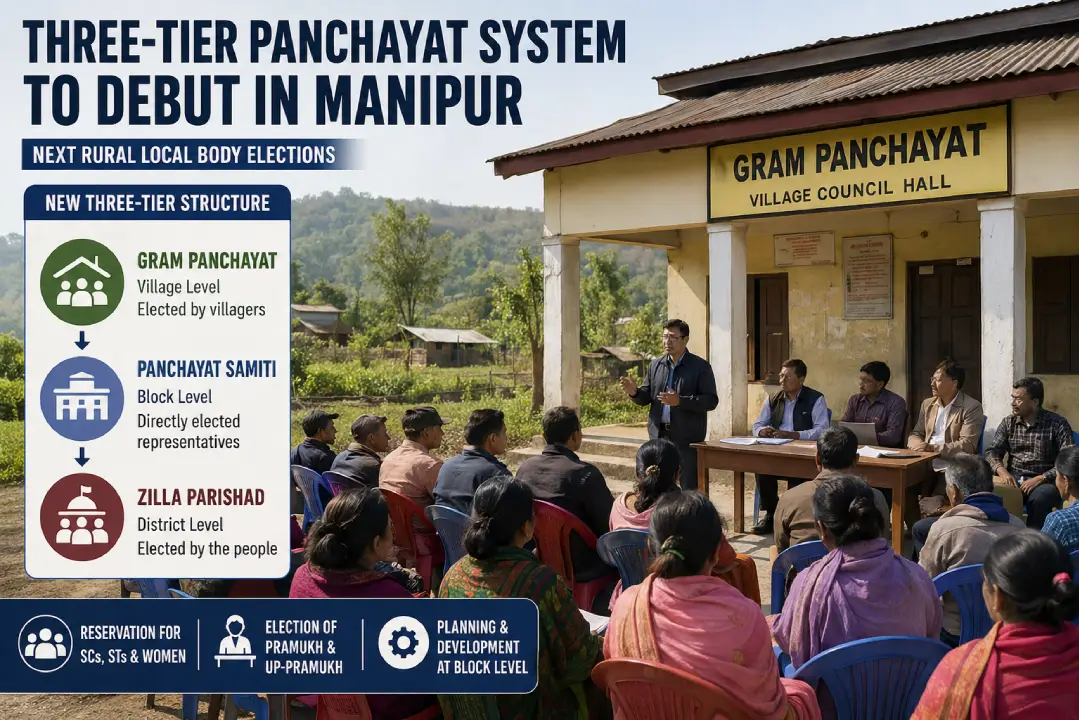
Imphal, June 6: The next Panchayati Raj elections in Manipur are expected to mark a significant shift in rural local governance with the implementation of the Manipur Panchayati Raj (Eighth Amendment) Act, 2023, which introduces a new intermediate tier of administration at the block level.
The amendment, enacted as Manipur Act No. 1 of 2023, was passed by the Manipur Legislative Assembly on February 20, 2023, and published in the Official Gazette on February 22, 2023, from which date it came into force.
The legislation inserts a new Chapter VI into the Manipur Panchayati Raj Act, 1994, providing for the constitution of Panchayat Samitis at the development block level. The move brings Manipur's valley-based Panchayati Raj institutions in line with the three-tier system envisaged under the Constitution, consisting of Gram Panchayats, Panchayat Samitis and Zilla Parishads.
Until now, rural local governance in Manipur's Panchayat areas functioned largely through a two-tier structure of Gram Panchayats and Zilla Parishads. With the amendment, voters will now elect representatives to an additional layer of local government.
Under the amended law, every development block will have a Panchayat Samiti comprising directly elected members from territorial constituencies carved out within the block. The law also creates the positions of Pramukh and Up-Pramukh, who will be elected from among the elected Panchayat Samiti members.
The amendment lays down provisions for reservation of seats for Scheduled Castes, Scheduled Tribes and women in Panchayat Samitis. Reservation of the offices of Pramukh and Up-Pramukh has also been provided, with allocation to be determined through rotation.
Officials say the creation of Panchayat Samitis is intended to strengthen planning, coordination and implementation of development programmes at the block level while increasing local representation between village and district administrations.
The government has already begun implementing the new system ahead of future elections.
On June 4, 2026, the Rural Development and Panchayati Raj Department issued a notification proposing the territorial limits of Panchayat Samiti constituencies across the state under the Manipur Delimitation of Panchayat Samiti Constituencies Rules, 2026. The notification invited views, objections and representations from affected persons within 20 days of publication.
According to the notification, a total of 18 Panchayat Samitis and 85 territorial constituencies have been proposed across Panchayat areas in the state.
|
Panchayat Samiti / Block |
Territorial Constituency |
GPs Covered |
|
Sawombung |
(i) Tellou Chana Seijang |
Tellou Chana Seijang & Nongren Chingnungkok |
|
(ii) Pungdongbam |
Pungdongbam & Takhel |
|
|
(iii) Sawombung |
Sawombung & Waiton |
|
|
(iv) Uyumpok |
Uyumpok & Pukhao |
|
|
(v) Khundrakpam |
Khundrakpam & Haraorou Tangkham |
|
|
(vi) Makeng Dolaithabi |
Makeng Dolaithabi |
|
|
Heingang |
(i) Kontha Khabam |
Kontha Khabam & Heingang |
|
(ii) Luwangsangbam |
Luwangsangbam & Nilakuthi |
|
|
(iii) Laipham Khunou |
Laipham Khunou & Khurai Lairikyengbam Leikai |
|
|
(iv) Kairang Khomidok |
Kairang Khomidok & Khurai Konsam Leikai |
|
|
(v) Khurai Nandeibam Leikai |
Khurai Nandeibam Leikai & Khurai Laishram Leikai |
|
|
(vi) Khurai Chingangbam Leikai |
Khurai Chingangbam Leikai & Khurai Khaidem Leikai |
|
|
(vii) Kangla |
Kangla & Moirangkampu |
|
|
Kshetrigao |
(i) Bamon Kampu |
Bamon Kampu & Ucheckon Nongpok |
|
(ii) Bashikhong |
Bashikhong & Torban Kshetri Leikai |
|
|
(iii) Thongju |
Thongju Part-I & Thongju Part-II |
|
|
(iv) Naharup |
Naharup & Thambalkhong |
|
|
(v) Top Dusara |
Top Dusara & Top Naoria |
|
|
(vi) Ucheckon Nongchup |
Ucheckon Nongchup & Khongman |
|
|
(vii) Kshetrigao |
Kshetrigao Part-I & Kshetrigao Part-II |
|
|
Keirao |
(i) Tulihal |
Tulihal & Angtha |
|
(ii) Yambem |
Yambem & Top Chingtha |
|
|
(iii) Changamdabi |
Changamdabi & Tumukhong Moirangpurel |
|
|
(iv) Kiyamgei |
Kiyamgei & Urup Arapti |
|
|
(v) Keirao Makting |
Keirao Makting & Kyamgei Muslim Arapti |
|
|
(vi) Keirao |
Keirao & Chanam Sandrok |
|
|
Haorangsabal |
(i) Maklang |
Maklang & Awang Khunou |
|
(ii) Lairenkabi Kadangband |
Lairenkabi Kadangband & Phayeng |
|
|
|
(iii) Mayanglangjing |
Mayanglangjing & Phumlou |
|
(iv) Khurkhul |
Khurkhul & Kanglatongbi |
|
|
(v) Potsangbam |
Potsangbam & Khonghampat |
|
|
Patsoi |
(i) Kangmong |
Kangmong & Yarou Bamdiar |
|
(ii) Ngairangbam |
Ngairangbam & Moidangpok |
|
|
(iii) Yurembam |
Yurembam & Konthoujam |
|
|
(iv) Langjing |
Langjing & Patsoi |
|
|
(v) Changangei |
Changangei & Sagolband Thounaojam Leikai |
|
|
(vi) Bijoy Govinda |
Bijoy Govinda & Takyel |
|
|
(vii) Lamjaotongba |
Lamjaotongba & Sagolband Sapam Leikai |
|
|
Hiyangthang |
(i) Malom |
Malom & Kodompokpi |
|
(ii) Langthabal Ningombam |
Langthabal Ningombam & Hiyangthang |
|
|
(iii) Langthabal Mantrikhong Naorem Leikai |
Langthabal Mantrikhong Naorem Leikai & Mongsangei |
|
|
(iv) Sangaiprou Mamang |
Sangaiprou Mamang & Naoria Pakhanglakpa Heinou Khongnembi |
|
|
(v) Maibam Leikai |
Maibam Leikai & Oinam Thingel |
|
|
Wangoi |
(i) Uchiwa |
Uchiwa & Samushang Bitra Urokhong |
|
(ii) Lairenjam Meijrao |
Lairenjam Meijrao |
|
|
(iii) Laphupat Komlakhong Phougakchao Sekamijin |
Laphupat Komlakhong Phougakchao Sekamijin |
|
|
Thoubal |
(i) Leisangthem |
Leisangthem & Moijing |
|
(ii) Khangabok |
Khangabok Part-II & Khangabok Part-III |
|
|
(iii) Khangabok Part-I |
Khangabok Part-I & Wangbal |
|
|
(iv) Sangaiyumpham |
Sangaiyumpham Part-I & Sangaiyumpham Part-II |
The proposed constituencies have been formed by grouping one or more Gram Panchayats within each development block. The largest proposed Panchayat Samitis in terms of constituencies are Heingang, Kshetrigao and Patsoi, each with seven territorial constituencies, while Jiribam and Borobekra have two constituencies each.
The introduction of Panchayat Samitis means that rural voters in Panchayat areas will cast votes for representatives at three levels of local government.
Key changes expected in the next elections include:
Election of Panchayat Samiti members for the first time.
Creation of new territorial constituencies at the block level.
Election of Pramukh and Up-Pramukh in every Panchayat Samiti.
Reservation of seats and leadership positions for women, Scheduled Castes and Scheduled Tribes.
Greater involvement of block-level institutions in development planning and implementation.
The reform is expected to increase the number of elected representatives in rural local governance and establish an institutional link between Gram Panchayats and Zilla Parishads. With the delimitation exercise now underway, the groundwork is being laid for the first-ever Panchayat Samiti elections in Manipur, setting the stage for a significant restructuring of the state's rural governance framework.
For voters, the next Panchayat elections will be notably different from previous polls. Besides electing members of their Gram Panchayats and Zilla Parishads, voters in Panchayat areas will also elect representatives to the newly created Panchayat Samitis at the block level. The election process will involve newly delimited Panchayat Samiti constituencies, and elected members will subsequently choose the Pramukh and Up-Pramukh to lead the block-level bodies. The introduction of this intermediate tier is expected to bring elected governance closer to local communities by creating a dedicated institution responsible for planning, coordinating and monitoring development activities at the block level. As a result, voters will be participating for the first time in a three-tier Panchayati Raj system comprising Gram Panchayats, Panchayat Samitis and Zilla Parishads.
The rollout of the new three-tier system is taking place against the backdrop of a prolonged delay in Panchayati Raj elections in Manipur. The last Panchayat elections in the state were held in October 2017 across the six valley districts of Imphal East, Imphal West, Thoubal, Bishnupur, Kakching and Jiribam. The five-year tenure of the elected Gram Panchayats and Zilla Parishads ended in October 2022, but fresh elections have not been conducted since then.
In the absence of elected local bodies, Panchayat institutions have been functioning through government-appointed administrative committees. Earlier this year, the State Government directed Deputy Commissioners to constitute fresh administrative committees for Gram Panchayats until the next general Panchayat election is notified. Reports indicated that elected Panchayat bodies have remained absent for more than three years since the expiry of their term.
The delay has also attracted judicial and parliamentary attention. In August 2025, the Manipur High Court directed the State Government to conduct Panchayat elections within six months while permitting temporary administrative arrangements for a limited period. The court observed that Panchayat elections, originally due after the completion of the five-year term, had remained pending for an extended period.
At the national level, a Parliamentary Standing Committee on Rural Development and Panchayati Raj also expressed concern over delays in Panchayat elections in several states, including Manipur. The committee noted that timely conduct of Panchayat elections is a constitutional requirement under the 73rd Constitutional Amendment and warned that prolonged delays could affect the flow of certain rural development grants linked to elected local bodies.
With the delimitation of Panchayat Samiti constituencies now underway and the new block-level tier being operationalised, the upcoming Panchayat elections are expected not only to restore elected rural local governance after nearly four years but also to usher in the first-ever three-tier Panchayati Raj structure in the state.