The Manipur government has notified Kharung Pat in Kakching district as a Wildlife Sanctuary covering 227 hectares. Landowners and right holders have two months to submit claims before the settlement process is completed.
Kakching, June 29: The Government of Manipur has formally initiated the legal process for establishing Kharung Pat in Kakching district as a Wildlife Sanctuary, setting in motion the statutory procedure to identify and settle individual and community rights over land falling within the notified area.
A notification issued by the Office of the Deputy Commissioner, Kakching, on June 17 states that the move follows the State Government's notification dated May 22, 2026, declaring an area measuring 227 hectares (2.27 square kilometres) at Kharung Pat as a Wildlife Sanctuary under Section 18 of the Wildlife (Protection) Act, 1972, as amended in 2022.
The Deputy Commissioner, who has been designated as the Collector under Section 18-B of the Act, has now commenced the statutory inquiry required before the sanctuary is finally settled. The inquiry will determine the existence, nature and extent of any rights claimed by individuals or communities over land situated within the notified sanctuary.
According to the notification, the proposed sanctuary has been identified because of its ecological importance and its rich natural features, including its flora, fauna and geomorphological characteristics. The government said the area requires legal protection to conserve wildlife and preserve its natural habitat.
The notification notes that the Governor of Manipur has exercised powers under Section 18(1) of the Wildlife (Protection) Act to declare the area as the Kharung Pat Wildlife Sanctuary.
Land rights inquiry
Under the Wildlife (Protection) Act, declaration of a sanctuary does not immediately extinguish private or customary rights. Instead, the law requires the Collector to investigate every claim relating to ownership, occupation, easement or other legally recognised interests before the process is completed.
Residents, landowners and any other persons claiming rights within the notified area have been asked to submit their claims or objections within two months from the publication of the notification under Section 21(b) of the Act.
The administration has clarified that applications received after the prescribed period will not be considered.
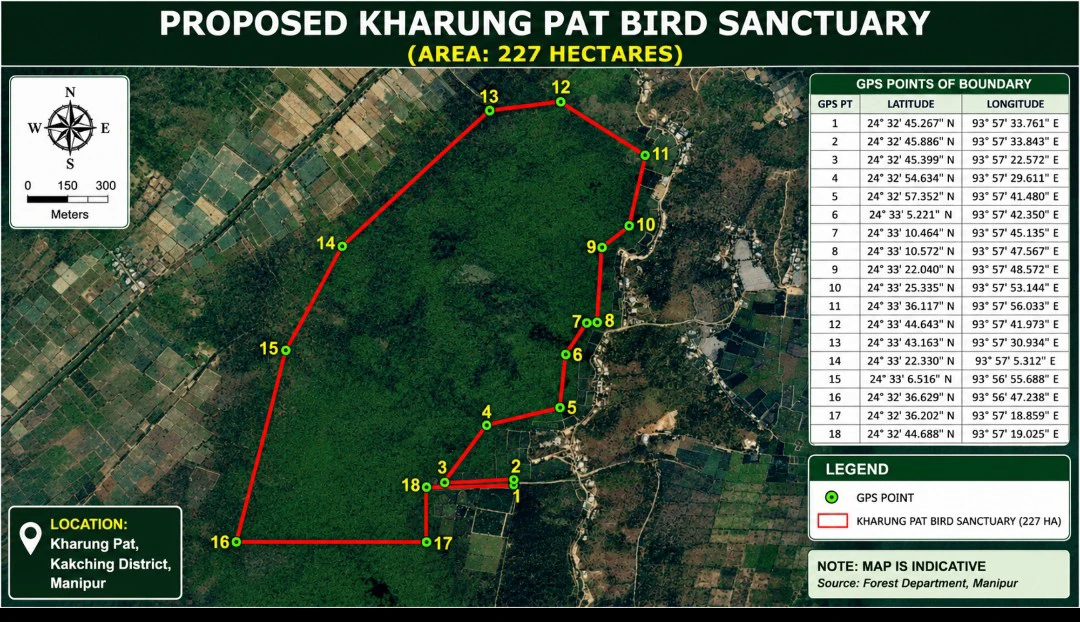
The notification also specifies the sanctuary's boundaries through a series of GPS coordinates beginning near Marakshi Thampam and extending around the northern, western, southern and eastern limits of the proposed protected area.
Officials have attached a detailed map marking all GPS stations forming the boundary of the sanctuary.
Restrictions now applicable
The notification further states that, under Section 18-A of the Wildlife (Protection) Act, the provisions contained in Sections 27 to 33-A have come into immediate effect in and around the sanctuary.
These provisions regulate activities within protected areas, including entry, grazing, destruction or removal of wildlife and forest produce, use of fire, hunting and other activities that could adversely affect wildlife habitats. Such restrictions remain subject to rights that may eventually be recognised during the settlement process.
Why this notification matters
The declaration marks one of the significant recent conservation measures undertaken in Manipur under the Wildlife (Protection) Act.
Unlike a simple administrative notification, the declaration of a wildlife sanctuary triggers a detailed legal process balancing two important objectives—environmental conservation and protection of legitimate rights of people living in or around the proposed protected area.
The settlement of rights is often the most crucial stage because it determines whether existing private land, community land, traditional usage rights, grazing rights or access rights will continue, be modified or be acquired by the government in accordance with law.
The inquiry conducted by the Deputy Commissioner is therefore not merely procedural. It will decide the future legal status of lands falling within the sanctuary and shape how conservation measures are implemented in the area.
Potential implications for local communities
The notification is expected to draw attention from residents of villages surrounding Kharung Pat, particularly those who may possess land ownership documents, customary rights or long-standing resource-use practices within the notified area.
Failure to submit claims within the stipulated period could affect the recognition of such rights during the final settlement process.
Experts have often noted that early participation by affected communities helps minimise future disputes while allowing conservation authorities to develop management plans that balance ecological protection with local livelihoods.
For the Forest Department, completion of the settlement process will provide the legal foundation for long-term conservation, habitat management, biodiversity protection and regulation of human activities within the sanctuary.
With the notification now in force, the focus shifts to the claims and objections process, which will determine how the newly declared sanctuary is administered while addressing the legal rights of those with interests in the notified land.