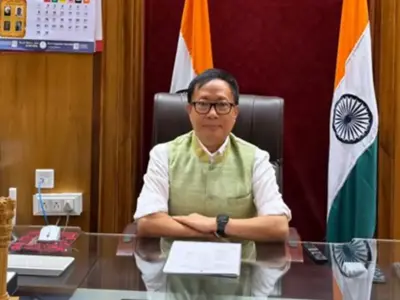
Manipur Chief Minister Yumnam Khemchand Singh urged NITI Aayog to support economic recovery, connectivity projects, fiscal reforms and Act East initiatives.
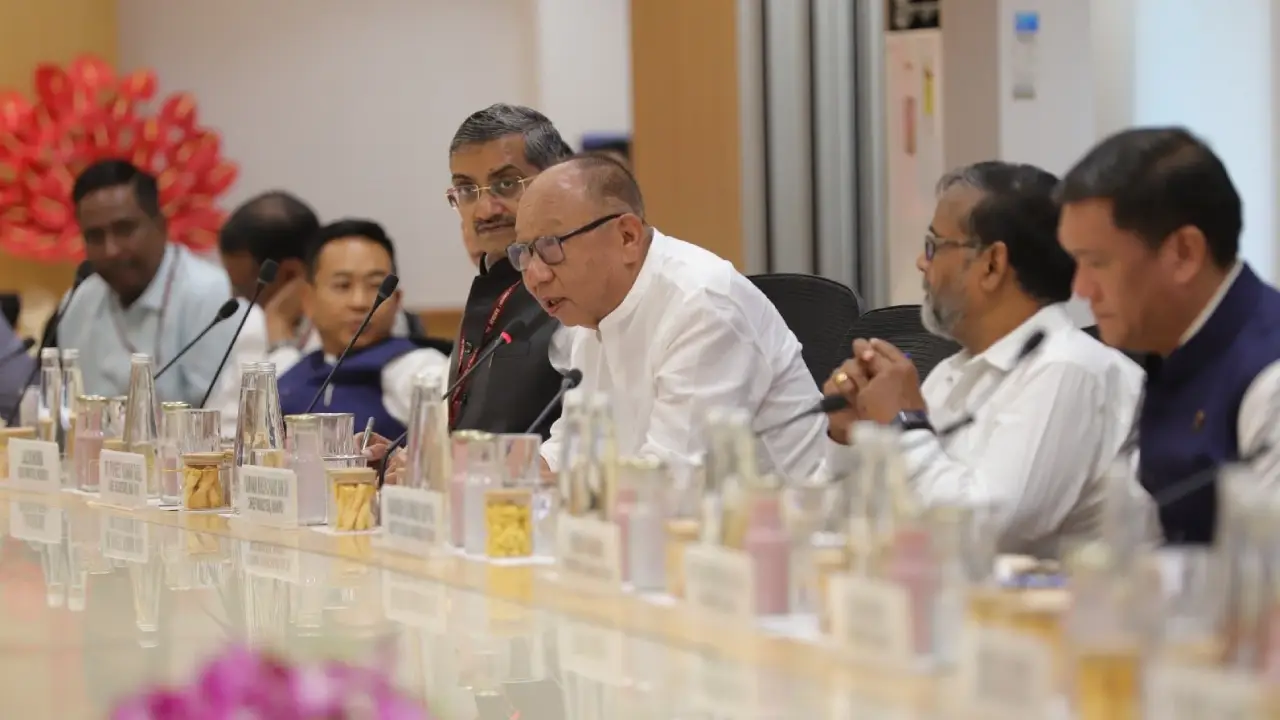
Imphal, June 12: Chief Minister Yumnam Khemchand Singh on Thursday urged NITI Aayog to play a more proactive role in Manipur's economic recovery, peace-building efforts and long-term development, stating that development remains the most effective instrument to overcome insurgency and unrest in the state.
The Chief Minister made the appeal during an interaction between NITI Aayog and the Chief Ministers and Chief Secretaries of the eight North-Eastern states held in New Delhi. The meeting was chaired by NITI Aayog Vice-Chairman Ashok Kumar Lahiri and attended by Chief Ministers, Chief Secretaries and senior officials from across the region.
Referring to Prime Minister Narendra Modi's vision of the Northeast as the "Growth Engine of India" and the "Ashtalakshmi" of the nation, Khemchand Singh said Manipur had suffered considerably in recent years in economic, social and developmental terms and required sustained support to regain momentum.
"NITI Aayog has a big role to play in the development of the North East and Manipur," the Chief Minister said, seeking assistance in planning economic recovery, coordinating with central ministries and engaging international development partners.
A major focus of the Chief Minister's intervention was the need for accelerated investment in connectivity infrastructure.
Khemchand Singh said projects such as the railway connection to Imphal, National Highway corridors linking Manipur to the rest of the country and the ongoing airport terminal expansion have the potential to fundamentally transform the state's developmental landscape.
He urged NITI Aayog to support the early completion of these projects and also sought backing for new initiatives including the Imphal Ring Road Project, an elevated highway in Imphal and the proposed Imphal-Moreh railway line.
The Chief Minister noted that improved connectivity would be crucial for economic growth, trade expansion and regional integration.
Participated in the Interaction with Chief Ministers of the North-Eastern States convened by NITI Aayog.
— Khemchand Yumnam (@YKhemchandSingh) June 12, 2026
Reaffirmed Manipur’s commitment to #ViksitBharat and stressed the importance of stronger Centre–State collaboration for infrastructure development, better service delivery,… pic.twitter.com/TT8sxEip04
Highlighting the strategic significance of Manipur under India's Act East Policy, Khemchand Singh observed that while the policy envisions Manipur as India's principal land gateway to Southeast Asia, implementation of many projects has been hampered by cross-border political instability and related challenges.
He said these difficulties have created a persistent gap between policy announcements and actual project execution.
To address the issue, the Chief Minister proposed the establishment of a high-level "Act Fast Implementation Unit" under NITI Aayog to safeguard critical cross-border logistics and infrastructure projects from localized disruptions.
He also suggested the creation of an "Act East Regional Coordination Cell" in collaboration with the North Eastern Council to enable regular coordination among Northeastern states on border management, logistics planning and security-related issues.
According to him, such institutional mechanisms could help accelerate implementation of strategic projects while strengthening regional cooperation.
The Chief Minister also highlighted the potential of Manipur's healthcare sector, particularly institutions such as the Regional Institute of Medical Sciences (RIMS) and Jawaharlal Nehru Institute of Medical Sciences (JNIMS).
He said both institutions require substantial modernization but possess significant potential to serve patients from neighbouring Southeast Asian countries, especially Myanmar.
Khemchand Singh proposed that NITI Aayog coordinate with the Ministry of Health and Family Welfare to develop a Super-Specialty Tertiary Care Expansion Framework for Manipur.
Such an initiative, he argued, could help transform the state into a medical tourism destination for patients from Southeast Asia while strengthening healthcare infrastructure for local residents.
Addressing the economic impact of the ongoing crisis, the Chief Minister said security-related challenges and civil friction have created a risk environment that discourages private investment and increases project implementation costs.
He noted that infrastructure projects in Manipur often face higher construction and maintenance expenses because of security concerns.
To offset these disadvantages, Khemchand Singh sought NITI Aayog's assistance in designing a special fiscal incentive framework incorporating Vulnerability Gap Funding (VGF) for infrastructure projects affected by security-related challenges.
Such support, he said, would help attract investment and improve the viability of major development projects.
The Chief Minister also argued that existing central funding mechanisms do not adequately account for the geographical realities of the North-East.
He pointed out that the same financial allocations under central schemes often generate significantly less physical infrastructure in hilly states such as Manipur compared to plains regions because of higher construction costs and difficult terrain.
To address this disparity, Khemchand Singh proposed the development of a "Terrain-Weighted Cost Index Matrix" that would provide Northeastern states with a 20 to 30 per cent fiscal premium in central fund allocations.
According to him, such a framework would better reflect actual implementation costs and ensure more equitable development outcomes.
The Chief Minister also drew attention to Manipur's financial dependence on central grants.
He stated that the state's own tax revenue currently accounts for only around 10 per cent of total revenue receipts, limiting its ability to independently finance development programmes.
Seeking long-term solutions, Khemchand Singh urged NITI Aayog to assist in preparing a roadmap for strengthening Manipur's fiscal capacity.
Among the measures proposed were a Fiscal Stabilisation Grant mechanism, greater flexibility in central scheme funding and efforts to leverage financial and technical support from multilateral development banks.
Such interventions, he said, would improve the state's financial resilience while supporting sustained economic growth.
The interaction saw participation from all eight Northeastern states—Arunachal Pradesh, Assam, Manipur, Meghalaya, Mizoram, Nagaland, Sikkim and Tripura.
Arunachal Pradesh Chief Minister Pema Khandu highlighted hydropower development, human resource capacity building and governance innovations. Assam Chief Minister Himanta Biswa Sarma stressed balanced development and regional cooperation, while Meghalaya Chief Minister Conrad K. Sangma focused on human development and regional collaboration.
Mizoram Chief Minister Lalduhoma sought support for tourism and agricultural initiatives, Nagaland Chief Minister Neiphiu Rio advocated continued financial support and infrastructure expansion, Sikkim Chief Minister Prem Singh Tamang highlighted connectivity and industrial development, and Tripura Chief Minister Dr Manik Saha called for greater investment in trade, connectivity and skill development.
The discussions covered a broad range of sectors including agriculture, rural development, healthcare, education, tourism, livelihoods, infrastructure and employment generation.
According to NITI Aayog, Khemchand Singh also highlighted the ongoing rehabilitation and resettlement measures being undertaken in Manipur.
He stressed the importance of robust monitoring systems to ensure timely implementation of reconstruction and housing initiatives and called for coordinated efforts to support affected communities and restore normalcy.
The emphasis reflects the state's continuing efforts to rehabilitate internally displaced persons and rebuild infrastructure affected by the ethnic conflict that began in May 2023.
In her concluding remarks, NITI Aayog Member Joram Aniya thanked the participating states and assured them that the issues and suggestions raised during the interaction would be taken forward with the relevant ministries and departments of the Government of India.
Khemchand Singh expressed confidence that the deliberations would contribute towards building a "Viksit Manipur, Viksit North East and Viksit Bharat @ 2047."