Manipur University observed the International Day Against Drug Abuse with a "Mission of Drug-Free Campus" awareness programme, urging students to reject substance abuse and promote healthy lifestyles.
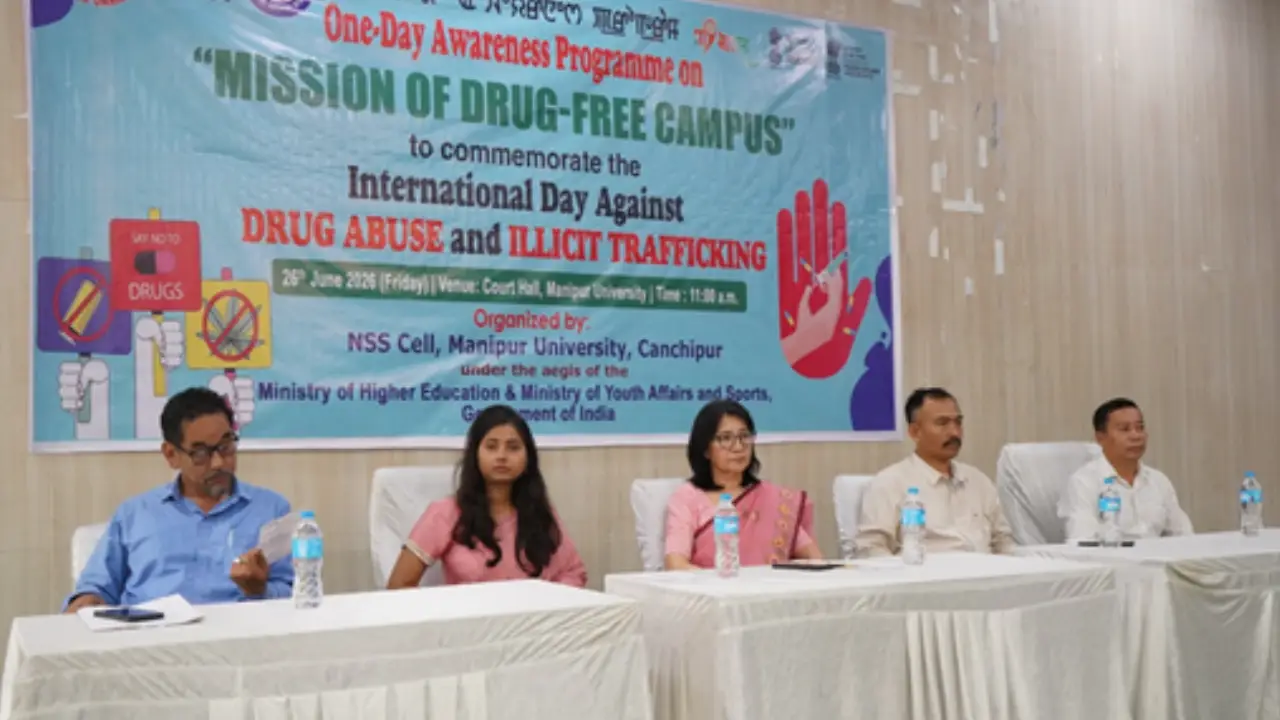
Imphal, June 26: Reinforcing its commitment to creating a healthy and substance-free academic environment, Manipur University on Friday organised a one-day awareness programme on the theme "Mission of Drug-Free Campus" to mark the International Day Against Drug Abuse and Illicit Trafficking.
The programme was organised by the National Service Scheme (NSS) Cell of Manipur University under the aegis of the Ministry of Education and the Ministry of Youth Affairs and Sports, Government of India, at the University's Court Hall. The event brought together university officials, faculty members, NSS volunteers and students to raise awareness about the social, legal and psychological consequences of drug abuse.
Prof. Sumitra Phanjoubam, Vice-Chancellor (In-charge), attended the programme as the Chief Guest. Registrar Prof. M. Premjit Singh, District Youth Officer Princi Gupta and Dr. Sapam Dilipkumar Singh, Assistant Professor in the Department of Law, participated as Guests of Honour, while the programme was presided over by Prof. Laishram Santosh Singh, Programme Coordinator of the NSS Cell.
Addressing the gathering, Prof. Sumitra Phanjoubam appreciated the NSS Cell for organising the programme despite the ongoing university vacation. She also thanked the students and NSS volunteers for their enthusiastic participation, describing their presence as a reflection of the university community's commitment to social responsibility.
Speaking on the significance of the observance, she said drug abuse remains one of the most serious challenges confronting modern society, affecting not only individuals but also families, educational institutions and the nation as a whole.
"Drugs destroy lives, shatter dreams, break families and endanger the future. The mission of a drug-free campus is not only an institutional responsibility but also a collective responsibility of every member of the university community," she said.
Prof. Phanjoubam observed that many young people enter universities with aspirations of building successful careers and contributing positively to society. However, she noted that academic pressure, competition, anxiety and emotional stress can sometimes make students vulnerable to harmful habits, including smoking, alcohol consumption and drug abuse.
She urged students to choose healthier ways of dealing with stress by engaging in sports, yoga, community service, cultural activities and peer support. She also highlighted the importance of counselling and mentorship in helping students overcome personal and academic challenges before they escalate into more serious problems.
Calling for a united effort, she said every teacher should serve as a mentor, every student should act as an ambassador against drug abuse and every member of the university community should consider themselves responsible for protecting the campus environment.
She further stressed the need for regular awareness campaigns, stronger counselling services and a more vibrant campus atmosphere that supports students' mental, emotional and social well-being.
Registrar Prof. M. Premjit Singh, in his address, provided participants with a historical perspective on drug abuse and illicit trafficking. Referring to the Opium War in China and the significance of June 26 as the International Day Against Drug Abuse and Illicit Trafficking, he said the global drug problem has evolved over centuries and continues to pose serious challenges for governments and societies.
He observed that legislation and law enforcement alone cannot eradicate the menace of drugs. According to him, lasting success can only be achieved through public education, social awareness and the determination of citizens, particularly young people, to reject substance abuse.
District Youth Officer Princi Gupta also encouraged students to avoid drugs and other addictive substances that may appear to provide temporary relief from stress or emotional difficulties. She reminded participants that drugs offer only short-lived escape while causing long-term physical, mental and social harm.
She advised students to cultivate healthy lifestyles by practising yoga, participating in physical activities and adopting natural methods to manage stress and maintain emotional well-being.
As part of the observance, the university administered a pledge against drug abuse under the guidance of Prof. Sumitra Phanjoubam. Students, NSS volunteers and faculty members pledged not to indulge in drug abuse, to discourage family members and friends from taking drugs, and to actively support efforts to help individuals overcome addiction.
The programme also featured a technical session conducted by Dr. Sapam Dilipkumar Singh, who interacted with students on the legal framework governing drug-related offences in India. His presentation covered criminal provisions relating to narcotic drugs and psychotropic substances, punishments prescribed under the law, the international drug trade, the Golden Triangle region and the broader social implications of illicit drug trafficking.
He also explained the significance of observing the International Day Against Drug Abuse and Illicit Trafficking and stressed the importance of public awareness alongside legal enforcement in addressing the growing challenge of substance abuse.
Delivering the presidential address, Prof. Laishram Santosh Singh reaffirmed the university's commitment to promoting a clean, safe and drug-free learning environment. Besides addressing the issue of substance abuse, he also highlighted the importance of maintaining campus cleanliness, proper waste management and academic integrity as collective responsibilities of students and faculty alike.
He later proposed the vote of thanks, expressing appreciation to the distinguished guests, participants, organisers, NSS volunteers and all stakeholders who contributed to the successful conduct of the programme.
The programme concluded with a collective call for students and the wider university community to embrace the message, "No to Drugs, Yes to Life," while reaffirming Manipur University's commitment to building a healthier, safer and drug-free campus through sustained awareness, education and community participation.