Manipur University successfully released 53 Checkered Keelback hatchlings near Toubul after a 68-day artificial incubation programme, marking a significant conservation effort.
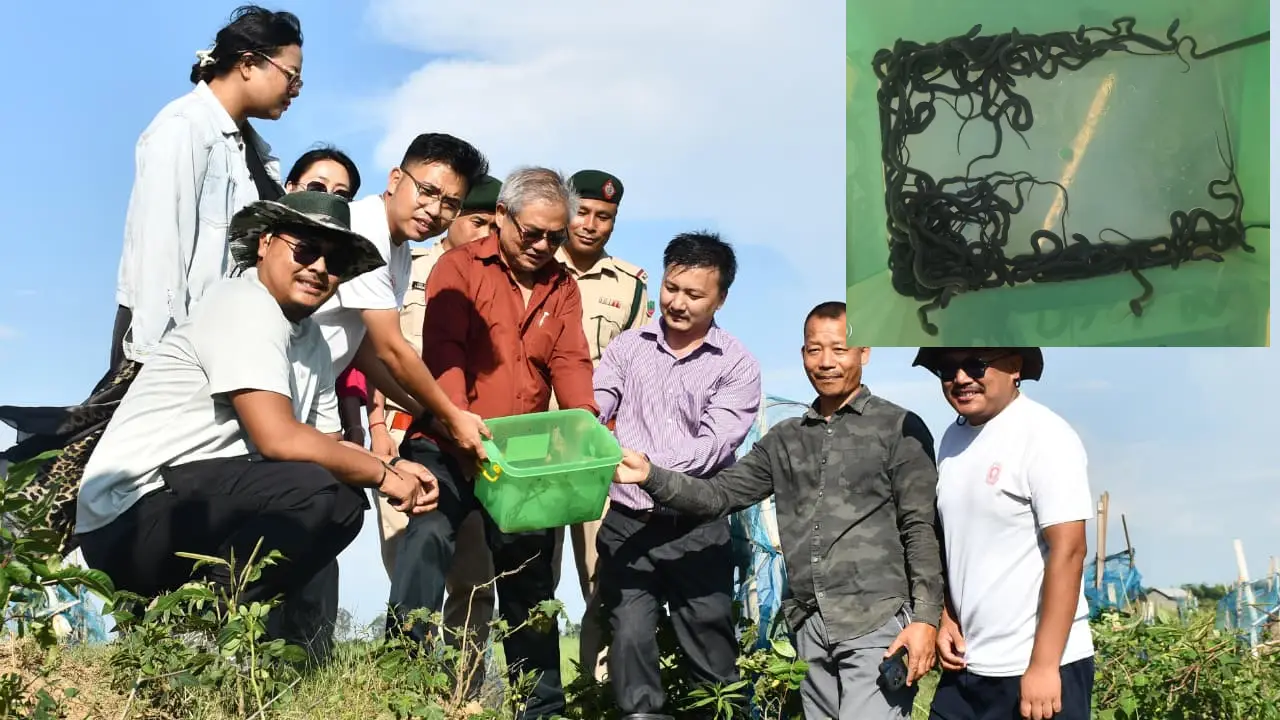
Imphal, June 26: In a notable achievement for wildlife conservation and scientific research in Manipur, the Department of Zoology, Manipur University, has successfully released 53 hatchlings of the Checkered Keelback (Fowlea piscator), locally known as Lilabob, into their natural wetland habitat near Toubul in Bishnupur district after completing an artificial incubation programme.
The hatchlings were released at Yawa Lamjao near Toubul in the presence of Prof. N. Mohilal Meitei, Dean of the School of Life Sciences, Manipur University, and Romabai Waikhom, Divisional Forest Officer (DFO), Bishnupur Division. The release programme was also attended by members of Wildlife Explorers Manipur (WEM), Green Brigade Toubul and research scholars from the Department of Zoology.
According to the Department of Zoology, the conservation initiative began with the rescue of an adult female Checkered Keelback from Toubul by wildlife enthusiast Elangbam Premjit Singh. Owing to its unusually large size, the snake was brought to the department for scientific observation and documentation.
On the very day it was rescued, the female snake laid a clutch of 58 eggs. Researchers then faced the challenge of ensuring the safety of both the mother snake and the eggs. Since releasing the adult snake together with the freshly laid eggs was considered unsuitable under the circumstances, the team decided to examine the snake before releasing it back into its natural habitat while retaining the eggs for artificial incubation.
The department stated that the eggs were transferred to a temporary artificial incubation facility specially prepared by researchers. Of the 58 eggs laid by the snake, 54 were found to be fertile after careful examination.
Following an incubation period of 68 days, 53 healthy hatchlings successfully emerged, representing an exceptionally high hatching success rate. The department described the outcome as a significant milestone in reptile conservation and an encouraging example of how scientific intervention can support wildlife survival when natural conditions pose challenges to successful reproduction.
The entire incubation and conservation programme was led by Nongthombam Hemeshwor Singh, a research scholar in the Department of Zoology, Manipur University. He was assisted by Jenishkumar Thingujam, Borish Loushambam and Dr. Sorokhaibam Mexico Singh. The project was carried out under the guidance and supervision of Prof. Naorem Mohilal Meitei of the Department of Zoology.
Following the successful hatching of the young snakes, the department, in coordination with the Forest Department and local conservation groups, selected a suitable natural wetland habitat at Yawa Lamjao near Toubul for their release.
The release programme brought together representatives from the academic community, the Forest Department and local conservation organisations. Besides Prof. N. Mohilal Meitei and DFO Romabai Waikhom, members of Wildlife Explorers Manipur, Green Brigade Toubul and research scholars from the university participated in the event.
The Department of Zoology said the successful rescue, incubation and release programme demonstrates the importance of coordinated conservation efforts involving researchers, local communities, conservation organisations and government agencies. Such collaboration, it said, plays a vital role in protecting Manipur's diverse wildlife and ensuring that species continue to thrive in their natural habitats.
The department further noted that scientific conservation measures can provide practical solutions in situations where natural breeding conditions are disrupted or where rescued wildlife requires temporary human intervention before being returned to the wild.
The Checkered Keelback is one of the most common freshwater snakes found across India and is widely distributed in Manipur's wetlands, rivers, ponds and paddy fields. Despite often being mistaken for venomous snakes because of its appearance, it is completely non-venomous and poses no threat to humans.
As a semi-aquatic species, the Checkered Keelback feeds primarily on fish, frogs and other small aquatic animals. By regulating these populations, it contributes to maintaining ecological balance in freshwater ecosystems. Conservationists consider the species an important indicator of healthy wetland habitats, as it depends on clean and functioning aquatic environments for survival.
Researchers also noted that reptiles such as the Checkered Keelback are frequently misunderstood and unnecessarily killed due to fear or lack of awareness. Public education, they said, remains an important component of wildlife conservation, particularly in encouraging coexistence between humans and non-venomous reptile species.
The Department of Zoology expressed gratitude to all stakeholders who supported the initiative, including local residents, conservation volunteers and the Forest Department. It also reaffirmed its commitment to promoting scientific research, wildlife conservation and public awareness programmes aimed at protecting Manipur's rich biodiversity.
Officials said the successful incubation of 53 hatchlings from a rescued clutch of eggs demonstrates how timely scientific intervention, combined with community participation and institutional support, can contribute meaningfully to the conservation of the state's native wildlife.