The Manipur government and DPIIT urged entrepreneurs and MSMEs to take advantage of the UNNATI Scheme, with applications open until September 2026.
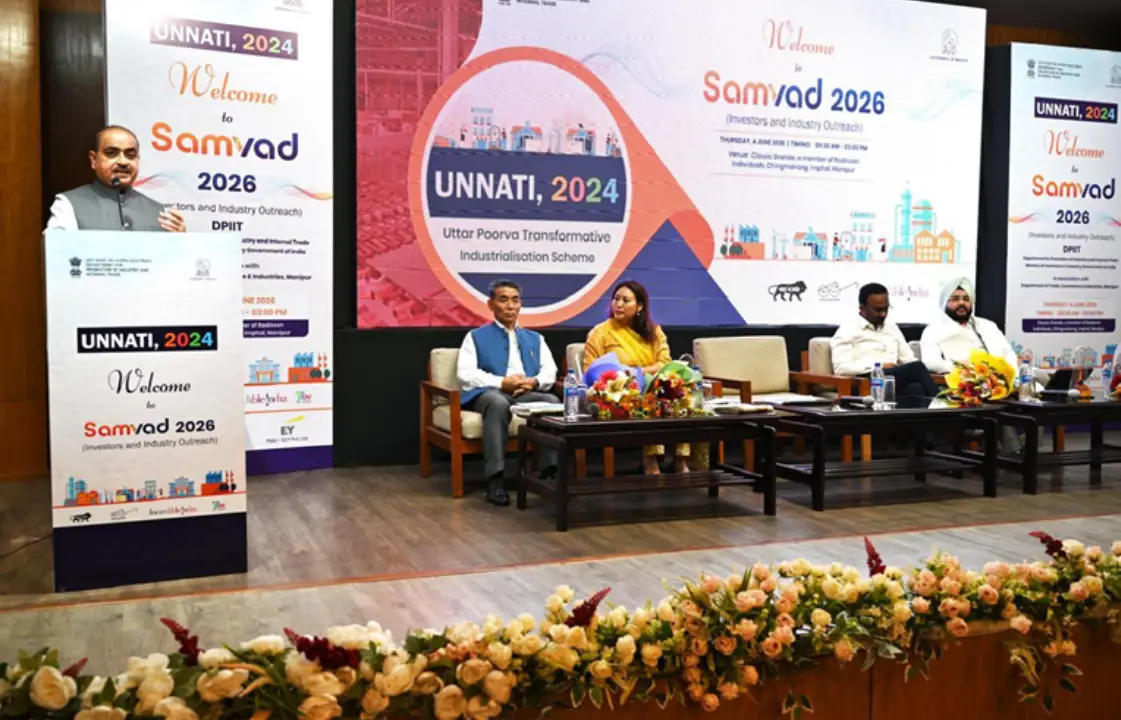
Imphal, June 4: The Department for Promotion of Industry and Internal Trade (DPIIT), Ministry of Commerce and Industry, Government of India, in collaboration with the Department of Textiles, Commerce and Industries, Government of Manipur, on Thursday organised a SAMVAD (Investors and Industries Outreach) programme on the UNNATI (Uttar Poorva Transformative Industrialization Scheme) 2024 in Imphal to encourage greater participation of entrepreneurs and businesses in the industrial incentive scheme.
The outreach programme was held at Classic Grande, Chingmeirong, and brought together government officials, bankers, industry associations, investors, manufacturing units and entrepreneurs from various sectors to discuss opportunities available under the flagship scheme aimed at accelerating industrial growth in the Northeast.
The event was chaired by Additional Chief Secretary (Textiles, Industry and Commerce) Anurag Bajpai. Other officials present included Director of Trade, Commerce and Industries Hannah Kahmei, DPIIT Under Secretary Arun Kumar Vishwakarma, DPIIT Nodal Officer Dr. Karam Paul Brar, Joint Director of Textiles, Commerce and Industries K.H. Dilip Singh, and representatives of the Project Implementation Unit (PIU).
Addressing the gathering, Bajpai highlighted that the registration period for the UNNATI Scheme is entering its final phase and urged eligible entrepreneurs, startups, service enterprises, manufacturing units and micro, small and medium enterprises (MSMEs) to complete their applications without delay.
He said enterprises with viable business proposals should finalise financing arrangements and take advantage of the incentives available under the scheme before the application window closes. According to him, timely participation could significantly improve the viability and competitiveness of projects while helping businesses expand and generate employment.
The Additional Chief Secretary also acknowledged the support being extended by DPIIT in facilitating implementation of the scheme in Manipur and across the Northeast. He appreciated the role of the Project Implementation Unit, led by Grant Thornton, in providing technical guidance, awareness programmes and handholding support to entrepreneurs seeking to avail benefits under the scheme.
Highlighting the broader industrial development strategy of the state, Bajpai said the Manipur government is simultaneously pursuing reforms aimed at improving the Ease of Doing Business ecosystem. These include simplification of procedures, digital approval systems, investor facilitation mechanisms and measures to reduce compliance burdens for businesses.
He noted that when combined with the incentives offered under the UNNATI Scheme, such reforms create a favourable environment for investment and industrial expansion in the state.
Calling on banks to play a more proactive role, Bajpai stressed that access to credit remains one of the most critical requirements for the growth of MSMEs. He said financial institutions are key partners in the success of the scheme and urged them to expedite loan processing and provide suitable financial products to entrepreneurs.
The Additional Chief Secretary also highlighted challenges faced by entrepreneurs, particularly in areas where land records and formal surveys are still evolving. He suggested that banks explore innovative financing solutions within existing regulatory frameworks, including project-based lending, alternative collateral mechanisms, credit guarantees and cash-flow-based assessments to ensure deserving entrepreneurs are not excluded from accessing credit.
Describing MSMEs as the backbone of Manipur's economy, Bajpai said the sector plays a crucial role in generating local employment, encouraging entrepreneurship, promoting value addition in agriculture and horticulture, supporting handloom and handicraft industries and strengthening the state's economic base.
He further highlighted Manipur's industrial potential in sectors such as handloom and textiles, forestry, agriculture, horticulture, tourism, handicrafts, pisciculture, healthcare, natural medicines and toy manufacturing.
The state government, he said, is working to strengthen the investment climate through policy initiatives including the New Industrial Estate Policy 2026 and the Manipur Industrial and Investment Promotion Policy 2022. These policies are intended to provide a more conducive environment for investors and industrialists while promoting private sector participation and industrial growth.
Bajpai also noted that the State Single Window Portal has been integrated with the National Single Window System, enabling investors and entrepreneurs to access licences, approvals and government services through a streamlined digital platform.
Providing an update on the implementation of the UNNATI Scheme in Manipur, DPIIT Nodal Officer Dr. Karam Paul Brar said the state has been allocated ?334 crore under the scheme. However, the total projected value of applications received so far stands at approximately ?165 crore, indicating significant scope for greater participation.
According to Brar, Manipur has received 39 applications under the scheme to date, of which 15 have been approved. Among the approved projects, seven belong to the service sector while eight are manufacturing units. Several other applications remain under various stages of documentation and processing.
He urged entrepreneurs across the state to take advantage of the scheme before the application deadline in September 2026.
The programme concluded with an interactive session during which entrepreneurs raised questions regarding eligibility criteria, application procedures and other operational aspects of the scheme. DPIIT officials responded to the concerns and assured participants of continued support to facilitate implementation and improve access to the benefits available under the UNNATI Scheme.
The outreach programme forms part of broader efforts by both the Centre and the Manipur government to encourage industrial investment, strengthen MSMEs and create employment opportunities in the state through targeted policy interventions and financial incentives.