PIB Imphal organised a Vartalap workshop on 12 years of governance, focusing on education and economic reforms and media engagement.
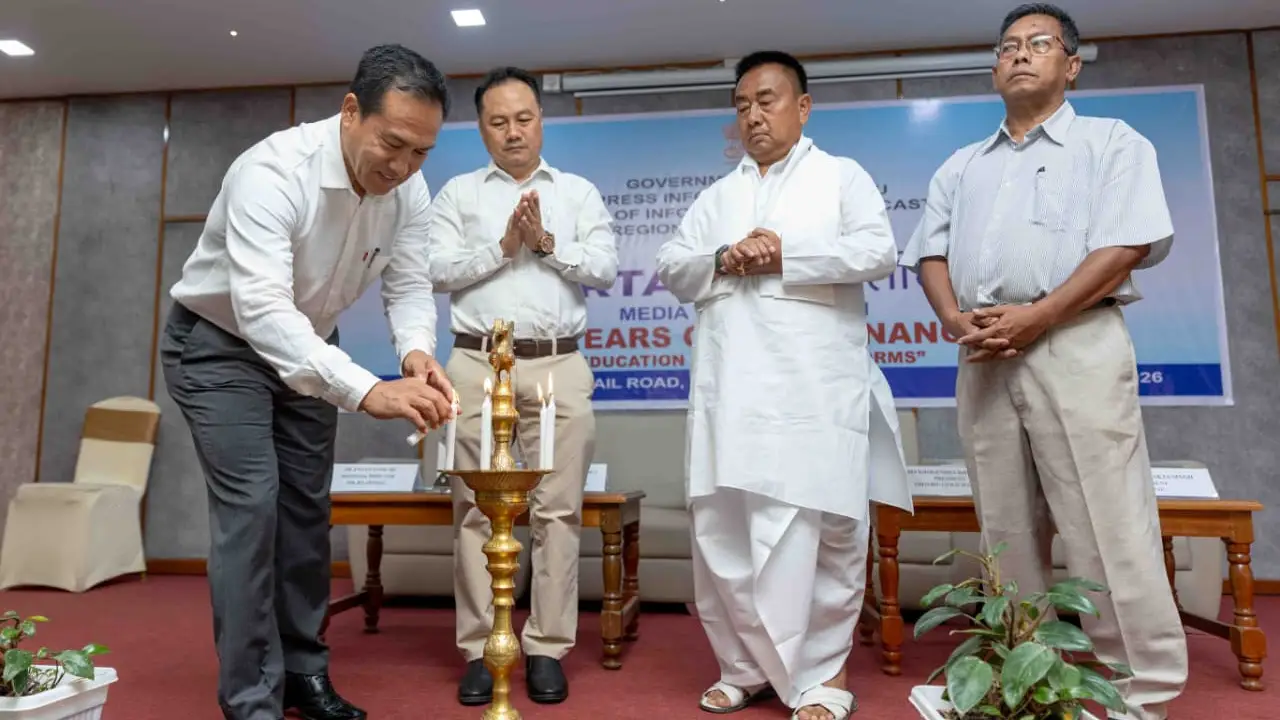
Imphal, June 25: The Press Information Bureau (PIB), Imphal, under the Ministry of Information and Broadcasting, organised a one-day media workshop titled “Vartalap” on the theme “12 Years of Governance: Education and Economic Reforms” at Hotel Imolesh in Imphal on Thursday.
The programme brought together journalists, editors, media professionals and government officials to discuss major policy initiatives and reforms undertaken by the Government of India over the past 12 years, with a focus on education and economic transformation.
The inaugural session was attended by Director of Information and Public Relations (IPR), Government of Manipur, Dr. Th. Charanjeet Singh, as chief guest. Director of PIB Imphal, Dr. Engam Pame, IIS, presided over the programme. Editors’ Guild Manipur president Khogendra Khomdram and All Manipur Working Journalists’ Union (AMWJU) president Ashem Bhakta were present as guests of honour.
The workshop began with the ceremonial lighting of the lamp, followed by a keynote address by Pushpa Maibam, Media and Communication Officer of PIB Imphal. She described the media as an important bridge between the government and the public and stressed the responsibility of journalists in providing accurate information and promoting informed public discussion.
Addressing the gathering, Dr. Charanjeet Singh said effective coordination between the government and the media is essential for good governance. He noted that policies and welfare programmes can benefit citizens only when information reaches the public in a timely and accurate manner.
He said the media remains one of the most important pillars of democracy and plays a key role in helping people understand government schemes and initiatives. He also encouraged journalists to continuously update their knowledge and make use of opportunities such as the workshop to better communicate policy issues to the public.
Dr. Engam Pame said the Vartalap programme serves as a media outreach initiative aimed at strengthening engagement between government institutions and media professionals. He stated that such interactions help improve understanding of policy matters, address misinformation and create greater awareness about developmental programmes.
Referring to the Government of India’s vision of Viksit Bharat @2047, he said the country requires collective effort and participation from all sections of society. He also highlighted welfare initiatives implemented during the last 12 years in areas such as drinking water, electricity, healthcare, education and financial inclusion.
Speaking during the inaugural session, Khogendra Khomdram said media organisations have an important responsibility in informing citizens about government policies, taxation reforms, educational initiatives and welfare schemes. He called for responsible journalism and urged media professionals to remain well informed on policy matters.
The workshop featured two technical sessions focusing on economic and educational reforms.
The session on economic reforms under the Goods and Services Tax (GST) was conducted by Barun Ray, IRS, Assistant Commissioner, CGST Imphal, and A. Dhaneshor Singh, Superintendent, CGST Imphal Commissionerate. The speakers explained the evolution of GST, its structure and implementation, and its role in creating a unified tax framework across the country.
According to the resource persons, GST has simplified the indirect taxation system by replacing multiple central and state taxes under a single framework. They also discussed recent reforms aimed at reducing compliance burdens, improving ease of doing business and strengthening economic activity.
Dhaneshor Singh noted that the reforms could particularly benefit small industries, traditional crafts and agro-based enterprises in Manipur by lowering costs and improving access to wider markets.
The second technical session was delivered by Prof. Angom Dilipkumar Singh of the Department of Physics, Manipur University, who spoke on educational reforms under the National Education Policy (NEP) 2020.
Prof. Singh described NEP 2020 as a major reform intended to create a more holistic, flexible and multidisciplinary education system. He highlighted key features of the policy, including the 5+3+3+4 curricular structure, emphasis on mother tongue instruction during foundational learning, vocational education from Class VI and reforms in assessment methods.
He also discussed measures aimed at improving educational equity and inclusion, particularly for students from disadvantaged backgrounds and girls, while promoting quality and accessibility in education.
Both technical sessions were followed by interactive discussions during which participants sought clarifications on various aspects of GST and the National Education Policy.
The workshop concluded with a vote of thanks and summary of the day’s deliberations by Moirangthem Rustum Singh, Assistant Director, Central Bureau of Communication (CBC), Field Office, Chandel.
Officials said the programme was intended to strengthen constructive engagement between the government and media institutions and to improve public understanding of policy reforms and development initiatives.