An IIT Madras-led study finds that greater representation of women in policing improves trust and reporting of gender-based crimes but warns against overuse of informal dispute resolution.
Imphal, June 29: Increasing the representation of women in India's police force could significantly improve the reporting, investigation and delivery of justice in gender-based crimes, according to a new multi-institutional study led by the Indian Institute of Technology (IIT) Madras. However, the researchers caution that these gains may be undermined if police increasingly rely on informal settlements instead of pursuing legal action in serious offences.
The study argues that the solution to improving justice for survivors is not simply recruiting more women into policing, but creating an institutional environment where female officers are empowered through leadership opportunities, specialised training and accountability mechanisms.
Published in the peer-reviewed journal Systems Research and Behavioral Science, the study examined whether greater representation of women in policing translates into better institutional responsiveness, improved justice outcomes and higher public trust among victims of gender-based crimes.
The research was conducted by Prof. Kandaswamy Paramasivan of IIT Madras, Prof. Thangatur Sukumar Hariharan of T A Pai Management Institute, Bengaluru, Dr. Nabila Khan of IIM Lucknow, and S. Thejaswin of SRM Institute of Science and Technology.
Gender-based violence continues to remain one of India's most underreported categories of crime. Researchers note that offences occur in both public and private spaces, with domestic violence often remaining hidden because of fear, stigma, social pressure and economic dependence.
Against this backdrop, the study found that women police officers can play a transformative role in making the criminal justice system more accessible to survivors.
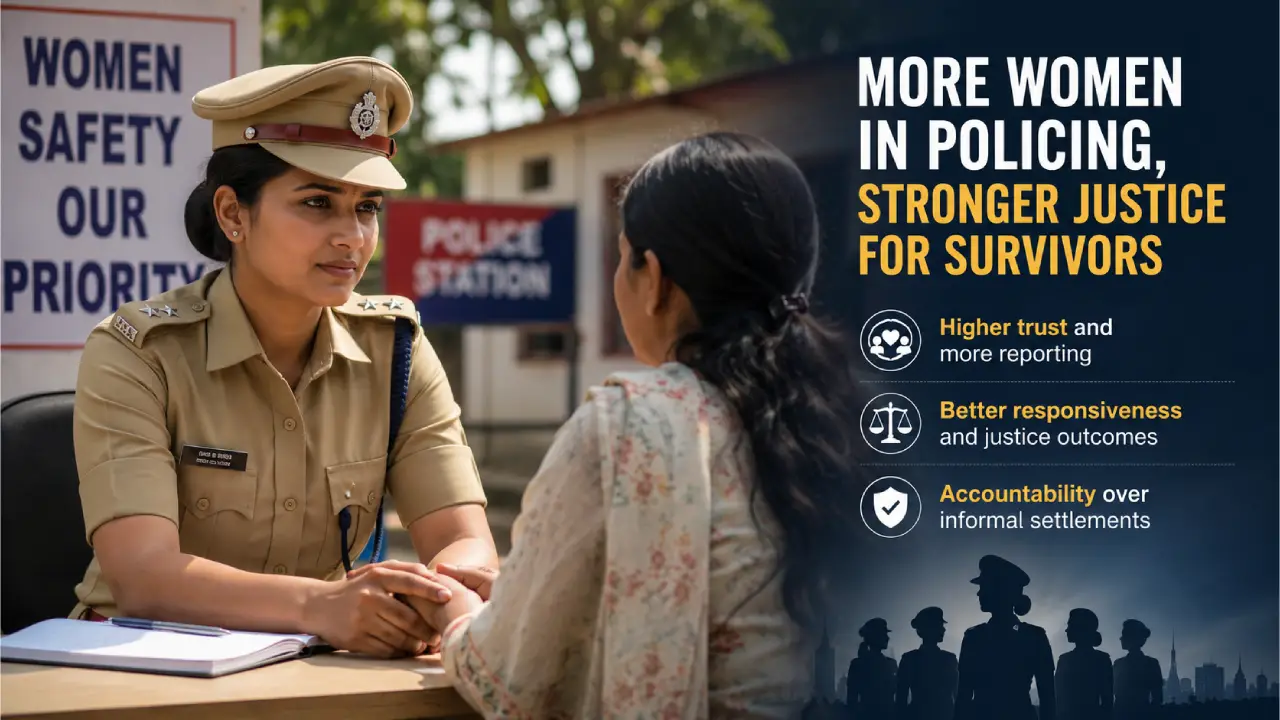
According to the findings, women officers tend to create a more empathetic and supportive environment, encouraging victims to approach the police and formally report crimes.
Prof. Kandaswamy Paramasivan, a retired IPS officer and Professor of Practice at IIT Madras, said greater participation of women in policing improves institutional responsiveness while increasing victims' confidence in law enforcement.
"We found that greater participation of women in policing improves institutional responsiveness towards victims of gender-based crimes and encourages higher reporting rates by fostering greater victim trust. Women police officers were also found to influence organisational culture positively by bringing a more empathetic and caregiving approach to policing," he said.
The researchers observed that empathy alone is not sufficient. Institutional reforms are equally necessary to ensure that survivors receive timely investigations, fair treatment and meaningful legal outcomes.
Despite several policy initiatives over the years, women continue to constitute a relatively small share of India's police force.
According to data cited from the Bureau of Police Research and Development (BPR&D), women accounted for only 11.75 per cent of police personnel across India in 2022.
To examine how this affects policing outcomes, the researchers conducted focus group discussions with police personnel from different parts of the country. Their findings were subsequently validated through consultations with criminologists, psychologists, advocates and social workers.
The study concludes that increasing female representation has the potential to strengthen institutional credibility and public confidence, particularly among survivors of gender-based violence.
One of the study's most significant findings is what the authors describe as the "Alternative Dispute Resolution (ADR) paradox."
While women officers often demonstrate greater sensitivity towards survivors, researchers found that some may also prefer resolving disputes through counselling or mediation instead of registering formal criminal complaints, particularly in cases involving married women.
According to the study, this tendency is frequently motivated by concern for preserving family relationships, preventing marital breakdown and reducing the emotional burden on survivors.
However, researchers warn that such an approach can produce unintended long-term consequences.
Prof. Thangatur Sukumar Hariharan said over-reliance on mediation may unintentionally embolden repeat offenders by allowing serious offences to escape formal legal scrutiny.
"There appears to be a tendency among some women police officials to encourage alternate dispute resolution rather than formally registering a complaint, often out of a concern that victims—especially married women—should not lose their conjugal and family lives because of a criminal case," he said.
The researchers stressed that mediation should never replace criminal proceedings where the law requires prosecution. Instead, they argue that the victim's informed choice must remain central to every decision.
"If the victim prefers formal complaint registration over ADR, that preference should be respected and acted upon," Hariharan added.
S. Thejaswin of SRM Institute of Science and Technology similarly cautioned that while mediation may reduce police caseloads in the short term, indiscriminate use could compromise justice and encourage repeat offending.
The study argues that simply increasing recruitment targets will not automatically improve policing outcomes.
Dr. Nabila Khan of IIM Lucknow said meaningful reform requires creating an ecosystem in which women officers can exercise influence throughout the policing hierarchy.
"The research underscores the need to balance empathetic and victim-centric resolution mechanisms with formal legal accountability to ensure sustainable justice outcomes," she said.
The authors recommend expanding leadership opportunities for women officers, strengthening specialised training in handling gender-based crimes, establishing stronger accountability mechanisms and providing institutional support that enables effective investigation and victim assistance.
They also call for regular independent reviews of crimes against women, awareness campaigns to encourage reporting and measures to improve conviction rates, all of which they believe are essential to building public trust.
The study notes that affirmative measures such as reservation policies, recruitment drives, maternity benefits, childcare leave and improved healthcare access have contributed to increasing women's participation in policing, but further structural reforms remain necessary.
The study contributes to an ongoing national debate on police reform by shifting attention from numerical representation to institutional effectiveness. While successive governments have sought to increase women's participation in policing through recruitment targets and reservation policies, the research suggests that representation alone cannot guarantee better justice outcomes unless supported by organisational reform.
Its findings also reflect a difficult balance faced by police personnel dealing with gender-based violence. On one hand, victim-centred approaches and counselling may provide immediate emotional support and help survivors navigate complex family situations. On the other, excessive dependence on informal settlements risks weakening legal accountability, particularly in cases involving repeated abuse or serious offences.
Rather than portraying empathy and legal enforcement as competing approaches, the researchers argue that both must operate together. Women officers may improve trust and reporting, but institutional systems must ensure that survivor welfare, due process and criminal accountability reinforce one another.
For policymakers, the study presents a broader roadmap than simply increasing recruitment numbers. It suggests that sustained investment in training, leadership development, investigative capacity and accountability mechanisms may be equally important if India is to strengthen public confidence in policing and improve justice for survivors of gender-based crimes.