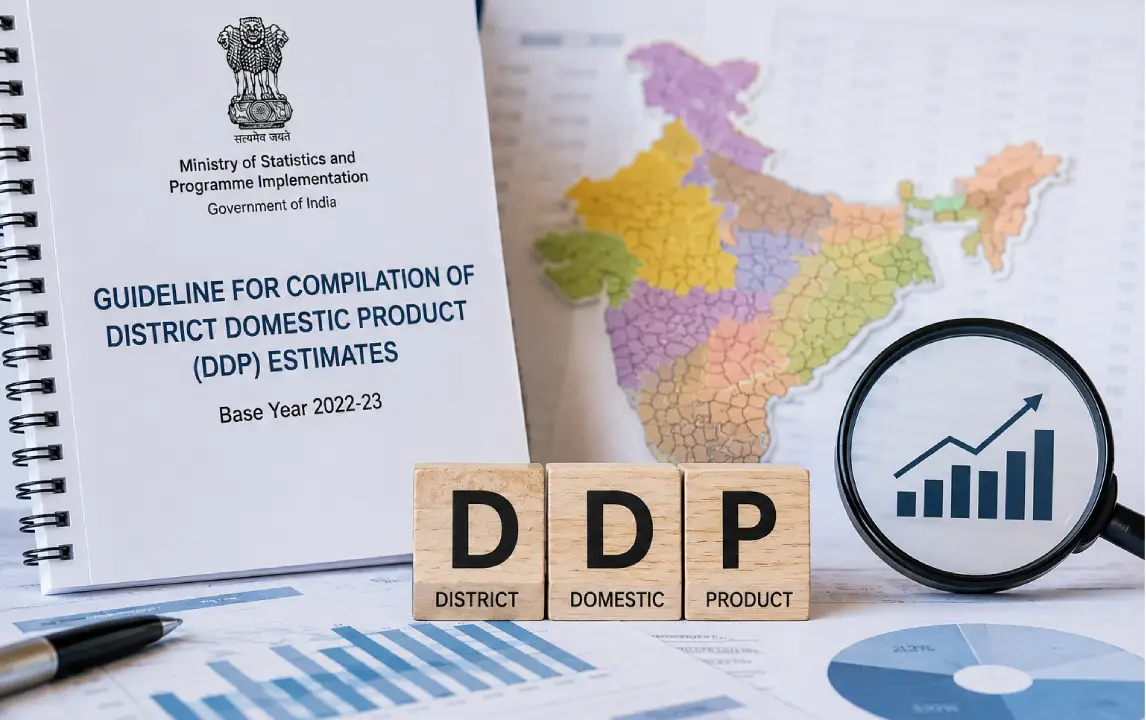
MoSPI's new District Domestic Product guideline introduces a uniform methodology for measuring district economies, promising better planning, sharper policy targeting and deeper insights into regional disparities.
New Delhi, June 4: India's economic growth is usually discussed through national GDP figures and state-level economic indicators. Yet behind these broad numbers lies a far more complex reality, one in which districts within the same state can have vastly different economic trajectories, income levels and development outcomes.
Recognising this gap, the Ministry of Statistics and Programme Implementation (MoSPI) has released a comprehensive national guideline for the compilation of District Domestic Product (DDP) estimates under the revised base year 2022-23. The document, finalised after consultations with states, Union Territories, researchers and academic institutions, seeks to establish a common framework for measuring economic activity at the district level.
The move may appear technical on the surface, but economists and planners view it as an important step towards improving India's understanding of local economies and strengthening evidence-based governance.
The guideline provides detailed methodologies for estimating Gross District Domestic Product (GDDP), Net District Domestic Product (NDDP) and district-level Per Capita Income. More importantly, it attempts to address a long-standing problem in India's statistical system, the lack of uniformity in how districts measure economic output.
NSO, MoSPI has Released the "Uniform Guidelines for the Compilation of District Domestic Product (DDP) Estimates with Base Year 2022-23 ". This comprehensive framework ensures consistency, comparability, and methodological standardization for GDDP, NDDP, and Per Capita Income…
— Ministry of Statistics & Programme Implementation (@GoIStats) June 4, 2026
Economic statistics in India have traditionally been strongest at the national and state levels. While Gross State Domestic Product (GSDP) estimates offer valuable insights into the performance of states, they often conceal significant variations within those states.
A state may record robust economic growth while certain districts continue to lag behind. Conversely, fast-growing industrial or urban districts may drive state-level growth even as large rural regions struggle with limited economic opportunities.
District Domestic Product estimates seek to capture these differences.
The importance of such data has grown as district administrations increasingly play a central role in implementing development programmes, monitoring outcomes and allocating resources. Reliable district-level economic estimates allow policymakers to identify growth centres, track regional imbalances and evaluate the effectiveness of public investments more accurately.
MoSPI notes that DDP estimates can support decentralised planning, regional development analysis, Human Development Index calculations and informed policy interventions at the local level.
One of the key issues identified by the ministry is the lack of consistency in existing DDP estimation practices.
Currently, only 26 States and Union Territories compile district-level economic estimates. Even among those that do, methodologies often vary considerably. Different states use different data sources, allocation indicators and estimation techniques, making comparisons difficult and sometimes unreliable.
As a result, a district GDP estimate in one state may not be directly comparable with a district estimate in another.
The new guideline seeks to address this challenge through methodological standardisation.
By establishing common concepts, definitions, data sources and estimation procedures, the framework aims to create a more coherent system of district-level economic statistics across the country.
The objective is not merely statistical uniformity. Comparable district data can improve the quality of policy decisions, facilitate research and enable governments to benchmark development outcomes across regions.
Perhaps the most significant feature of the guideline is its emphasis on a bottom-up approach to economic measurement.
Traditionally, many states have relied on top-down estimation methods. Under this approach, state-level economic output is distributed among districts using indicators such as population, workforce, cultivated area or administrative records.
While practical, such methods often assume that economic activity is distributed in proportion to those indicators, an assumption that may not always reflect reality.
The new guideline encourages states to adopt bottom-up estimation wherever district-level data are available.
Under a bottom-up framework, economic activity is measured directly at the district level using local administrative records, surveys and sector-specific databases before being aggregated upwards.
This approach is expected to produce more realistic estimates because it captures actual economic activity rather than relying solely on allocation formulas.
The guideline nevertheless recognises that district-level data remain unavailable in certain sectors. In such cases, it recommends top-down methods supported by carefully selected allocation indicators. A mixed approach combining both methods is also permitted where necessary.
The guideline reflects the growing availability of administrative and digital datasets across India.
In recent years, government departments have accumulated vast quantities of economic information through taxation systems, digital payments, welfare programmes, business registrations and administrative records.
The framework incorporates several of these emerging data sources.
For manufacturing and business activities, the guideline recommends using information from the Annual Survey of Unincorporated Sector Enterprises (ASUSE), GST databases and enterprise-level records.
For public administration, salary and expenditure data available through the Public Financial Management System (PFMS) can be utilised.
Transport, construction, real estate, education, healthcare and financial services sectors are also linked to various administrative datasets that can provide district-specific information.
The increasing use of such datasets marks a significant evolution in India's statistical system. Rather than relying solely on traditional surveys, economic estimation is increasingly drawing upon real-time administrative records generated through routine governance processes.
To support the transition, MoSPI has also undertaken efforts to improve the statistical infrastructure needed for district-level estimation.
The ministry has expanded district-level stratification in key surveys and increased sample sizes in programmes such as the Periodic Labour Force Survey (PLFS) and the Annual Survey of Unincorporated Sector Enterprises.
These changes are intended to generate more reliable district-level data and reduce dependence on indirect estimation techniques.
The guideline further encourages states to strengthen data collection systems, improve coordination among departments and build statistical capacity at local levels.
For many states, particularly those with limited institutional resources, implementation may require substantial investments in training, data management and inter-departmental cooperation.
The implications of the new framework could be particularly significant for the Northeast.
Most northeastern states contain districts that differ widely in geography, infrastructure, population density and economic structure. State-level economic figures often fail to capture these variations.
In Assam, for instance, districts such as Kamrup Metro, Dibrugarh and Tinsukia have economic profiles that differ considerably from those of remote riverine or hill districts.
Similarly, in Arunachal Pradesh, economic activity in districts connected to major highways and administrative centres differs markedly from that in remote border regions.
The same applies to Nagaland, Meghalaya and Manipur, where districts face varying levels of connectivity, market access and public investment.
A robust DDP framework could therefore provide a clearer picture of where economic growth is occurring and where development gaps persist.
For policymakers, such information may become increasingly important in targeting infrastructure projects, livelihood programmes and social sector investments.
The significance of district-level GDP extends beyond economic accounting.
Reliable DDP estimates can influence how governments understand poverty, employment, urbanisation and regional inequality.
For decades, policymakers have often relied on proxy indicators to identify backward regions. More accurate district-level economic estimates may provide a stronger empirical basis for such assessments.
They could also help evaluate the effectiveness of flagship schemes and identify districts that require special policy attention.
In an era where governance is increasingly data-driven, local economic statistics are becoming as important as national aggregates.
Despite its potential, the framework faces practical challenges.
Large sections of India's economy continue to operate in the informal sector, where economic activity is difficult to measure accurately. Agricultural production, small-scale enterprises and informal services often lack comprehensive district-level records.
Data quality may also vary significantly between states and districts.
Moreover, the success of the framework will depend on the willingness and capacity of states to adopt the recommended methodologies. Standardisation can only be achieved if implementation is consistent.
There is also the challenge of ensuring that statistical improvements translate into actual policy use. Economic data often become most valuable when they inform decisions rather than simply populate reports.
The release of the District Domestic Product guideline marks an important development in India's evolving statistical architecture.
Over the past decade, policymakers have increasingly recognised that economic development cannot be understood solely through national or state averages. Local realities matter, and those realities often emerge most clearly at the district level.
By creating a uniform framework for measuring district economies, the new guideline seeks to provide governments, researchers and citizens with a more detailed map of India's economic landscape.
For a country as diverse as India, where economic conditions can change dramatically within the span of a few hundred kilometres, that deeper understanding may prove essential for achieving balanced and inclusive growth.
The real test, however, will come in implementation. If states adopt the framework effectively and strengthen their local statistical systems, District Domestic Product estimates could become one of the most important tools for regional planning and development in the coming years.